
As we move deeper into 2026, the intersection of Artificial Intelligence and Decentralized Finance (DeFi) is hitting a massive, invisible wall: Regulatory Compliance. While retail investors are distracted by the latest "AI-agent" hype, institutional players are paralyzed. Why? Because in the world of regulated finance, "probabilistic" outputs are a liability. If an AI model hallucinating a financial report leads to a billion-dollar miscalculation, who goes to jail? This "Liability Gap" is exactly why the industry is starting to look at verification protocols not as a luxury, but as a legal necessity.
After reviewing the recent integration of Real-World Assets (RWA) within the Mira-20 ecosystem, it’s clear that Mira Network is building something far more valuable than a simple verification tool. They are building a "Legal Moat."
The fundamental issue with current Large Language Models (LLMs) is their "Black Box" nature. For a bank or a hedge fund, using an unverified AI to execute trades or analyze RWA collateral is a violation of fiduciary duty. Regulators—from the SEC to the architects of the EU AI Act—demand an audit trail. They demand to know why a decision was made and who verified its accuracy. Current blockchain solutions often fail here because they focus on the transaction of value, but ignore the verification of the intelligence that triggered that value.
Mira’s architecture solves this through the cert_hash. By breaking down AI outputs into atomic, verifiable claims and running them through a decentralized consensus of validators, Mira creates a "Standard of Truth." For a compliance officer, a cert_hash is essentially an insurance policy. It is a permanent, immutable record that a specific piece of intelligence was vetted by a decentralized network of incentivized actors before it was acted upon. This transforms AI from a "rogue agent" into a "governed asset."
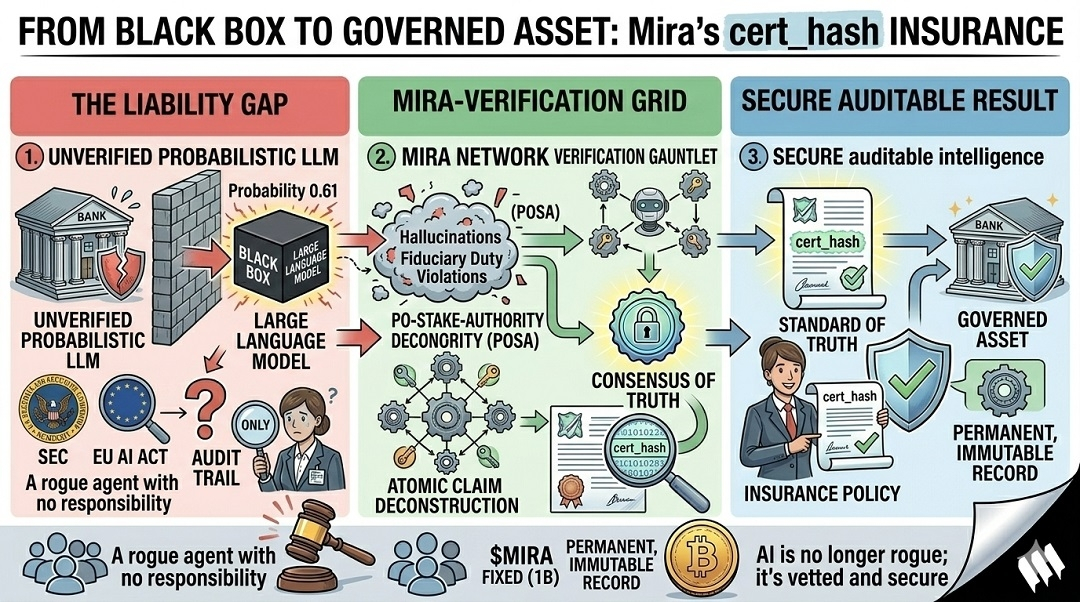
However, we must ask a critical investigative question: Can a decentralized network truly satisfy centralized regulators? The brilliance of Mira’s Proof-of-Stake-Authority (PoSA) model lies in its hybrid nature. It provides the transparency of a public ledger while maintaining the institutional-grade security that high-stakes finance requires. With over 3.5 million community members and a growing influx of 10,000 users daily, the network is creating a "Data Gravity" that is hard to ignore.
The $10 million developer grant program is another strategic piece of this moat. By incentivizing developers to build compliance-first applications on Mira, the network is ensuring that the next generation of RWA tokenization—whether it’s real estate, private equity, or carbon credits—is "Mira-Verified" by default. If a protocol can prove its AI-driven valuations are anchored by a cert_hash on the Mira-20 blockchain, its path to regulatory approval becomes significantly smoother.
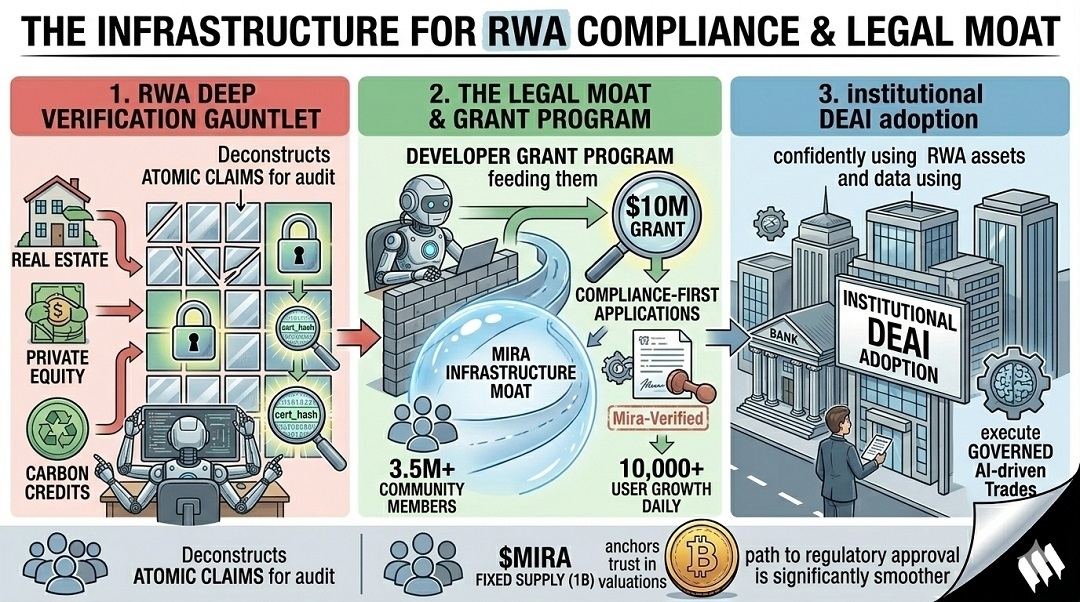
But let's be realistic: the transition to "Regulated DeAI" won't be overnight. There is a tension between the "move fast and break things" ethos of AI and the "slow and compliant" nature of finance. Mira is positioning itself right in the middle of that friction. The $MIRA token, with its fixed supply of 1 billion, isn't just a utility for paying fees; it represents a stake in the world's first auditable truth layer.
As an analyst, I see the "Legal Moat" as Mira’s strongest long-term play. Markets can be irrational, and hype cycles eventually fade, but the requirement for legal accountability in finance is eternal. Those who provide the infrastructure for that accountability are the ones who will own the next decade of institutional Web3. The question isn't whether AI will run our financial systems—it's whether we will have the cryptographic evidence to trust it when it does.
@Mira - Trust Layer of AI $MIRA #Mira #AI #Regulation #BinanceSquare #Web3