

Let’s be honest. This whole thing sounds like another “big idea” that tries to glue robots and blockchain together and call it the future. And yeah on paper it looks clean. Open network. Public ledger. Verifiable this decentralized that. We’ve heard it all before.
The first problem is simple. Nothing actually works that smoothly in real life. You can say “global open network” all day but who’s running it? Who’s fixing it when something breaks? Because something always breaks. Especially when you mix hardware software and a bunch of random people from the internet.
And robots are not like apps. If an app crashes you restart it. If a robot messes up it can break things. Hurt people. That’s a different level of risk. So when someone says “we’ll manage robots with a public ledger” I just wonder how that helps when a machine does something stupid in the real world.
Then there’s this whole “verifiable computing” idea. Sounds nice. Everything is transparent. Everything can be checked. Cool. But who is actually checking it? Normal people are not reading logs or verifying proofs or whatever. They’ll just trust that someone else did it. Same as always. So now you’ve got a complicated system that still ends up relying on trust anyway.
And let’s talk about governance. That word always shows up. “Community decides.” “Decentralized control.” In reality it usually means a small group of people arguing while everyone else ignores it. Or worse big players quietly taking over while pretending it’s still open. Seen that movie already.
Also open networks sound great until incentives kick in. People don’t just contribute for fun. They want money control or both. So now you’ve got robots data and decision making all tied into a system where people are trying to game it. That’s not comforting.
The modular thing is another buzzword that sounds good but gets messy fast. Sure you can plug different parts together. But then nothing fully matches. Updates break stuff. One module expects something the other doesn’t provide. Now you’ve got a system held together with patches and workarounds.
And this idea of robots as “participants” in a network… I get what they’re trying to say but it feels weird. These are machines. Tools. The more we pretend they’re something else the easier it is to forget who’s actually responsible when things go wrong.
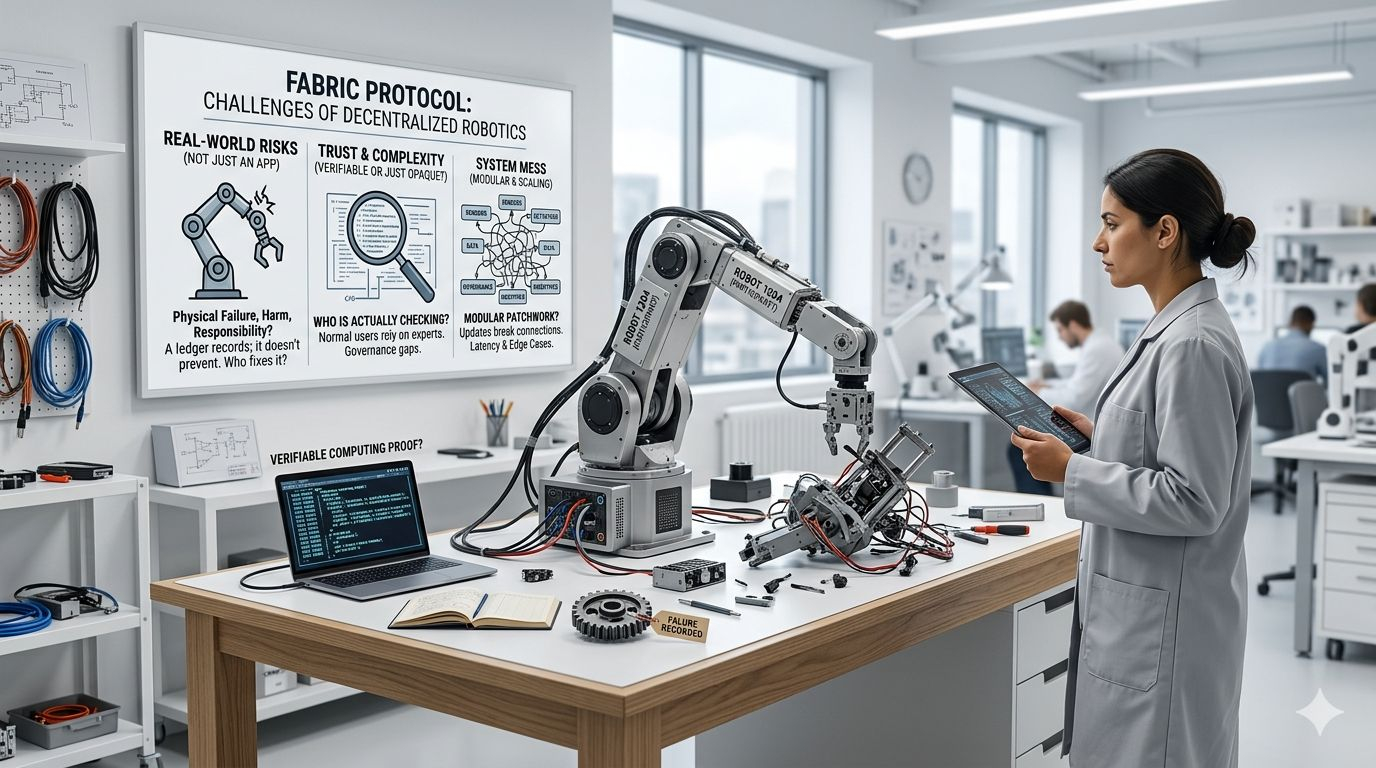
The safety part is where I really start doubting things. They say the system will be safe because everything is tracked and governed. But safety isn’t just about tracking. It’s about preventing bad outcomes before they happen. A ledger doesn’t stop a mistake. It just records it after.
Also scaling this sounds like a nightmare. You’re talking about data computation and rules all flowing through one big system. That’s already hard in pure software. Now add physical machines into the mix. Latency failures edge cases everywhere. Good luck keeping that stable.
And yeah the idea of sharing data across robots sounds useful. One machine learns something others improve. Fine. But who owns that data? Who gets paid? Who decides what’s valid? That part always turns into a mess.
It feels like the same pattern again. Big vision. Clean diagrams. Lots of words about openness and collaboration. But when you zoom in it’s just layers of complexity stacked on top of each other.
I’m not saying it’s all useless. There’s something interesting here. Having better ways to track what machines do. Sharing improvements. Making systems less opaque. That stuff matters.
But this whole “protocol for everything” approach? That’s where I check out a bit. Because usually the more universal a system tries to be the less it actually works in specific cases.
At the end of the day I just want machines to do their job and not break things. I don’t need a global ledger to tell me that. I need reliability. Simple systems. Clear responsibility.
Maybe this turns into something real later. Maybe it doesn’t. Right now it just feels like another late night idea that sounds amazing until you try to build it.
@Fabric Foundation #robo $ROBO
