
I’ve been watching Fabric Foundation long enough now to know it doesn’t fit neatly into the usual categories this market likes to recycle.
Another attempt to position itself as “infrastructure” before the real demand has fully materialized. We’ve seen that pattern play out across multiple cycles. The language evolves, the narratives shift, but the structure often stays the same. So naturally, the instinct isn’t to believe — it’s to question.
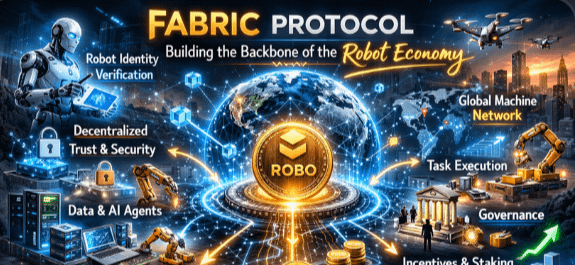
But Fabric is at least pointing at something that feels unresolved.
The idea of machine coordination isn’t theoretical anymore. Whether it’s AI agents, robotics, or autonomous systems interacting across open environments, the friction is already visible. Not in concept — in execution. Questions around verification, identity, trust, and accountability don’t disappear once systems become autonomous. If anything, they get harder. Who verifies the action? Who owns the data? Who gets paid when decisions are made without direct human input?
That’s where Fabric tries to position itself — not as an application, but as a coordination layer beneath it all.
And to be fair, that’s a serious claim.
Because if such a layer actually becomes necessary, it doesn’t just support the system — it becomes part of the system. Something other builders depend on rather than compete with. That’s the difference between something that exists and something that matters.
Still, history makes it hard to take that leap too quickly.
Crypto has a habit of identifying real future bottlenecks early — and then rushing to financialize them before they’re fully understood. A valid problem becomes a narrative. The narrative becomes a token. And suddenly, belief starts getting priced in long before utility has had a chance to prove itself.
Fabric isn’t immune to that pattern.
The thesis is strong enough to attract attention. A protocol for machine economies. Verifiable identity layers. Economic rails for agents. These are big ideas, and they carry weight. But weight in language doesn’t always translate into necessity in practice. That gap is where most projects quietly fade.
So the real question isn’t whether the idea sounds important — it’s whether it becomes unavoidable.

Does coordination at this level truly require a decentralized protocol, or does it end up being solved more efficiently elsewhere?
Does the token actually facilitate that coordination, or is it layered on top as an incentive mechanism that could be replaced?
Do real systems begin to depend on it, or does it remain a framework that only makes sense inside its own narrative?
Right now, Fabric sits in that uncomfortable middle ground.
Not easy to dismiss, but not easy to trust either.
There’s enough substance to keep it on the radar, especially as conversations around AI and autonomous systems continue to evolve. But there’s also enough uncertainty to justify restraint. Because in this market, conviction is often manufactured faster than proof.
Maybe Fabric turns out to be early to something real.
Or maybe it’s another case of the market getting ahead of the infrastructure it’s trying to predict.
For now, it feels like something to watch — closely, but carefully.
Because the real test isn’t whether people understand the story today.
It’s whether, over time, the system reaches a point where something like Fabric isn’t optional anymore — it’s required.
And until that moment becomes visible, the only honest position might be this:
Are we looking at the foundation of future machine coordination…
or just another well-structured idea waiting for a problem big enough to justify it?