

@MidnightNetwork For a long time, it felt simple in my head. You build everything out in the open, let the system stay transparent, and if something sensitive comes up, you deal with it later. Maybe you encrypt it, maybe you push it off-chain, maybe you just accept a bit of exposure as the cost of being on blockchain. It wasn’t perfect, but it felt… acceptable.
Then I started really looking at Midnight Network, and that way of thinking just didn’t hold up anymore.
What caught me wasn’t some big feature or technical buzzword. It was a quieter shift. Midnight doesn’t ask how to protect data after it’s exposed—it questions why that data needed to be exposed at all. And once that idea settles in, it starts to feel uncomfortable, because you realize how much of Web3 is built on showing everything first and thinking later.
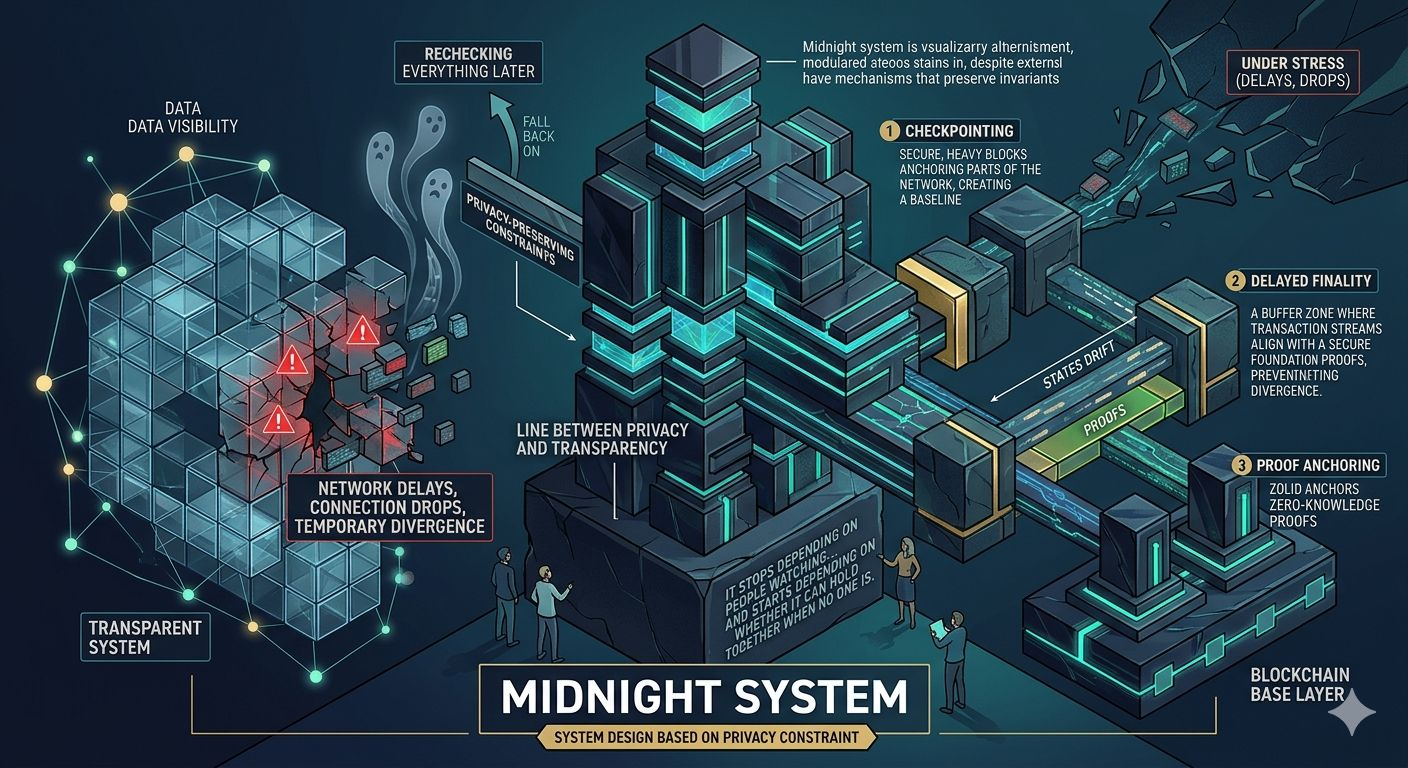
The more I sat with it, the more I noticed how deeply transparency is tied to trust in most systems. We trust because we can see. We verify because everything is visible. But Midnight doesn’t lean on that at all. It replaces that entire habit with something stricter—proof. Not “look and verify,” but “prove it without showing it.” And that changes the responsibility. Now the system has to carry the weight, not the observer.
And honestly, that’s where things start to feel real.
Because once you remove full visibility, there’s no room for loose assumptions. You can’t rely on people double-checking things in the background. The logic has to hold on its own, under pressure, without shortcuts. That’s where zero-knowledge stops sounding impressive and starts feeling necessary. Not because it’s advanced, but because without it, the system just doesn’t work.
What made it click even more for me was thinking about how these systems connect to the outside world. Privacy sounds clean when it’s isolated, but nothing in Web3 really stays isolated. You still need to interact with other chains, move value around, coordinate state. And that’s usually where things get messy. Either too much gets exposed, or you quietly introduce trust again through some middle layer.
Midnight feels like it’s trying to sit right in that tension instead of avoiding it. It uses proofs not just internally, but at the boundaries—like a way of saying, “you don’t need to see everything, you just need to know this is valid.” That’s a very different kind of interoperability. Less sharing, more proving.
But the part that really shifted my thinking wasn’t the design in ideal conditions—it was imagining what happens when things go wrong.
Because they always do.
Networks lag. Messages don’t arrive when they should. Sometimes systems just stop syncing for a while. In a transparent setup, you can usually recover by just re-checking everything later. But in a privacy-first system, you don’t have that fallback in the same way. You need the system to stay consistent even when it’s partially blind.
And that’s where Midnight starts to feel less like an idea and more like something built with real-world pressure in mind. You can almost see the reasoning behind things like checkpoints, delays, and proof anchoring. Not as features, but as safeguards. Quiet mechanisms that keep things from breaking when conditions aren’t perfect.
Looking back, I think what changed for me wasn’t just how I see privacy—it’s how I see the whole structure of Web3 systems. I used to think privacy was something you add carefully on top. Now it feels more like something that forces you to rebuild everything underneath.
And once that thought settles in, it’s hard to ignore.
Because the question stops being how to hide data…
…and turns into why we were exposing so much of it in the first place.
