
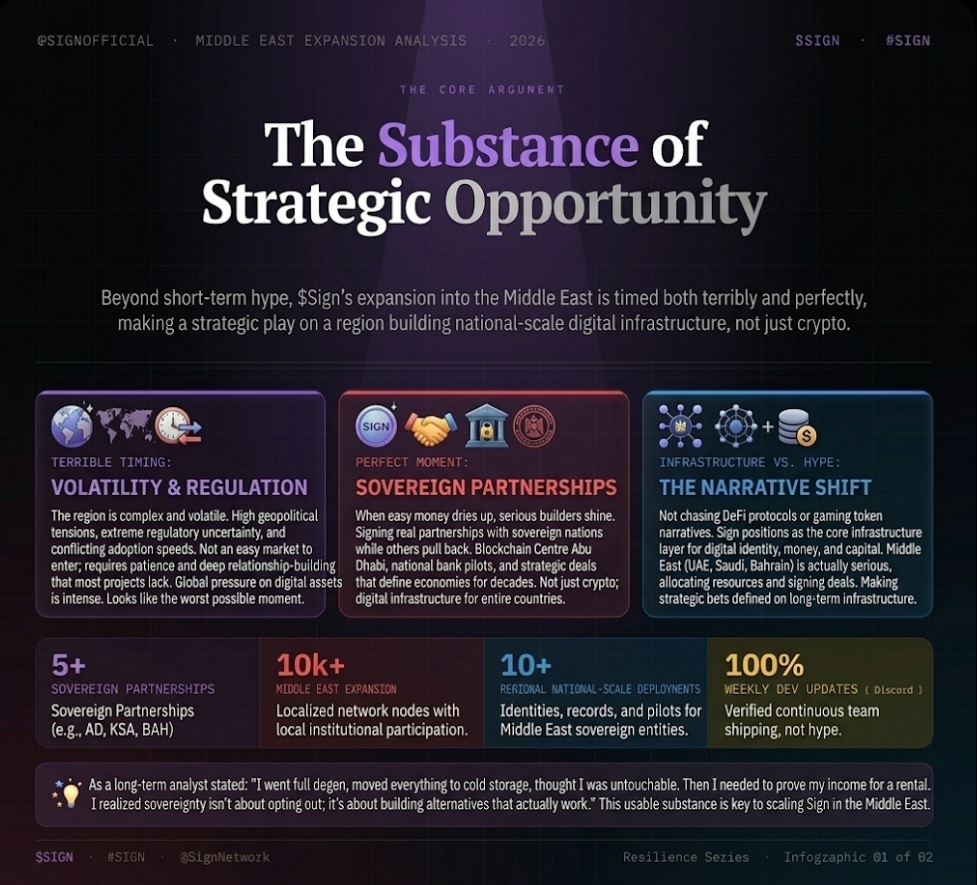
I've been watching SignOfficial's expansion into the Middle East, and honestly? The timing is both terrible and perfect. Let me explain what I mean.
On one hand, the region is a mess right now. Geopolitical tensions are high. Regulatory uncertainty is everywhere. You've got countries moving at completely different speeds on crypto adoption, and the global pressure on digital assets isn't letting up. If you were looking for an easy market to enter, the Middle East right now would not be your first choice. It's complicated, it's volatile, and it requires a level of patience and relationship-building that most crypto projects simply don't have. So in that sense, yeah — it's kind of the worst possible moment to be making a big push.
But here's the thing about worst moments: they're often the best moments for the people who are actually serious. Because when the easy money dries up and the hype fades, the projects that are still building — still showing up, still signing partnerships, still doing the hard work — they're the ones that end up owning the space. And that's exactly what SignOfficial is doing. While everyone else is pulling back or pivoting to whatever the next shiny narrative is, Sign is quietly locking down real partnerships with sovereign nations in the region. The Blockchain Centre Abu Dhabi. Pilots with national banks. Conversations that aren't just about crypto — they're about digital infrastructure for entire countries.
That's the play that I think people are missing. Sign isn't trying to be the next DeFi protocol or the next gaming token. They're positioning themselves as the infrastructure layer for digital identity, money, and capital. And the Middle East? It's one of the few regions in the world where sovereign nations are actually serious about building that infrastructure. Not just talking about it — allocating resources, signing deals, making it happen. The UAE, Saudi Arabia, Bahrain — these countries aren't dabbling. They're making strategic bets on digital infrastructure that will define their economies for decades. And Sign is right there, building alongside them.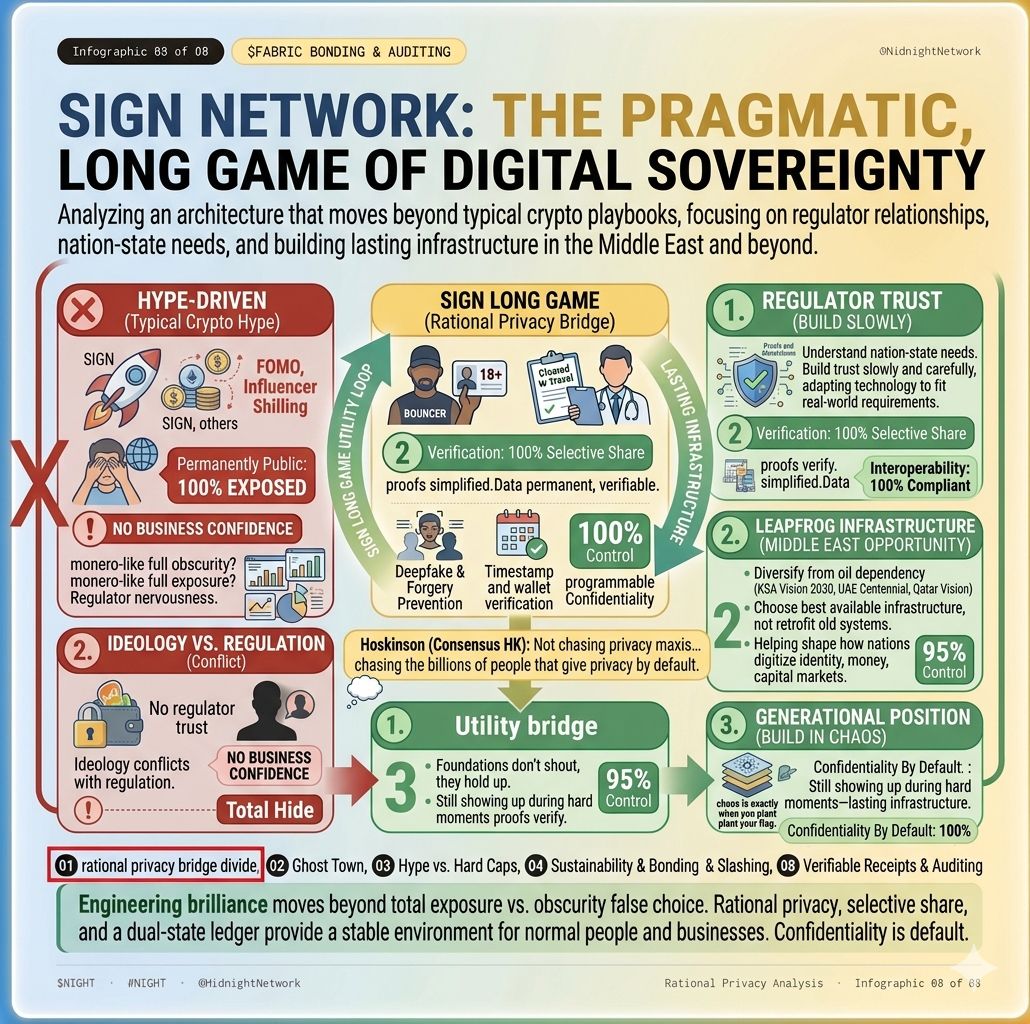
What strikes me most is the approach they're taking. It's not the typical crypto playbook — launch a token, hype it up, hope the price goes parabolic. Sign is playing the long, patient game. Building relationships with regulators. Understanding the specific needs of each country. Adapting their technology to fit real-world requirements, not forcing governments to adapt to crypto ideology. That kind of approach doesn't make for exciting Twitter threads. But it does make for lasting infrastructure. And in a region where trust is built slowly and carefully, that patience is actually an advantage.
There's something else worth noting. The Middle East isn't just any market for digital infrastructure. It's a region that's actively diversifying away from oil dependency. Saudi Vision 2030, UAE's centennial plan, Qatar's national vision — these aren't just slogans. They're multi-billion dollar commitments to building digital economies from the ground up. And when you're building from scratch, you don't have to retrofit old systems. You can leapfrog. You can choose the best infrastructure available today, not whatever was built decades ago. That's the opportunity Sign is walking into. Not just selling a product, but helping shape how entire nations digitize their identity, their money, their capital markets. That's not a partnership. That's a generational position.
So yeah, the timing is chaotic. The headlines are messy. But if you're building something that's meant to last, chaos is exactly when you plant your flag. When the dust settles and the region's digital infrastructure is fully built out, the projects that were still showing up during the hard moments — those are the ones that will still be standing. Sign is playing that long game. And honestly? That's the only game worth playing.
$SIGN #SignDigitalSovereignInfra #signdigitalsovereigninfra @SignOfficial