
When I first came across SIGN and its Leaderboard Campaign, it did not feel like something loud or flashy to me. It felt more like a quiet question sitting in the background of the internet. A question that slowly makes you uncomfortable the more you think about it. How do we really know who someone is online, and how do we prove what they have done without taking away their privacy or their freedom. That thought stayed with me longer than expected, almost like it was gently pulling my attention back again and again.
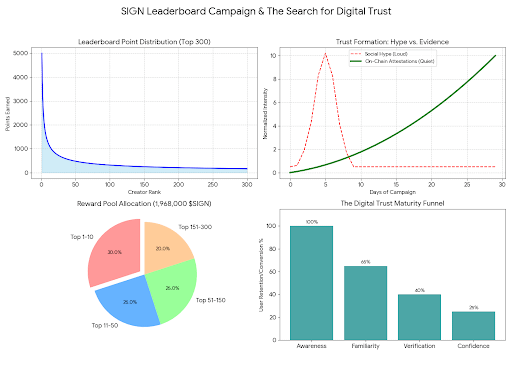
SIGN is trying to build something around credential verification and token distribution, but I do not see it only as a technical system. I see it as an attempt to bring trust into a space that often feels uncertain. The internet is full of activity, but not all activity feels real. Some of it is noise, some of it is repetition, and some of it disappears without leaving any meaning behind. So when a system tries to filter signals of real participation, it immediately feels important, but also a little sensitive.
The idea of a Leaderboard Campaign adds another emotional layer to it. Because the moment people hear leaderboard, something inside them reacts. There is a small spark of competition, a feeling of being measured, a quiet pressure to not fall behind. Even if no one says it out loud, humans naturally compare themselves. It is almost instinct. And that is where things become interesting and complicated at the same time.
In everyday life, we already live inside invisible rankings without noticing it clearly. People are constantly being measured in subtle ways through work, reputation, online activity, and social perception. It is not written anywhere, but it is always felt. SIGN feels like it is trying to make a version of that structure inside a digital system where actions can be tracked and rewarded more directly. That can feel fair in some moments, but also emotionally heavy in others.
What feels hopeful about SIGN is the idea that real participation could finally matter in a clearer way. If someone genuinely contributes, shows up consistently, and interacts in a meaningful way, the system can recognize it instead of ignoring it. That creates a feeling of being seen. And being seen, even in a digital environment, is something people quietly value more than they admit.
But at the same time, I cannot ignore the emotional tension inside this kind of structure. When you start measuring participation, you also start shaping behavior. People may begin to act not from curiosity or passion, but from the desire to stay higher on a list. Slowly, without noticing, effort can turn into pressure. And what once felt natural can start to feel like an obligation.
There is also a deeper uncertainty that I keep thinking about. If a system decides what counts as valid proof of identity or activity, then it also decides what is ignored. Human behavior is not always clean or predictable. Some people contribute in small ways, some in irregular patterns, and some in ways that are not easy to measure. A system that is too strict might miss the quiet value that does not fit into its structure.
Still, I find myself not fully rejecting the idea. Because the problem it is trying to solve is real. The digital world struggles with trust. Fake activity, duplicated accounts, and empty engagement make it harder for genuine users to feel their presence matters. If SIGN can reduce that noise and make participation more meaningful, then it could bring a sense of clarity that many systems currently lack.
I keep imagining what it would feel like for an ordinary person entering such a system. Instead of feeling invisible, they might feel that their actions slowly build something real over time. A kind of digital reputation that does not expose their personal life but still reflects their consistency and honesty. That idea feels comforting in a quiet way, almost like being acknowledged without needing to explain yourself.
But there is always a fragile side to systems like this. Everything depends on design choices that users do not always see. How activity is measured, how fairness is defined, and how rewards are distributed can change everything. Even a small imbalance can slowly shape outcomes that feel unfair, even if no one intended it.
So when I think about SIGN, I do not see something perfect or complete. I see something still learning how to exist. It is trying to translate trust, something deeply human and emotional, into a structured digital form. And that is not an easy thing to do, because trust is not only about proof. It is also about feeling safe, feeling recognized, and feeling understood in ways that numbers alone cannot fully capture.
In the end, what stays with me is a mixture of hope and hesitation. Hope that systems like this can make digital participation more real and meaningful. And hesitation about how easily measurement can turn into pressure. It feels like we are standing in a space where something important is being built, but the final shape is still unclear.
And maybe that is the most honest feeling I can hold. Not certainty, not rejection, but a quiet awareness that we are still learning how to turn human trust into something digital without losing the human part inside it.