
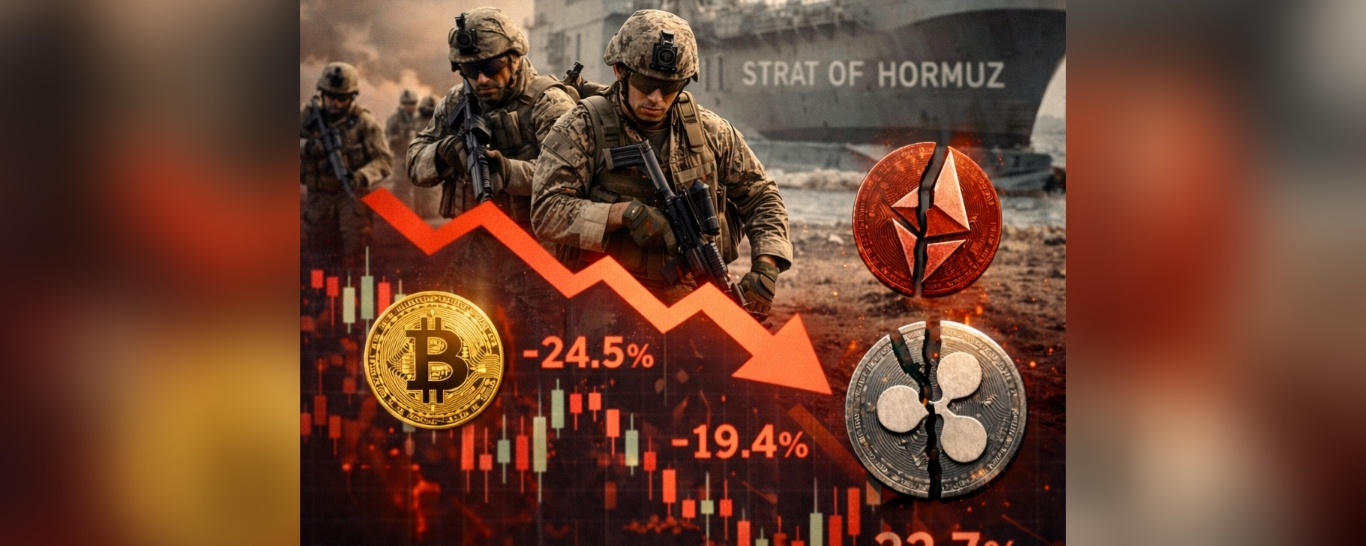
In recent weeks, the cryptocurrency market has experienced a sharp and unsettling downturn, wiping out billions in market value and shaking investor confidence 💥. While digital assets like Bitcoin and Ethereum are often viewed as decentralized and independent of traditional geopolitical risks, global events continue to prove otherwise ⚠️. One of the most critical emerging factors is the escalating tension surrounding the Strait of Hormuz—a strategic chokepoint that could reshape not only energy markets but also the future trajectory of crypto.
---
📊 Current Market Situation
The crypto market is currently in a bearish phase characterized by:
📉 Rapid price declines across major assets
💣 Increased liquidation of leveraged positions
🌪️ Heightened volatility driven by macroeconomic uncertainty
This downturn is not occurring in isolation. It aligns with broader global instability, particularly in energy markets and geopolitical hotspots 🌐.
---
⛽ Why the Strait of Hormuz Matters
The Strait of Hormuz is one of the most vital oil shipping routes in the world, with nearly 20% of global oil supply passing through it daily 🚢.
Any military escalation—especially involving the United States Armed Forces—could have immediate and far-reaching consequences:
🚫 Disruption of oil supply chains
📈 Surge in global oil prices
🔥 Rising global inflation
💸 Increased pressure on financial markets, including crypto
---
🪖 Scenario: U.S. Military Control of the Strait
If the United States Armed Forces were to assert control over the Strait, the implications could be profound:
1. ⚡ Energy Shock → Market Panic
Oil prices would likely spike sharply 📈. This would increase inflationary pressure globally, pushing central banks toward tighter monetary policies—historically negative for risk assets like cryptocurrencies.
2. 🏦 Liquidity Crunch
Investors tend to move toward safer assets (such as gold and the U.S. dollar) during geopolitical crises 🛡️. Cryptocurrencies, still considered high-risk, often suffer capital outflows.
3. 📉 Short-Term Crypto Crash
A sharp sell-off could occur as traders return to uncertainty, triggering liquidations and amplifying downward momentum 🔻.
4. 🔄 Long-Term Mixed Impact
Over the longer term, cryptocurrencies could potentially benefit:
🌍 Increased distrust in centralized financial systems
🔐 Growing demand for borderless, censorship-resistant assets
🧠Expansion of stablecoins and decentralized finance (DeFi)
---
📚 Historical Insight
Cryptocurrency markets have historically reacted strongly to geopolitical shocks ⚔️. During major global crises, Bitcoin often declines initially due to panic selling 😰 and liquidity needs. However, it has also shown a tendency to recover later as investors begin to view it as an alternative store of value 💡.
This dual behavior suggests that crypto functions both as a speculative risk asset and, in some contexts, a hedge against systemic instability.
---
🔮 Future Outlook
If tensions escalate further in the Strait of Hormuz, the crypto market could follow one of two main paths:
🐻 Bearish Scenario (Short-Term)
📉 Continued sharp declines
💧 Reduced liquidity
😱 Widespread panic selling
🐂 Bullish Scenario (Long-Term)
🚀 Increased adoption amid financial uncertainty
🏛️ Greater institutional interest in decentralized assets
🌐 Expansion of blockchain-based financial systems
---
🧭 Conclusion
The current crypto market downturn is not merely a correction—it is closely tied to broader geopolitical developments 🌍. The potential involvement of the United States Armed Forces in controlling the Strait of Hormuz could serve as a major catalyst for continued volatility ⚡.
In the short term, uncertainty and risk aversion are likely to dominate 😬. However, over the long term, such crises may reinforce the core idea behind cryptocurrencies: providing an alternative financial system that operates beyond the influence of centralized power and geopolitical instability 🔗💰.


