 I have noticed something about games that introduce economies.
The hardest part is not creating value.
It is controlling how that value behaves.
In traditional games, economies are usually contained. Developers decide how resources are generated, how they are distributed, and how players interact with them. The system is designed to remain stable because it is managed centrally.
Web3 changes that structure.
When players can earn, trade, and interact with assets in an open environment, the economy becomes less controlled and more reactive. Player behavior starts to shape the system as much as the design itself.
This is where most blockchain games struggle.
They create systems where earning becomes the dominant behavior.
Players optimize.
They find the fastest ways to extract value.
They repeat actions not because they enjoy them, but because they are efficient.
Over time, the economy begins to reflect that behavior.
Gameplay becomes secondary.
Pixels is operating inside this exact challenge.
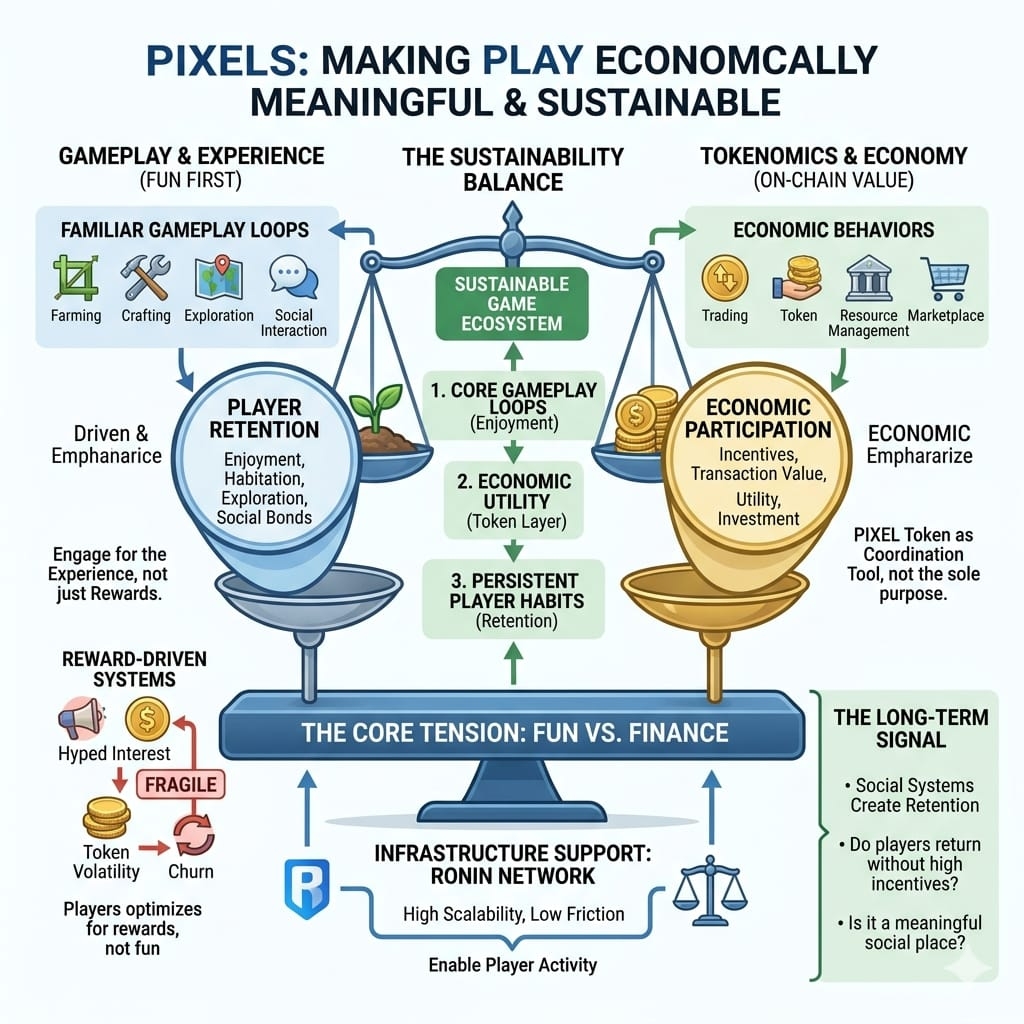
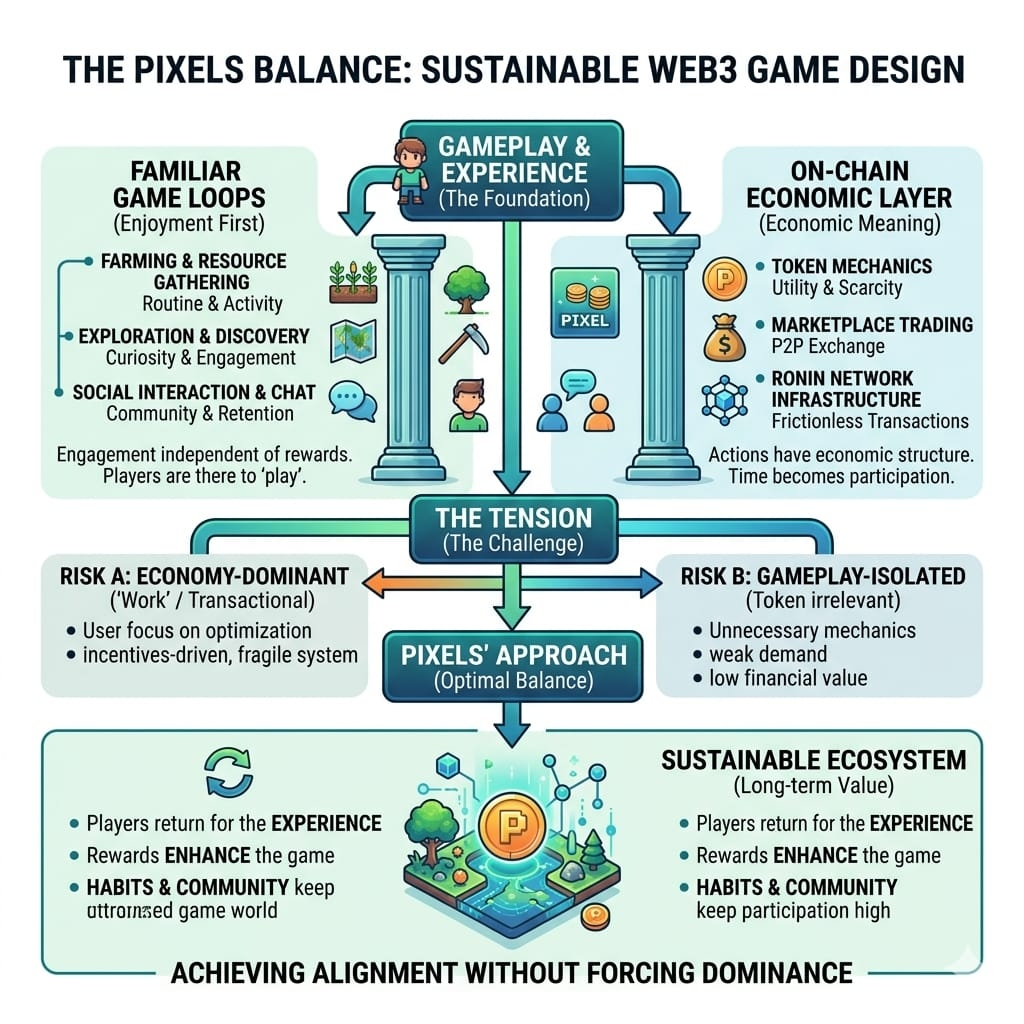
At its core, the game is built around simple, familiar mechanics. Farming, gathering, crafting, and interacting within a shared world. These are not new ideas, but they are effective because players already understand them.
The difference is that Pixels introduces an open economic layer through the PIXEL token.
This means that player activity is not just progression.
It has value outside the game loop.
That creates opportunity.
It also creates pressure.
When value is attached to actions, those actions begin to change. Players may prioritize efficiency over experience. Systems that were designed to be enjoyable can become repetitive because they are optimized for output.
This is the point where many games lose balance.
Pixels attempts to manage this by anchoring its economy to behavior that already feels natural within the game.
Farming is not introduced as a way to earn.
It is introduced as a core mechanic.
Exploration is not designed as a reward loop.
It is part of the experience.
This distinction matters because it influences how players interact with the system.
If the mechanics feel like work, the economy dominates.
If the mechanics feel like play, the economy integrates.
The role of the PIXEL token in this structure is to facilitate interaction rather than define it.
It connects player activity to a broader system. It allows value to move between participants. It creates incentives, but it does not replace the need for engaging gameplay.
This is a delicate balance.
Because in open economies, player behavior is unpredictable.
Even well-designed systems can shift if participants begin to interact with them in unintended ways. Farming loops can become extraction loops. Social systems can become transactional.
The sustainability of the game depends on how well it manages these shifts.
Another important factor is the social layer.
Pixels is not just an individual experience.
It is a shared environment.
Players interact, trade, collaborate, and exist within the same world. This creates a different kind of retention. Social environments tend to hold users longer because they create connections that go beyond mechanics.
When players feel part of a system, they are less likely to leave.
This social structure can help stabilize the economy.
It shifts behavior away from pure optimization and toward interaction.
But it also introduces complexity.
The more players interact, the more the system depends on collective behavior rather than individual actions.
This is where design and community begin to overlap.
Pixels is not just building a game.
It is shaping an environment where player behavior influences both the experience and the economy.
That is not easy to control.
The success of the system will depend on whether the game can maintain its identity as a game while supporting an open economy.
If the experience remains engaging, the economy becomes a natural extension of gameplay.
If the economy becomes the primary focus, the experience risks becoming transactional.
This is the tension every Web3 game faces.
Pixels is attempting to resolve it by starting with familiar mechanics and layering economic interaction on top.
Whether that balance holds will determine how the ecosystem evolves.
For now, the project represents an important question for Web3 gaming.
Can a player-driven economy exist without turning play into work?
The answer will not come from design alone.
It will come from how players choose to engage with the system over time.