
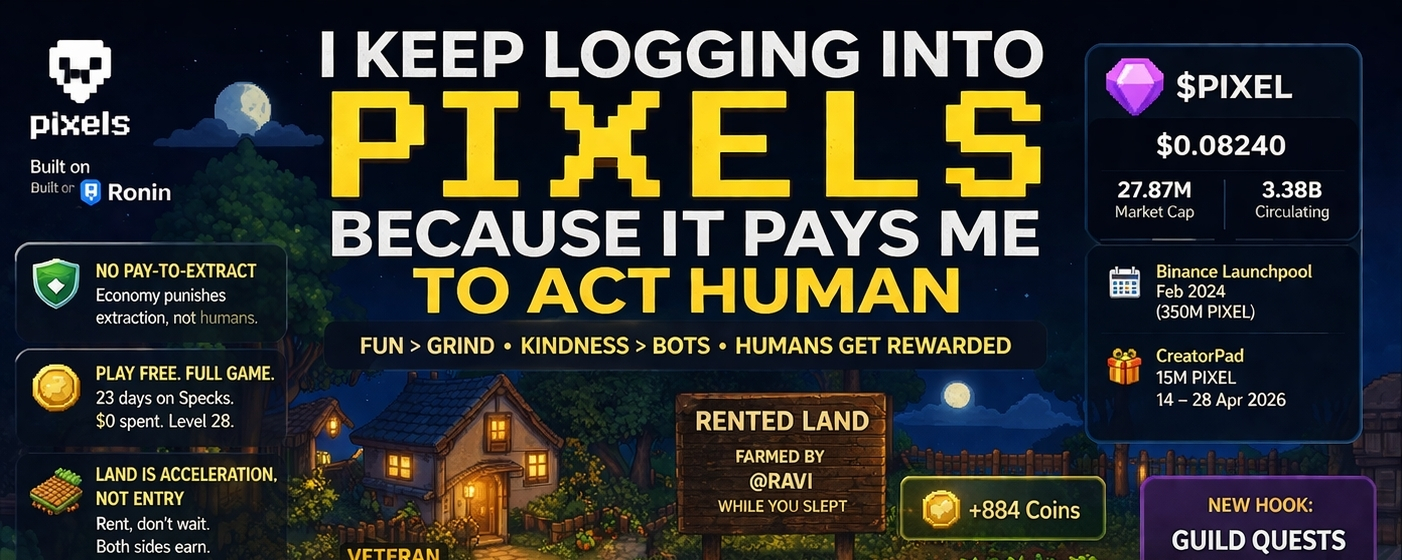

I used to mute every Web3 game after a week. The loop was always the same. Join free, hit a wall, buy an NFT, watch the token chart become a ski slope. I expected Pixels to follow the script. Pixel art farming, $PIXEL token, Ronin network. I had seen this movie. Then the game started rewarding me for stuff I never thought mattered. And that is where this gets dangerous, in a good way.
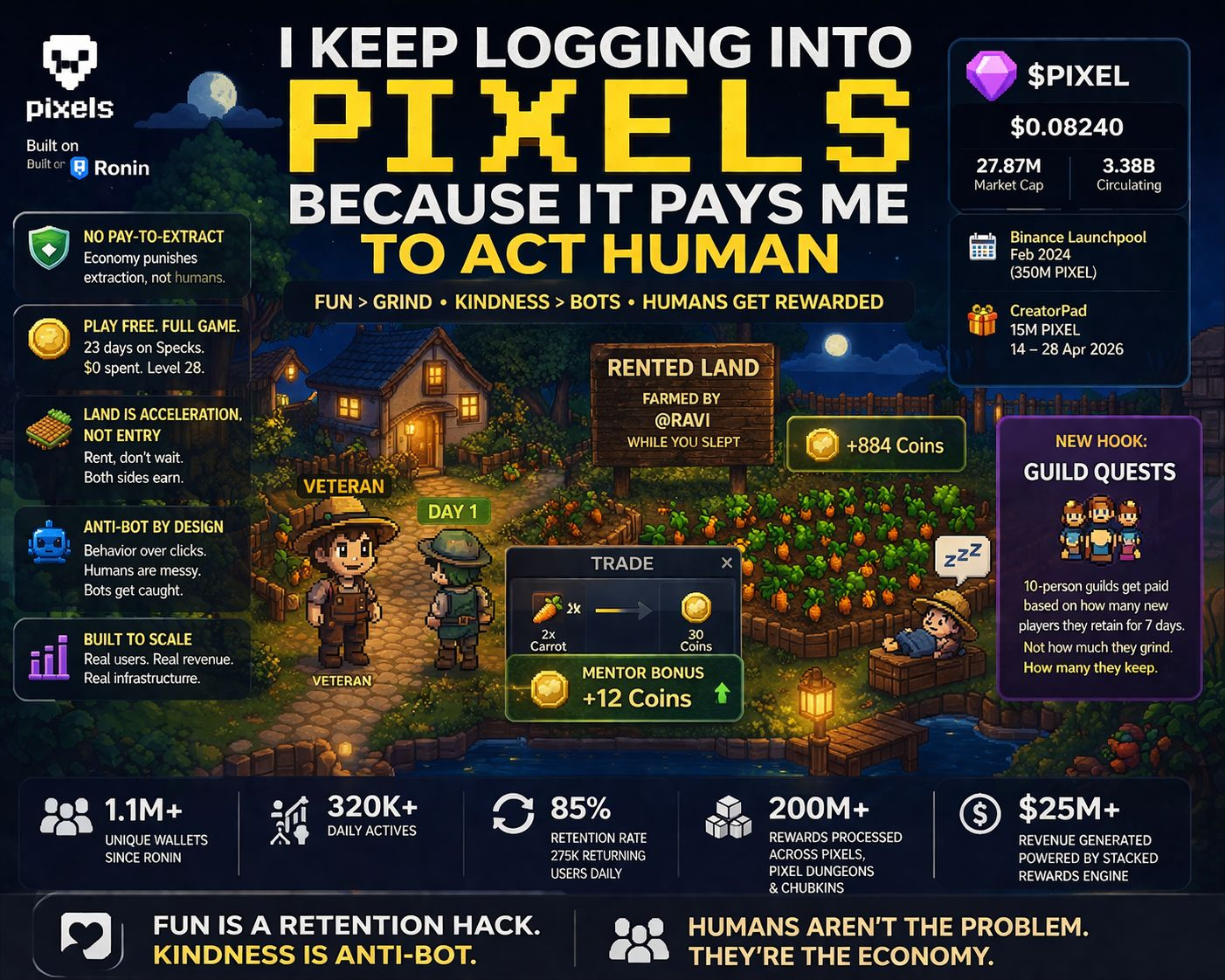
Question 1: “Is Pixels another play-to-extract scheme dressed as a cozy farm”. Answer: No, because the economy punishes extraction. Most Web3 games let tokens rain from the sky. Bots mint, dump, leave. Pixels killed that tap before I even joined. They removed $BERRY and moved daily activity to Coins. Coins are off-chain, instant, and useless to bot farms. $PIXEL sits above that for minting, guilds, pets, VIP, and withdrawals. That split means I can play for a month without touching an exchange. The moment a game stops begging me to buy its token, I start trusting it.
Question 2: “Can you actually play free or is that marketing”. Answer: I spent 23 days on Specks, the free plots. I crafted, sold, joined a guild, hit level 28. I did not spend a cent. The paywall does not exist. The upgrade path does. If I want land perks or faster progression, PIXEL helps. But the core loop is open. That is rare. Usually free means demo. Here free means full game with a ceiling you choose to break.
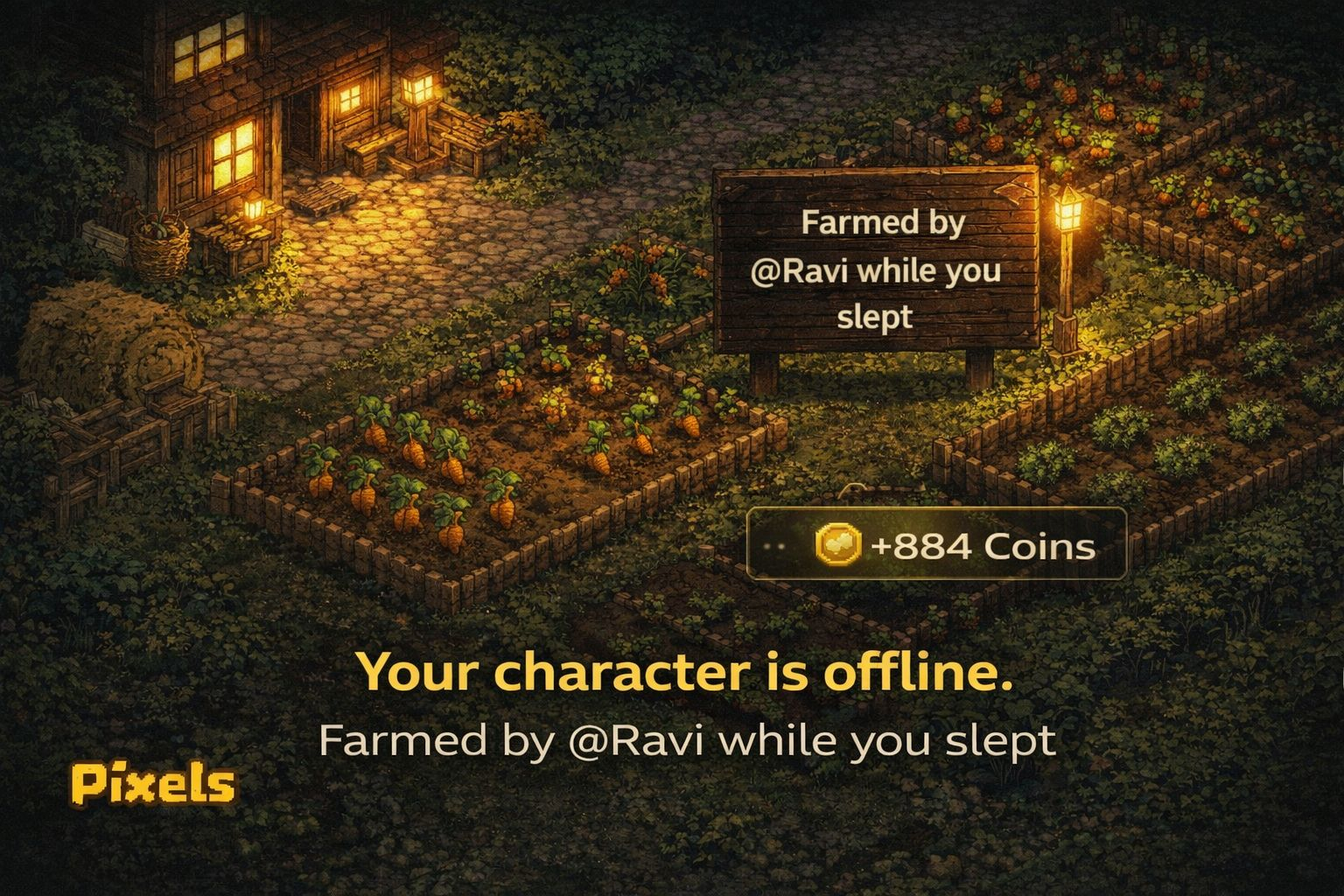
Question 3: “Land is limited to 5,000 plots. Is this just for whales”. Answer: Land is acceleration, not entry. I am level 41 with zero land owned. Two of my guildmates are top 300 players, also landless. The real meta is renting. If you own land and cannot play, you rent it out. If you are active and landless, you rent from someone sleeping. Both sides earn. That keeps plots moving instead of collecting dust in wallets. I rented a Tier 2 farm for 6 days last week. Cost me 90 Coins. I made 340 back. Try that with a JPEG in other games.
Question 4: “How is this not drowning in bots”. Answer: Because Pixels tracks behavior, not just clicks. If you sit for 7 hours clicking one tile, no chat, no trade, no movement, the system flags you. Humans are messy. We mis-click, we stop to talk, we help a noob, we go AFK. Bots are efficient. That efficiency gets them caught. The result is visible in the market. Carrot prices have stayed between 0.9 and 1.3 Coins for 4 months. In Web3, stable pricing is basically a miracle.
Question 5: “Fine, it works now. What happens at 2 million daily users”. Answer: I do not have a crystal ball. I have scaling data. Since moving to Ronin, Pixels has seen 1.1 million unique wallets. Current daily actives sit above 320,000. Retention is near 85% with 275,000 returning users daily. The backend is Stacked, a rewards engine that has already processed 200 million plus rewards across Pixels, Pixel Dungeons, and Chubkins. It helped drive 25 million dollars plus in revenue. Cross-game quests are live. I did a Pixel Dungeons run yesterday and my Pixels character got a chest for it. That is infrastructure, not hype. PIXEL itself trades at 0.008240 with a 27.87 million dollar market cap and 3.38 billion circulating. Binance listed it in February 2024 with a 350 million PIXEL Launchpool. Right now a 15 million PIXEL CreatorPad runs from 14 to 28 April 2026. New hook: they are testing “Guild Quests” where a 10-person guild gets paid based on how many new players they retain for 7 days. Not how much they grind. How many they keep. That is the first time I have seen retention become a direct bounty.
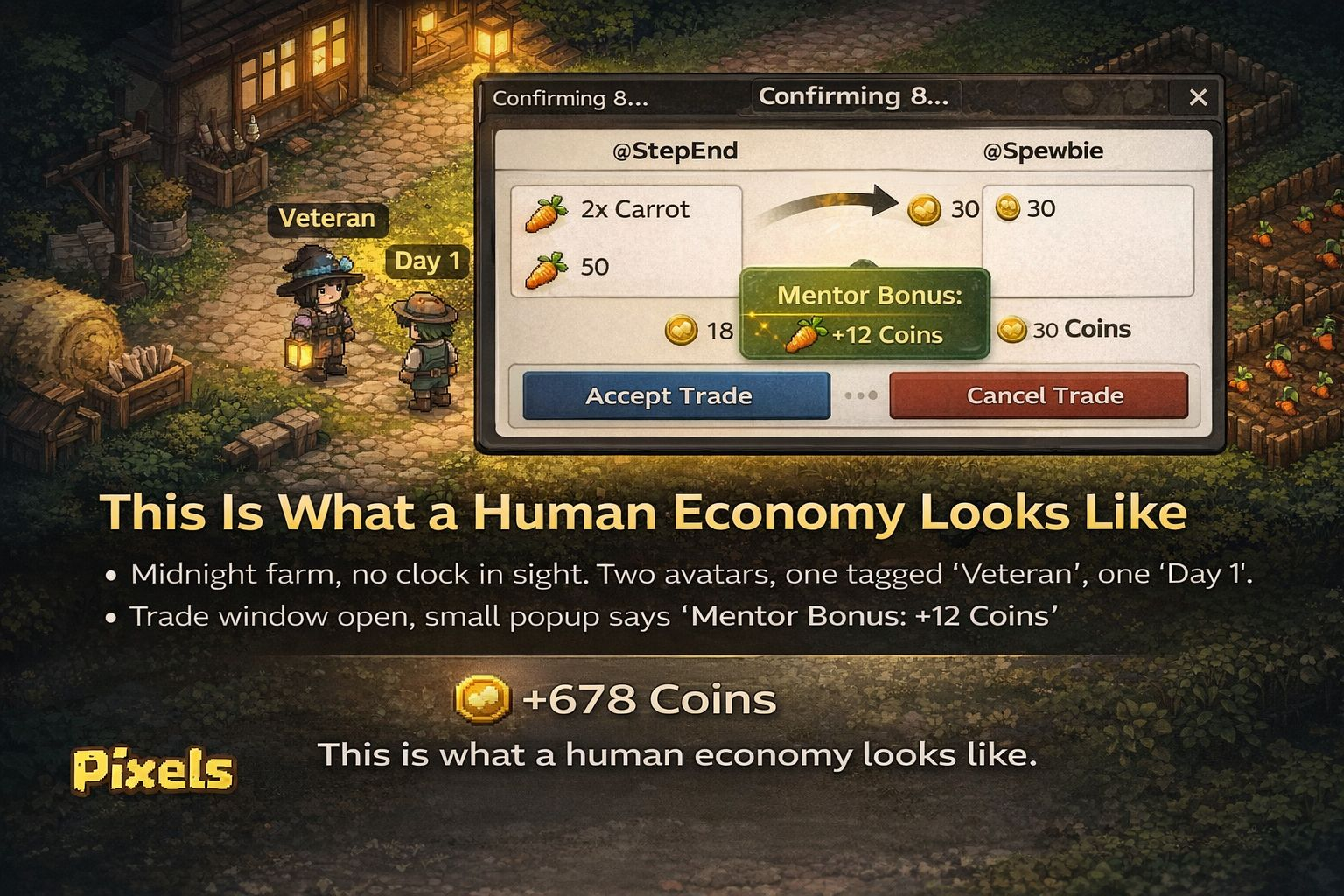
My take, since you asked. I think Pixels figured out that fun is a retention hack and kindness is an anti-bot filter. My friend Sana plays 20 minutes a day. She answers questions and runs one weekly event. I sweat for 2 hours. She out-earns me three days a week. The system weighs impact over hours. That is terrifying and brilliant. Brilliant because for once being a decent person is alpha. Terrifying because the day the code misjudges what “good” means, the magic dies. Until then, I log in. Not for the token. For the moment someone says “thanks for the help” and the game agrees with them.
So here is the mindshare question I cannot shake. If a game can tell the difference between a farmer and a friend, and it pays the friend more, will the next generation of games compete on who extracts better, or on who understands better?