

At first glance, @Pixels looked like it had already solved the hardest part of Web3 gaming. The numbers were there. High DAU, constant activity, players showing up every day. From the outside, it felt like proof that the model works.
But the more I sat with it, the more something didn’t feel right.
Because activity alone doesn’t mean sustainability. And that’s where the real crack started to show.
What $PIXEL revealed is something most projects don’t openly confront you can have users, you can have rewards, you can even have growth… and still have a broken system underneath. The issue wasn’t that players weren’t engaged. It was that the economy wasn’t holding them.
Coins were being earned, but not meaningfully spent. Resources were being collected, but not meaningfully consumed. And over time, that creates a silent imbalance. The system keeps producing value, but it doesn’t know how to keep it.
That’s when the loop breaks.
The moment players realize that extracting is more rational than reinvesting, the entire design starts working against itself. Instead of a cycle, it becomes a one-way flow. Craft, earn and then exit. No return, no pressure to stay, no reason to put value back into the system.
And honestly, this is where Pixels made a shift that I find deeply important.
Instead of trying to fix engagement, they focused on fixing the loop.
Because the real problem was never how players play. It was how value behaves after the play ends.
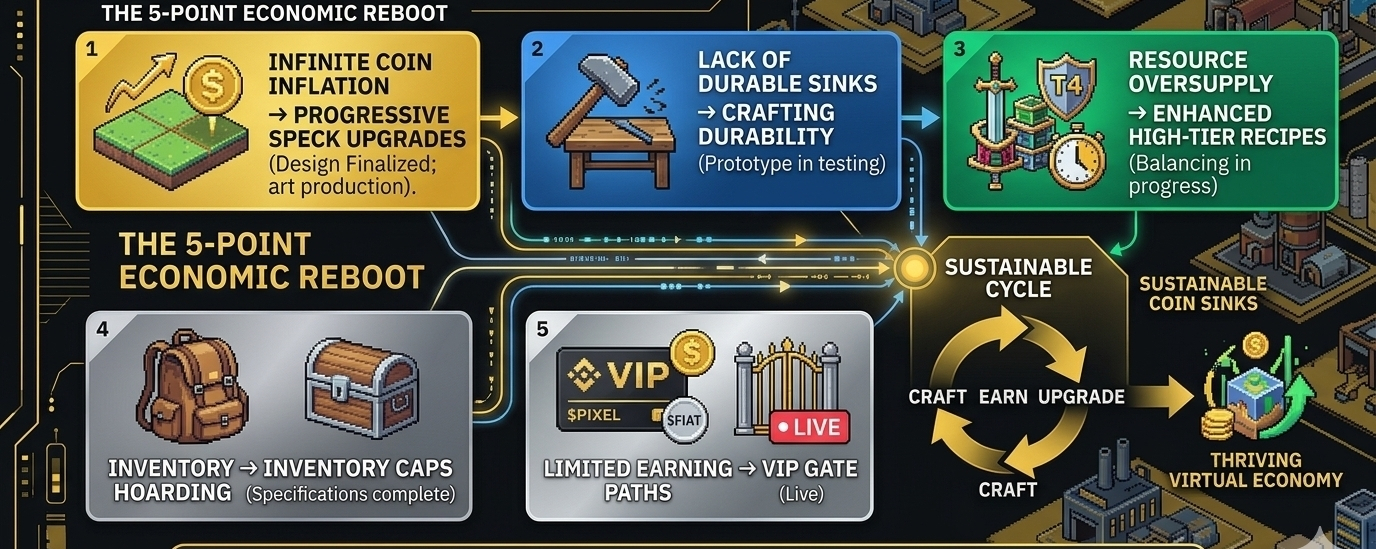
What’s happening now is not just adding features, it’s restructuring incentives at the core level. Expansion is no longer something you do passively. It becomes progressively expensive, almost forcing a decision. The more you grow, the more you must reinvest. That alone changes the psychology of the player. Growth is no longer free, it’s earned through commitment.
Then comes durability, which I think is one of the most underrated changes. When tools and stations degrade, it introduces something that was missing before recurring demand. Not artificial demand, but natural demand created by usage itself. Every action now carries a future cost, which quietly keeps the economy alive.
And this is where it starts to feel different.
Because instead of designing for rewards, Pixels is starting to design for circulation.
Even resource oversupply, which is a common issue in these systems, is being addressed through time and cost. High-tier crafting is no longer instant or cheap. It requires patience, planning, and significant input. This slows everything down in a way that actually benefits the system. It prevents players from rushing to extraction and instead keeps them inside the loop longer.
Inventory limits push this even further. When you can’t hoard infinitely, you’re forced to make choices. Do you store, do you use, or do you reinvest? That tension is important, because without it, there is no real economy only accumulation.
And then there’s the earning side being gated. This part is controversial, but also necessary. When rewards are accessible without friction, they lose meaning. By introducing VIP layers, Pixels is not just limiting access, it’s redefining value. Earning becomes something you qualify for, not something you passively receive.
All of these changes point toward one single idea that I keep coming back to.
A game economy doesn’t survive on how much it gives. It survives on how well it retains.
That’s the core shift happening here.
Pixels is moving from a system that distributes rewards to a system that recycles value. From a model where players come to earn, to a model where players stay to build. And that difference is subtle, but it changes everything.
Because when the loop is complete, behavior changes naturally. Players don’t need to be forced to stay. The system itself makes staying the most logical decision.
For me, this is the first time it feels like Pixels is not chasing growth, but designing sustainability. Not optimizing for short-term engagement, but for long-term balance.
And if this loop truly holds, then what we’re looking at is not just a better game economy.
It’s a working one.
