
There’s a small habit I’ve noticed in myself with apps I don’t fully quit. I just… stop opening them as often. No decision, no frustration. Just a slight delay between sessions, then a longer one. Eventually it fades out without ever feeling like an “exit.” If someone asked when I left, I wouldn’t be able to point to a moment. It was more like a slow drift.
Games probably see that pattern all the time, but they don’t really catch it while it’s happening. Most systems wait until the user is already gone, then try to react. That always felt a bit late to me. Like trying to talk someone back into a room after they’ve already walked out and shut the door.
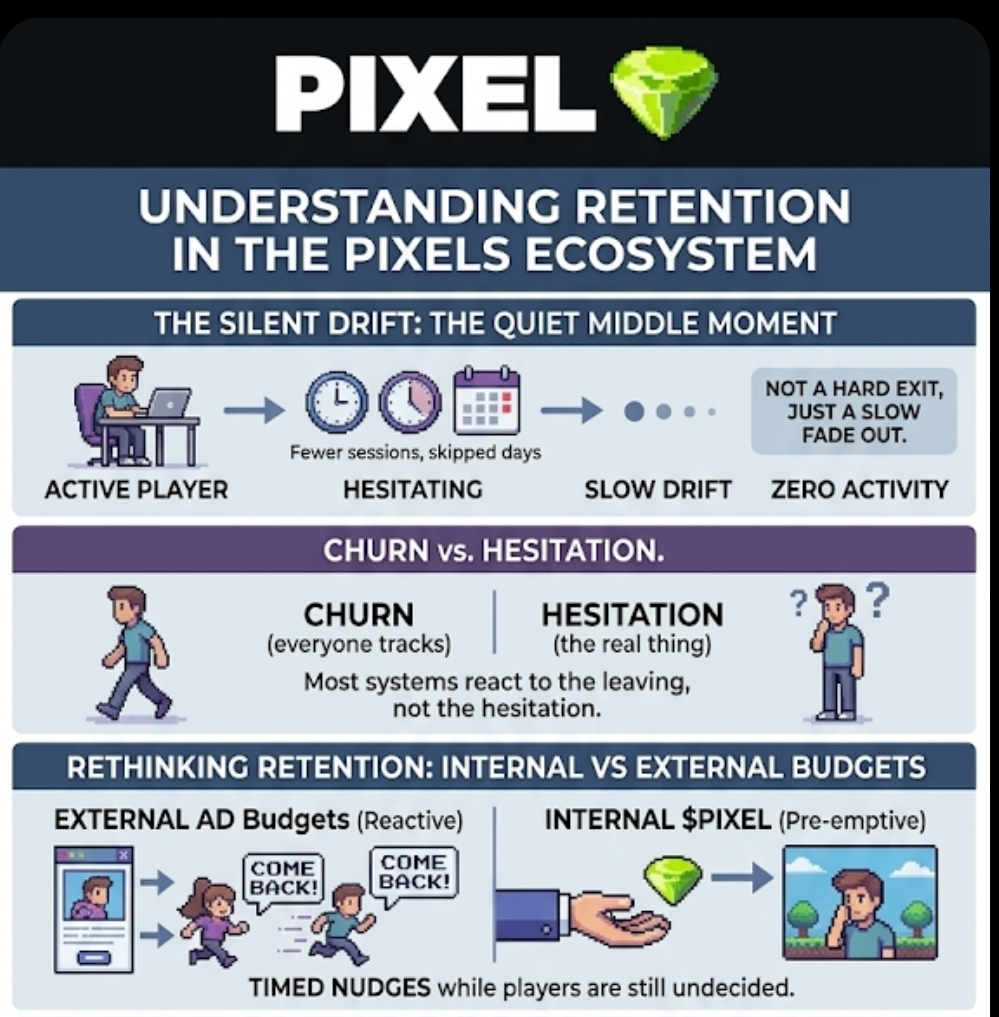
When I started looking at Pixels again, I didn’t immediately think about tokens or rewards. What caught me instead was how the system seems to pay attention to those in-between states. Not active, not gone. That awkward middle where behavior gets quieter but hasn’t disappeared yet. It’s not something most dashboards are built for. They show you retention curves and drop-off rates, but those are clean lines after messy decisions.
Churn, in simple terms, is when a player leaves. Everyone tracks it. But the real thing isn’t the leaving. It’s the hesitation before leaving. That part is harder to see because it doesn’t look dramatic. It shows up as smaller sessions, skipped days, less curiosity. You don’t feel it unless you’re looking closely, and even then it’s easy to misread.
I think that’s where $PIXEL starts behaving differently than it looks on the surface. At first, I treated it like any other in-game token. Earn, spend, repeat. But that model feels too clean for what’s actually happening underneath. The way rewards shift, the way progression adjusts… it doesn’t feel random. It feels timed. Not perfectly, but intentionally.
And timing changes the whole thing.
If a system can notice that you’re drifting before you fully disengage, it doesn’t need to convince you to come back later. It can just… nudge you while you’re still there. Maybe you get a slightly better reward. Maybe a task feels easier than expected. You don’t register it as an intervention. It just feels like the game is flowing again. That’s a very different kind of spending compared to ads chasing you across other apps after you’ve already left.
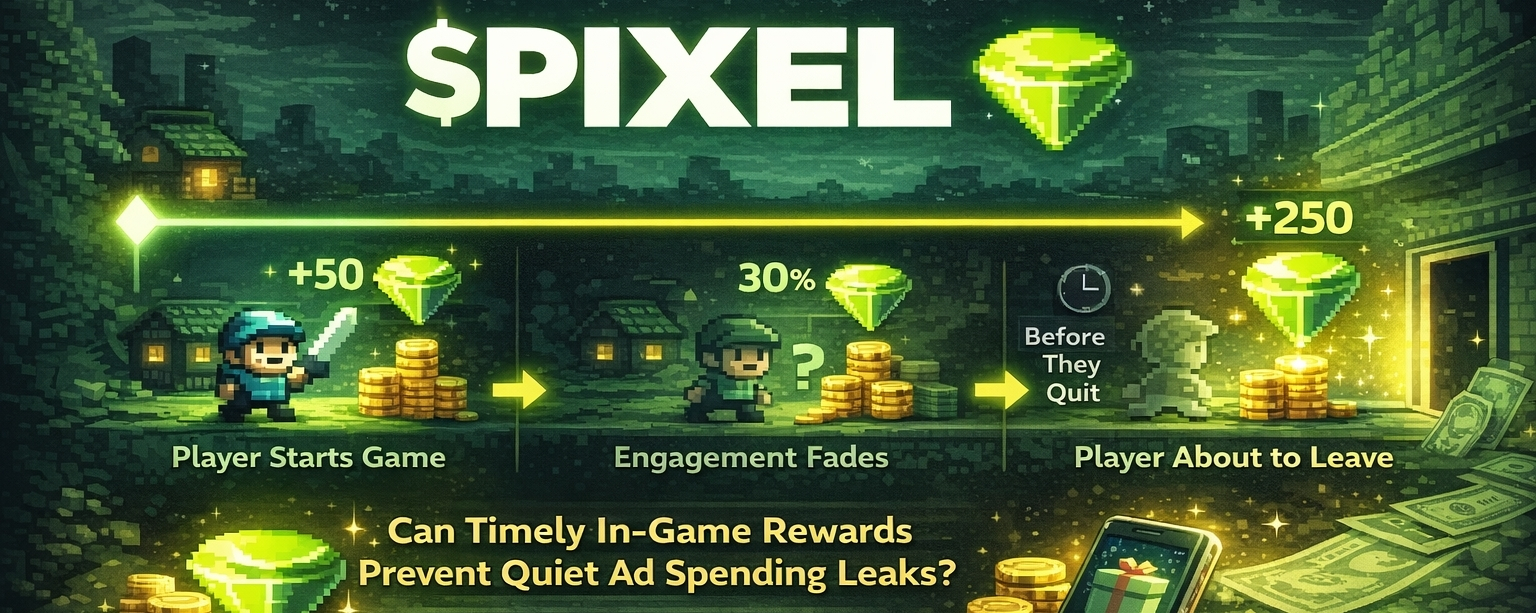
That’s where the idea of “leaking ad budgets” started making sense to me. A lot of money in gaming doesn’t go into the game itself. It goes into bringing people back after they disappear. Retargeting campaigns, notifications, incentives. It’s all external. And honestly, most of it feels disconnected from why someone left in the first place.
If Pixels can redirect even a small part of that spending internally, through $PIXEL, it changes the flow of value. Not by increasing rewards everywhere, but by concentrating them at specific moments. The moment where a player is still undecided. Still reachable.
But this is where I start getting a bit cautious.
Because players aren’t passive. They notice patterns, even if they don’t articulate them. If the system consistently “rescues” them when they slow down, some will start slowing down on purpose. Not in an obvious way. Just enough to trigger whatever adjustment exists. That’s when the token stops reflecting genuine engagement and starts reflecting behavior shaped around the system itself.
I’ve seen something similar on content platforms. On Binance Square, for example, visibility isn’t just about writing well. It’s about how your post interacts with ranking systems, timing, engagement signals. After a while, creators don’t just write. They adapt. They learn what gets picked up, what doesn’t. And slowly, the content shifts to fit the system.
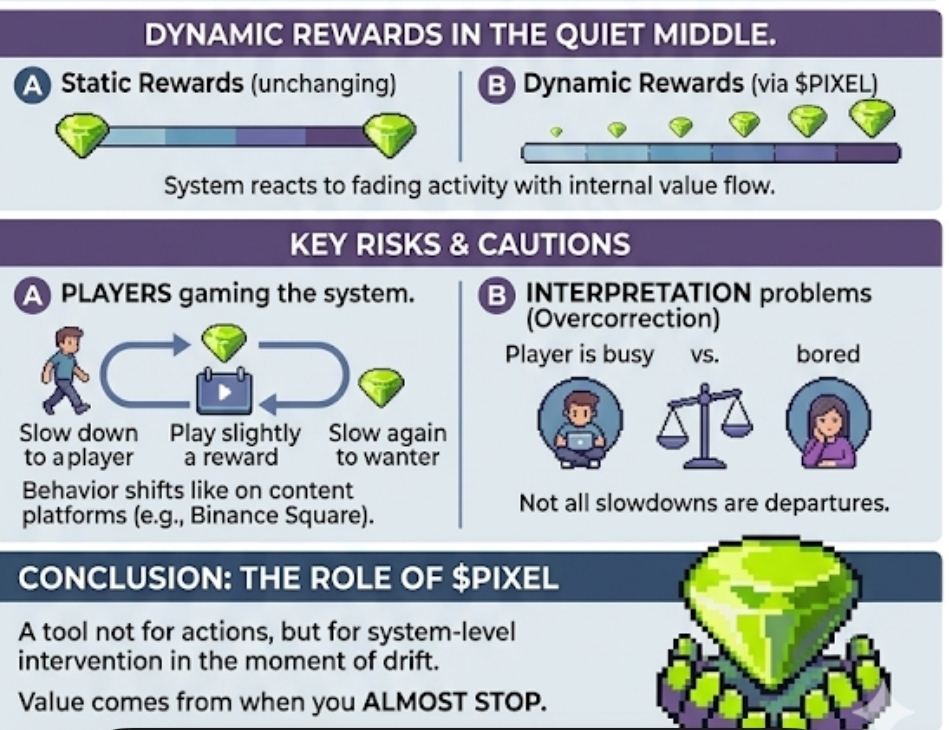
I can imagine a game drifting in that direction too. Where players aren’t just playing, they’re subtly negotiating with the system. Testing how it responds. That doesn’t break the system immediately, but it changes the texture of it.
There’s also the problem of interpretation. Not every slowdown means someone is about to leave. Sometimes people are just busy. Or distracted. Or trying something else for a few days. If the system reacts too aggressively to every dip in activity, it could end up overcorrecting. Giving away value where it doesn’t need to, or worse, making the experience feel uneven.
Still, I keep coming back to that quiet middle moment. The one that doesn’t show up clearly on charts. Most systems ignore it because it’s hard to measure. Too subtle, too inconsistent. But it’s also where the decision actually forms.
What Pixels seems to be doing, at least from what I can tell, is trying to sit inside that moment. Not after, not before. Right there while it’s happening.
I’m not sure if that turns into long-term value for $PIXEL or just a more refined version of the same retention game. It could go either way. But it does make me look at the token less as something you earn, and more as something the system uses when it needs to keep you from quietly drifting away.
And that’s a strange place for value to come from. Not from what you do, exactly. More from when you almost stop.