
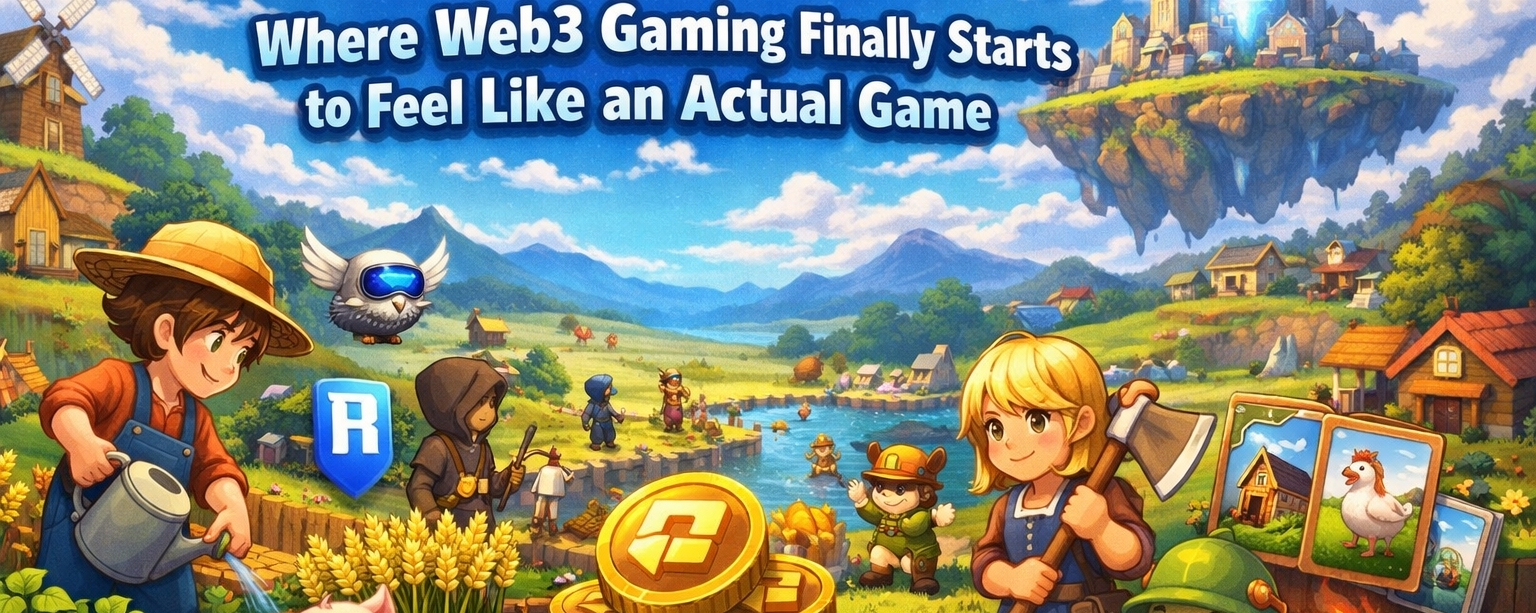

I remember the first time I came across Pixels (PIXEL) it wasn’t through a big announcement or some hype thread. It was actually during a casual discussion with a few friends who were debating whether Web3 gaming is finally becoming “playable” or still stuck in the phase of speculation disguised as gameplay. Someone mentioned Pixels almost as a side note, saying, “This one actually feels like a real game first, crypto second.” That line stuck with me, and it’s probably the best place to start understanding what this project is trying to do.
At its core, Pixels is a social, open-world farming and exploration game built on the Ronin Network. But calling it just a farming game would be underselling it. What it’s really trying to solve is something much deeper in Web3 gaming: the disconnect between fun and finance. For years, most blockchain games leaned heavily on earning mechanics tokens, NFTs, rewards but forgot that people play games primarily for enjoyment. Pixels flips that approach. It builds a simple, familiar gameplay loop farming, crafting, social interaction and then quietly layers ownership and token incentives underneath it.
The problem it addresses is straightforward but important. Traditional games give you time-based progression but no ownership. Web3 games tried to give ownership but often sacrificed gameplay quality. Pixels is attempting to sit right in the middle making a game that feels like something you’d play even without tokens, while still letting you benefit from the time you put in.
From a technology perspective, the architecture is intentionally kept simple from a user’s point of view, even though there’s quite a bit happening under the hood. The game runs off-chain for most interactions things like movement, farming actions, and social activity are handled like a normal online game. This keeps it fast and responsive. The blockchain layer, powered by Ronin, comes into play mainly for ownership and economic actions. Land, items, and tokens exist on-chain, meaning players actually own what they earn or buy. This separation is important because it avoids the common issue where every small action becomes slow and expensive due to blockchain limitations.
Ronin itself plays a big role here. It’s a gaming-focused blockchain that keeps transaction costs low and speeds high, which is essential for a game with frequent interactions. Without that kind of infrastructure, Pixels wouldn’t feel smooth enough to retain users.
Now, the PIXEL token sits at the center of the game’s economy, but it’s not forced into every action. That’s a deliberate design choice. The token is mainly used for premium features, progression boosts, governance elements, and certain crafting or upgrade paths. Instead of making everything revolve around the token, the system allows players to engage with the game freely and only interact with PIXEL when they want to accelerate or expand their experience.
Value flows in a loop. Players spend PIXEL on upgrades, land enhancements, and certain in-game advantages. That value cycles back into the ecosystem through rewards, incentives, and community-driven activities. Staking mechanisms and reward systems are designed to encourage longer-term participation rather than quick extraction. It’s less about “play to earn” in the old sense and more about “play and optionally earn while contributing.”
What makes Pixels interesting is how it connects to the broader blockchain ecosystem without feeling like it depends on it. It’s part of the Ronin ecosystem, which already has a strong gaming audience thanks to earlier successes. This gives Pixels a built-in user base and infrastructure advantage. At the same time, assets and tokens can interact with broader crypto markets, meaning players aren’t locked into a closed system.
In terms of real use, the game has already shown something many Web3 projects struggle with: actual user activity. People are logging in daily, farming, trading, and interacting. Not because they expect huge profits, but because the loop itself is engaging. That’s a subtle but powerful shift. When users stay for gameplay rather than rewards, the economy becomes more stable.
There are also integrations with NFT land ownership, where players can develop and customize their spaces, creating a sense of identity and long-term attachment. This isn’t just cosmetic — it feeds into productivity and social interaction, making land more than just a speculative asset.
That said, there are still real challenges. One of the biggest questions is sustainability. Even if the game is fun, the token economy still needs to balance inflation, rewards, and demand. If too many tokens are emitted without enough sinks, value can erode quickly. On the other hand, if rewards are too limited, players might lose interest.
Another concern is retention over time. Farming and casual gameplay loops can be engaging initially, but they need continuous updates, new mechanics, and evolving content to keep players involved. This is something traditional game studios spend years mastering, and Web3 projects are still learning.
There’s also the broader risk tied to the crypto market itself. Even a well-designed game can struggle if the surrounding market sentiment turns negative. Player behavior in Web3 is still partially influenced by token price, whether we like it or not.
Looking ahead Pixels seems to be moving in a direction that prioritizes gradual expansion rather than aggressive scaling. The focus appears to be on improving gameplay depth expanding social features, and refining the in-game economy. If they can maintain that balance keeping the game enjoyable while carefully managing the token layer they have a real chance of becoming one of the few Web3 games that people mention without rolling their eyes.
In a way Pixels feels like a quiet experiment. It’s not trying to reinvent gaming overnight or promise unrealistic returns. It’s simply asking a more grounded question: what if a blockchain game actually felt like a game first? And surprisingly that question alone might be enough to set it apart.