
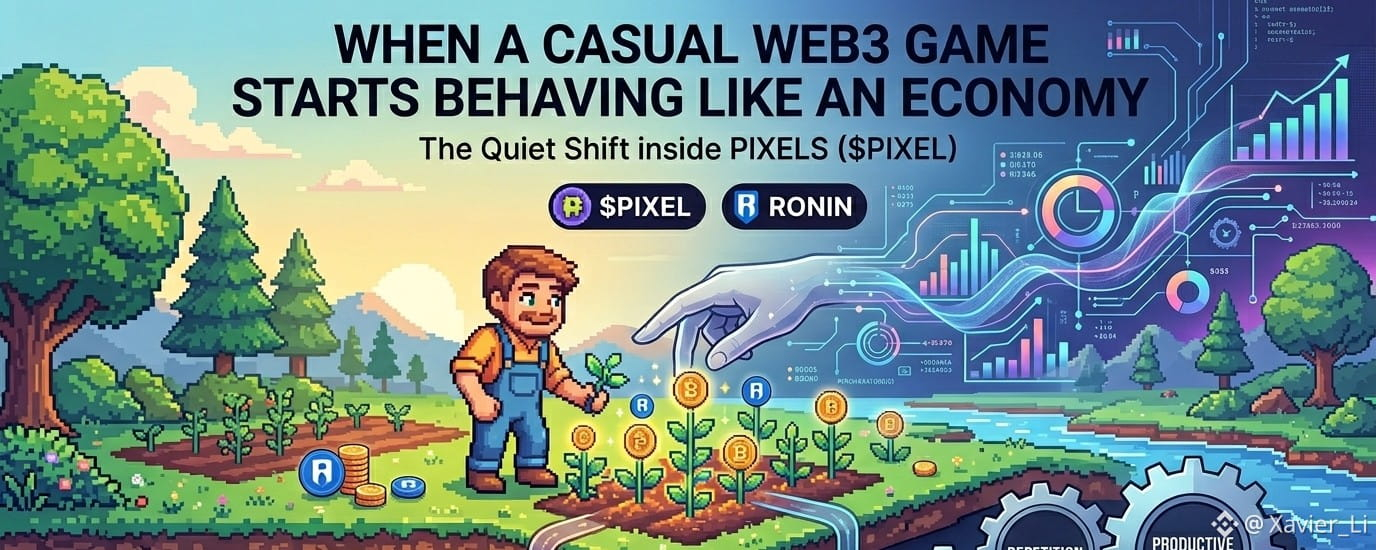
Have you ever looked at a game and wondered when it stops being “just a game” and starts behaving like something closer to an economy? That question kept coming back to me while looking at Pixels ($PIXEL), especially because on the surface it still feels familiar—almost soft, almost harmless. A farming loop, an open world, exploration, creation. Nothing about it immediately screams financial complexity. And yet, the longer you sit with it, the more you start noticing small structural signals that feel heavier than the visuals suggest.
At first glance, Pixels looks like a social casual Web3 game built for relaxation rather than intensity. It runs on the Ronin Network, and the experience is designed around simple human behaviors: tending land, gathering resources, moving through a world that feels intentionally low-pressure. It resembles the kind of game you open without commitment, something that sits in the background of your attention rather than demanding it. But that is exactly what made me pause. Because in Web3, simplicity is often not the end of the story—it is the entry point.
The deeper I looked, the more I started seeing how the structure of Pixels is not just about gameplay loops, but about behavioral loops. Farming is not just farming—it is resource timing. Exploration is not just movement—it is distribution of attention across a designed economy. Creation is not just expression—it is potential value generation inside a closed system. And suddenly, what looked like a casual game starts to resemble something more systematic: a soft economic engine wrapped inside a social world. Have you noticed how quickly “fun mechanics” can become “productive routines” in these environments?
That is where things become more interesting—and more complicated. Because systems like this rely heavily on repetition. The player returns daily not because they must, but because the environment subtly rewards consistency. That is not inherently negative; in fact, it is what makes games engaging. But in a Web3 context, repetition has an additional layer: it can begin to overlap with incentive structures tied to tokens and ecosystem rewards. And once that overlap happens, the line between play and participation becomes less visible than people expect.
What concerns me slightly is not the existence of incentives, but the direction they push behavior over time. When a game becomes habit-forming in a way that is economically reinforced, it starts to resemble a behavioral loop that is difficult to step outside of. On paper, this sounds efficient—high retention, strong engagement, sustained ecosystem activity. In practice, it raises a quieter question: are players engaging with the world, or are they being gently guided into maintaining it? And does that distinction even matter if the experience still feels enjoyable?
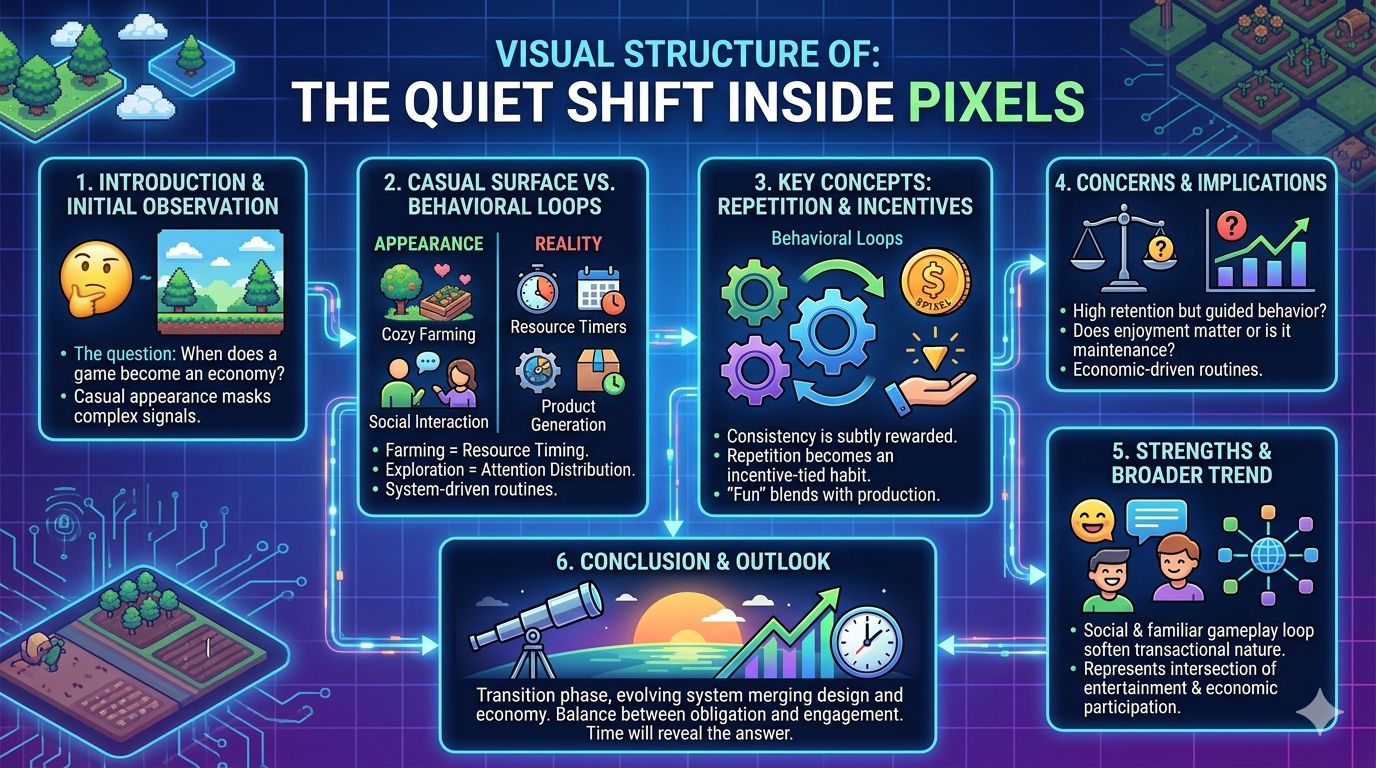
At the same time, it would be unfair to dismiss what Pixels is building. There is something structurally compelling about how it blends social interaction with a living, persistent world. Many Web3 games struggle because they feel transactional, but Pixels tries to soften that edge by embedding activity into a recognizable, almost nostalgic loop of farming and exploration. That design choice matters. It suggests an understanding that retention is not only about rewards, but about emotional familiarity. Still, familiarity can be powerful enough to mask dependency if one is not careful.
The broader implication here goes beyond Pixels itself. Games like this sit at the intersection of entertainment design and economic participation. And that intersection is still not fully understood. We often talk about “user growth” or “ecosystem expansion,” but less often about what happens when those metrics are driven by routine rather than genuine interest. If a world becomes valuable because people must keep it active for rewards to persist, then the health of the system depends less on enjoyment and more on continuity. That is a subtle but important shift.
And yet, I keep returning to the same thought: maybe this is simply the direction digital worlds are naturally moving toward. A blend of play, economy, and social structure that no longer separates fun from function. Pixels is not alone in exploring this space—it is part of a wider pattern in Web3 gaming where systems are becoming persistent, layered, and behavior-driven. The question is not whether this model can exist, but whether it can remain balanced without tipping too far into obligation disguised as engagement.
So I find myself sitting in this middle space of interpretation. Not fully convinced it is purely a game, but also not ready to label it as something entirely different. It feels like a transition phase something still learning what it wants to become. And maybe that is the most accurate way to see it. Not as a finished system, but as an evolving one where design, economy, and human behavior are slowly merging in real time.
Maybe that works. Maybe it doesn’t. And as always in Web3, the real answer may only become visible after enough time has passed inside the system itself.
