

Most Web3 games start with the same promise. Play, earn, repeat. For a while, it works. Rewards look attractive, users rush in, and activity spikes. But over time, things slow down. Not because the idea was bad, but because the system was never designed to sustain real usage.
That’s where Pixels starts to feel different.
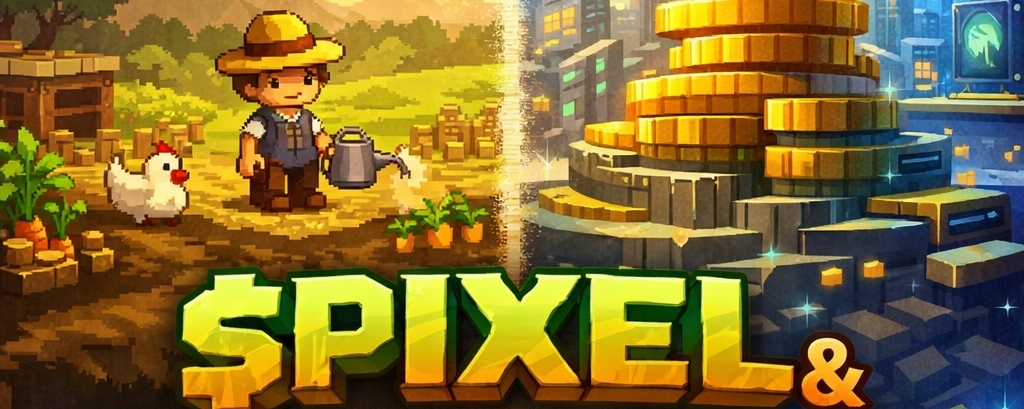
At first glance, it looks simple. A farming game where you plant crops, gather resources, explore land, and interact with other players. Nothing about that sounds revolutionary. But once you spend some time inside the game, the experience shifts. You stop thinking about tokens and start focusing on decisions.
And that’s an important difference.
Pixels doesn’t constantly push rewards in your face. It doesn’t force you to optimize every move for maximum extraction. Instead, it creates an environment where actions have context. Where what you do today can affect what you can do tomorrow.
A big part of this comes from how the game handles ownership.
Land in Pixels isn’t just cosmetic. It acts as a production layer. Players who own land can host activity, while others use that space to farm and build. Value starts to flow between players, not just from the system. Over time, this creates a natural structure where some players focus on grinding, while others focus on positioning.
It feels less like a game loop and more like an economy forming.
The introduction of systems like Tier 5 pushes this even further. Access is no longer only about time spent. It’s tied to resources, availability, and limited slots. Some industries require specific conditions, and those conditions don’t last forever. Expiring slots mean decisions carry weight. You can’t just unlock something once and forget about it.
That small design shift changes behavior.
Instead of rushing through content, players start thinking about timing, access, and efficiency. The focus moves from short-term rewards to long-term positioning. And that’s usually where most Web3 games struggle.
Another subtle but important change is how the game feels to play.
Because it runs on the Ronin Network, interactions are smooth. You’re not constantly dealing with friction or delays. That matters more than people think. When the experience feels natural, users stay longer. And when users stay longer, systems have a chance to stabilize.
Pixels also doesn’t try to over-explain itself as a “Web3 product.” It simply works as a game first. You log in, you play, you explore. The crypto layer sits underneath, supporting the experience instead of dominating it.
That balance is rare.
What’s happening here isn’t loud. There’s no constant hype or aggressive narrative. But under the surface, the structure is evolving. Ownership, access, time, and decision-making are starting to connect in a way that feels consistent.
And that’s usually how real systems grow.
Not through sudden spikes, but through small changes that make everything a bit more meaningful over time.
Pixels may not look like the future of gaming yet. But it’s slowly becoming something most Web3 games never manage to build.
A system that people don’t just use, but actually live inside.