
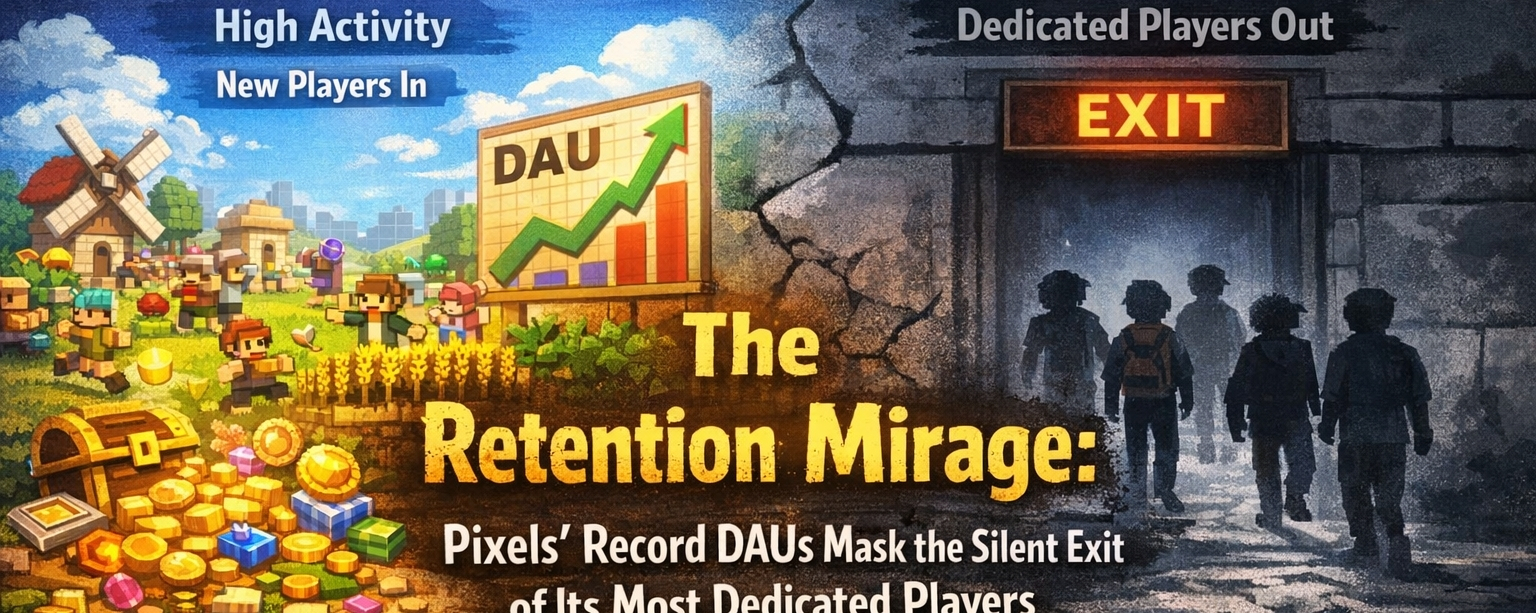

I’ve been tracking Pixels long enough to know that headline numbers rarely tell the full story. So when I saw the recent surge in daily active users, I didn’t immediately read it as strength.
I read it as a question.
Because in Web3 games, high DAUs can mean growth—but they can also mean rotation. New players coming in, while others quietly drift out.
And that’s exactly what I think is happening here.
On the surface, Pixels looks healthier than ever. Activity is up. Events are frequent. The ecosystem feels alive. But when I zoom in beyond the numbers, I start noticing something less visible—something you won’t catch from dashboards alone.
The players who once understood the system the best—the grinders, the optimizers, the consistent daily participants—are becoming less visible.
Not all at once. Not dramatically. Just… gradually.
That’s the part that concerns me.
Because DAU, by definition, measures presence—not commitment.
You can have 100,000 players logging in daily. But if a large portion of them are:
New entrants testing the system
Airdrop hunters optimizing short-term rewards
Casual users with low retention intent
…then the number starts to lose meaning as a measure of long-term health.
What matters more, in my view, is who is staying—and why.
And that’s where the idea of a “retention mirage” comes in.
From what I’ve observed, Pixels’ current growth is being fueled heavily by incentive-driven participation. Events, rewards, ecosystem campaigns—they bring people in quickly. And to be clear, that’s not a flaw. It’s a strategy.
But incentive-driven growth has a known weakness: it’s temporary.
If the underlying experience doesn’t convert those users into long-term participants, they don’t stay. They cycle out.
At the same time, the players who were already deeply engaged start to feel something different.
Not excitement—but friction.
I’ve seen this pattern before. A game evolves, introduces new mechanics, expands its economy—and in doing so, it unintentionally raises complexity and shifts balance.
For newer players, everything feels fresh.
For experienced players, the changes feel disruptive.
And when that disruption affects progression, efficiency, or fairness, it hits the most committed users first.
In Pixels, updates like land scaling, reward adjustments, and efficiency differences have introduced a subtle but important shift.
The game is becoming more system-driven and less player-driven.
What do I mean by that?
Earlier, optimization came from how you played—your strategy, your time investment, your understanding of the mechanics.
Now, a larger part of optimization comes from what you have—land tier, boosts, access to better production environments.
That shift changes behavior.
Players who once felt in control of their growth start to feel constrained by structural limits. And when effort no longer translates into proportional progress, motivation begins to drop.
Not instantly. But steadily.
This is where the “silent exit” begins.
It doesn’t show up as a sudden drop in DAU. It shows up as:
Reduced session times
Less strategic engagement
Gradual disengagement from core loops
Eventually, those players stop logging in—not because they’re frustrated in a loud way, but because they no longer see a compelling reason to continue.
Meanwhile, new users continue to enter the system, keeping DAU numbers high.
That’s the mirage.
High activity masking weakening retention quality.
If we look at broader Web3 gaming trends, this pattern isn’t unique. Many projects experience phases where:
User acquisition outpaces retention
Incentives drive spikes in activity
Core player base quietly shrinks
The problem is, this imbalance isn’t sustainable.
Because long-term stability in any game economy comes from committed users, not rotating ones.
Committed players:
Provide consistent economic activity
Build community culture
Create organic engagement
When they leave, even slowly, the system loses depth.
And depth is what keeps ecosystems alive beyond hype cycles.
Now, to be fair, Pixels is still evolving. It’s actively building, experimenting, and expanding. And that’s important.
But growth alone isn’t enough.
The real challenge is alignment—making sure that:
New players find value
Existing players maintain their sense of progress
Right now, I’m not fully convinced that balance is holding.
Because when I look beyond the DAU charts, I don’t just see growth.
I see replacement.
And there’s a difference.
Growth adds layers.
Replacement swaps them out.
One builds stability.
The other creates volatility.
I’m not saying Pixels is in decline. That would be an oversimplification.
What I am saying is this:
The current numbers may look strong—but they might not reflect the underlying reality of player commitment.
And if the most dedicated players continue to exit quietly, the impact won’t be immediate.
It will show up later in retention curves, in engagement depth, and ultimately, in how resilient the ecosystem proves to be when incentives alone are no longer enough.
That’s the moment that really matters.
Because in the end, a game isn’t defined by how many people show up.
It’s defined by how many choose to stay.