
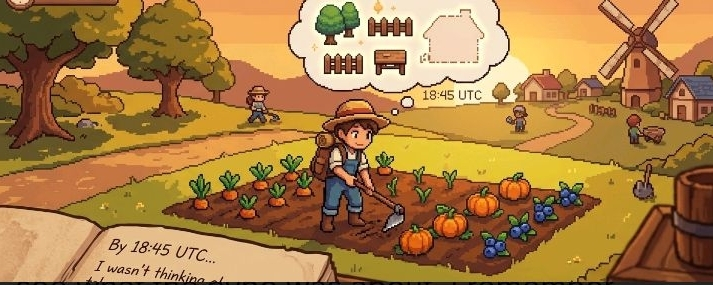
I didn’t expect much at first. Another Web3 game, another promise of ownership, another digital world trying to feel real. But then I stepped into Pixels, and something felt different. It wasn’t loud or overly polished. It didn’t try to impress me with complexity. Instead, it pulled me in slowly, almost quietly, until I realized I wasn’t just playing a game anymoreI was part of something alive.
Pixels runs on the Ronin Network, but what caught me wasn’t the technology behind it. It was the feeling. The world feels simple at a glance, almost nostalgic, like something familiar from older games. But beneath that simplicity, there’s a deeper rhythm. Every action feels connected. Farming, trading, buildingthese aren’t just tasks. They are small pieces of a larger system shaped by real people.
As I spent more time inside this world, I began to notice how natural everything felt. There’s no pressure to rush, no overwhelming systems thrown at you. Instead, Pixels gives you space. Space to explore, to grow, to understand things at your own pace. And in that space, something rare happensyou begin to care.
What surprised me most was how human it all felt. Behind every trade, every item, every piece of land, there is another person. Not a number, not an AI, but someone building their own path just like me. That’s where Pixels quietly shifts from being a game into something more meaningful. It becomes a shared world, shaped by effort, time, and emotion.
The PIXEL token isn’t just a featureit’s part of that living system. It moves through the world as players create value through their actions. But unlike many projects that focus only on earning, Pixels makes the experience come first. The economy exists because the world exists, not the other way around. That balance is what makes it feel stable, almost organic.
I found myself logging in not because I had to, but because I wanted to see what changed. What did other players build today? What new patterns were forming in the market? What opportunities appeared just because people were active and engaged? It’s this constant sense of motion that keeps the world from feeling static.
There’s also something quietly powerful about how Pixels avoids overcomplication. In a space where many projects try to impress with technical language and layered systems, Pixels stays clear and focused. It speaks in simple actions and visible outcomes. You don’t need to understand everything at onceyou learn by doing, and that makes the experience feel natural instead of forced.
Over time, I realized that Pixels isn’t trying to be the loudest project in Web3. It’s doing something smarter. It’s building trust through experience. It lets players discover value instead of telling them it exists. And that approach feels stronger, more lasting.
What makes this even more interesting is how the Ronin Network supports this growth without getting in the way. Transactions feel smooth, the system feels stable, and everything works quietly in the background. That invisible support allows the world of Pixels to stay front and center, exactly where it should be.
As I look at the broader Web3 space, I see many projects chasing attention. But Pixels is doing something else entirely. It’s building a world that people return tonot for hype, but for connection. And that difference matters more than it might seem.
I didn’t just play Pixels. I experienced it. I watched it grow around me, shaped by people who cared enough to stay. And somewhere along the way, I stopped thinking of it as just a game.
It became a place.
