
#pixel $PIXEL @Pixels I didn’t take it seriously at first. The idea that we could “solve” identity online has been floating around for as long as I’ve been paying attention, and it always arrives dressed slightly differently. New primitives, new language, same underlying promise: finally, a way to know who’s on the other side.

This version just feels more… committed.
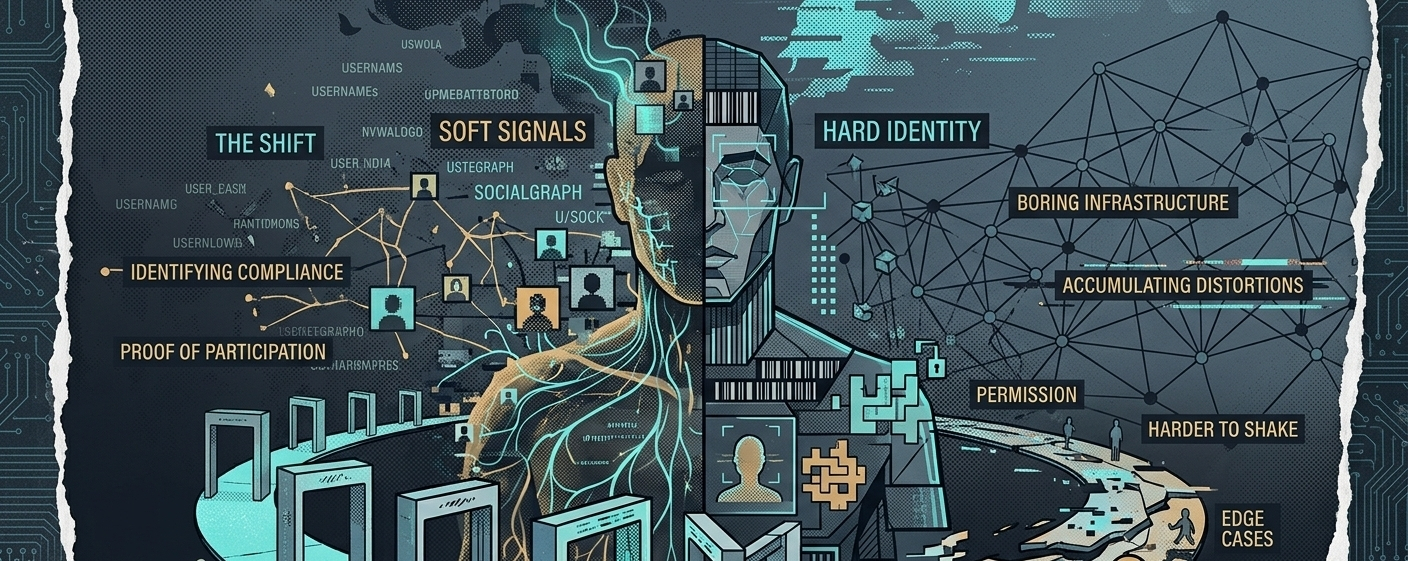
I keep coming back to that. The shift from soft signals — usernames, reputations, social graphs — to something harder. Something that tries to anchor identity in a single, persistent reference point. Not who you say you are, but proof that you exist in a way the system can recognize and reuse.
At a distance, it sounds clean. Almost necessary, given how noisy everything has become. Bots, sybils, farms of accounts all blending together until participation itself starts to feel cheap.
But up close, it’s less clean.
Because the system isn’t really identifying people. It’s identifying compliance. It rewards those willing to pass through whatever gate is set — scan this, verify that, link here. And over time, that behavior starts to look like identity itself. Not who you are, but what you’ve done to be accepted.
Maybe that’s too harsh. There’s a real problem here. Anyone who’s tried to distribute something fairly onchain runs into it almost immediately. You want uniqueness, but you don’t want friction. You want openness, but you can’t ignore abuse. So you start tightening things, little by little.

And eventually, you end up here.
What I find harder to shake is how these systems behave once they’re widely relied on. Not when they’re small and experimental, but when actual value depends on them. Access, money, coordination — all tied to whether the system recognizes you as “real.”
That’s where things start to feel uncomfortable.
Because now the edge cases matter more than the average case. The person who can’t or won’t verify. The false positive. The false negative. The regions, the devices, the quirks of infrastructure that quietly exclude people without announcing it.
And the system doesn’t really have a language for that. It just outputs a result.
I’ve seen similar dynamics before, just in less permanent forms. Credit systems, platform reputations, even early KYC pipelines. They all start with the same intention: reduce uncertainty. And they do, for a while. Until they start shaping behavior in ways that weren’t planned.

People adapt. They always do.
They find the shortest path through the rules. They cluster around whatever signal is being measured. And slowly, the signal stops meaning what it originally did. It becomes a proxy for something else — access, incentives, sometimes just survival inside the system.
I keep wondering what happens when this kind of identity layer becomes boring infrastructure. When no one questions it anymore, they just build on top. Does it stabilize into something reliable? Or does it accumulate small distortions that only show up under stress?
It’s hard to tell from here.
What I do notice is how quickly “proof of personhood” turns into “proof of participation,” and then into something closer to permission. Not explicitly. Just… gradually.
And once that shift happens, it’s difficult to reverse.
