
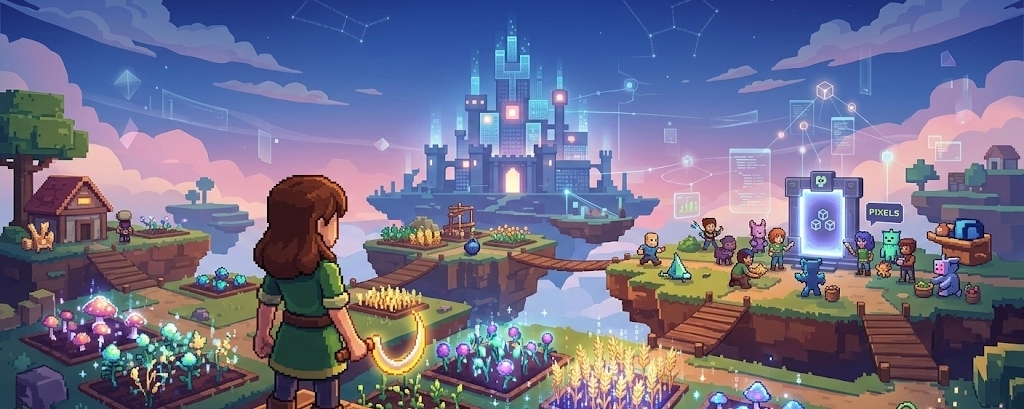

Why would I spend real time growing something that doesn’t physically exist?
That question didn’t feel philosophical when it first came to me. It felt practical, almost dismissive. I had opened Pixels expecting a familiar loop — plant, wait, harvest, repeat. Something light, something forgettable. But after a few sessions, I noticed I wasn’t treating it like something disposable. I was returning with intent. Not urgency, but continuity. That was new.
At first, I couldn’t explain why it felt different. The actions themselves weren’t revolutionary. Farming mechanics have existed for years, polished and repackaged in countless games. Yet here, something subtle kept pulling my attention forward. It wasn’t the crops. It was what seemed to sit behind them.
I started wondering what exactly I was accumulating. In most games, progress is a closed loop. You earn, you upgrade, and eventually you stop. Everything remains inside the system, valuable only as long as you stay. But here, the idea of “keeping” something felt less temporary. Not because it was rare or difficult, but because it didn’t seem entirely dependent on the game itself.
That’s when the structure behind it began to matter.
The assets I interacted with weren’t just entries in a database controlled by a single developer. They existed on a network that allowed them to move, persist, and be recognized beyond the game’s immediate environment. I didn’t need to fully understand the architecture to feel its effect. What changed was not the object, but the permission attached to it. I wasn’t just using things. I could hold them, transfer them, even leave with them.
That realization didn’t make the experience better or worse. It made it heavier.
Because once something carries weight outside the game, behavior shifts almost automatically. I found myself thinking less about what was fun in the moment and more about what made sense over time. Efficiency started to matter. Timing started to matter. Even patience started to feel like a strategy rather than a passive state.
And then I noticed something else. I wasn’t the only one adjusting.
Other players weren’t just moving through the world casually. They were organizing, sharing information, comparing outcomes. Not in a competitive, aggressive way, but in a way that suggested they were all responding to the same underlying signal. The system wasn’t telling them to collaborate. It simply made collaboration useful.
That’s when I realized the game wasn’t just presenting mechanics. It was shaping incentives.
Once rewards connect to something external, even loosely, the boundary between playing and participating becomes less clear. Actions begin to carry implications beyond immediate enjoyment. And yet, it didn’t feel like work either. It sat somewhere in between, not fully defined.
This ambiguity made me curious about control.
Who actually decides how this world evolves? It didn’t feel entirely centralized, but it wasn’t completely open either. There were developers guiding the structure, adjusting parameters, maintaining stability. But there were also players influencing direction, sometimes directly, sometimes indirectly through collective behavior. The system seemed to respond not just to design, but to pressure.
That tension felt important.
Because as more people enter a system like this, small decisions start to scale. What works for a few hundred players might behave differently with thousands. Resource distribution changes. Economic balance shifts. Social dynamics become more complex. Incentives that once aligned can start pulling in different directions.
I began to see the design less as a static product and more as something that evolves under stress.
And that’s where my confidence started to loosen.
A lot of what makes this system function depends on assumptions that aren’t guaranteed. That players will continue to engage in good faith. That the economy won’t tilt too heavily toward early participants. That adjustments will be made quickly enough to maintain balance. That the underlying infrastructure will remain secure under increasing demand.
None of these are visible when you’re just planting crops. But they quietly shape everything that happens around it.
So instead of asking whether this kind of system works, I found myself asking what conditions allow it to keep working. And more importantly, what signals would suggest that it’s starting to drift.
If new players begin to feel like they’re arriving too late, something shifts. If participation becomes more about extraction than contribution, something changes. If decision-making slows down as more voices enter the system, friction builds in ways that aren’t immediately obvious but gradually become harder to ignore.
At the same time, there’s another possibility. That these systems don’t break in obvious ways, but instead evolve into something we don’t yet fully understand. Something that isn’t purely a game, and not quite a marketplace either.
I’m not sure which direction this leads.
But I’ve stopped thinking of Pixels as a place where I grow crops. That part feels almost incidental now. What I’m really interacting with is a set of rules that tries to balance ownership, participation, and coordination at the same time.
And I’m still trying to figure out what that balance actually produces — not in theory, but over time.
