
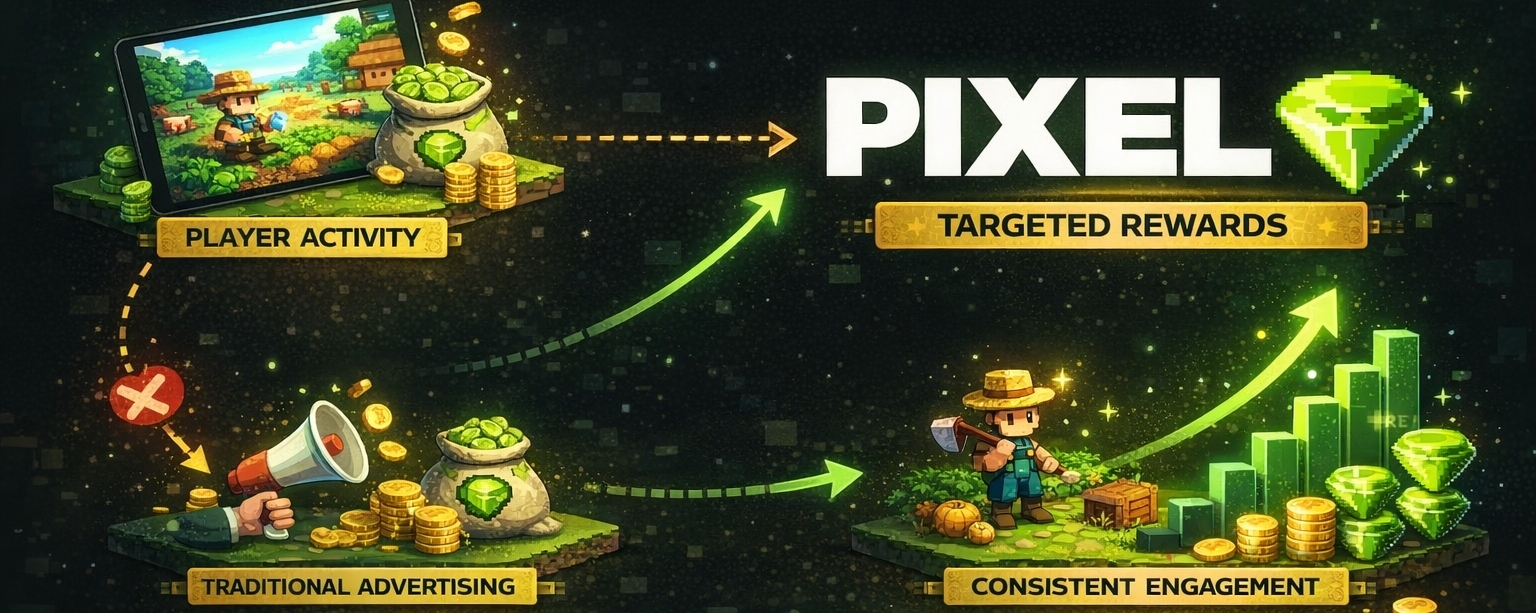
I didn’t really think about how much money gets wasted trying to get people into games until I saw a friend install one, play for maybe six minutes, then never open it again. No frustration, no complaint. Just… done. And somewhere in the background, that install probably cost real money to acquire.
That moment stuck with me more than it should have.
Because when I look at something like $PIXEL, I don’t see that same urgency to pull people in at all costs. It feels slower. Almost patient. Like the system doesn’t fully commit to you at the start. It waits a bit. Watches what you do. Then, only then, it starts giving more.
At first glance, it still looks like a normal reward loop. You play, you earn tokens, you use them. Nothing new. But after spending some time observing how people actually interact with it, I started noticing something slightly off. Not wrong. Just… selective.
Not everyone gets treated the same way over time.
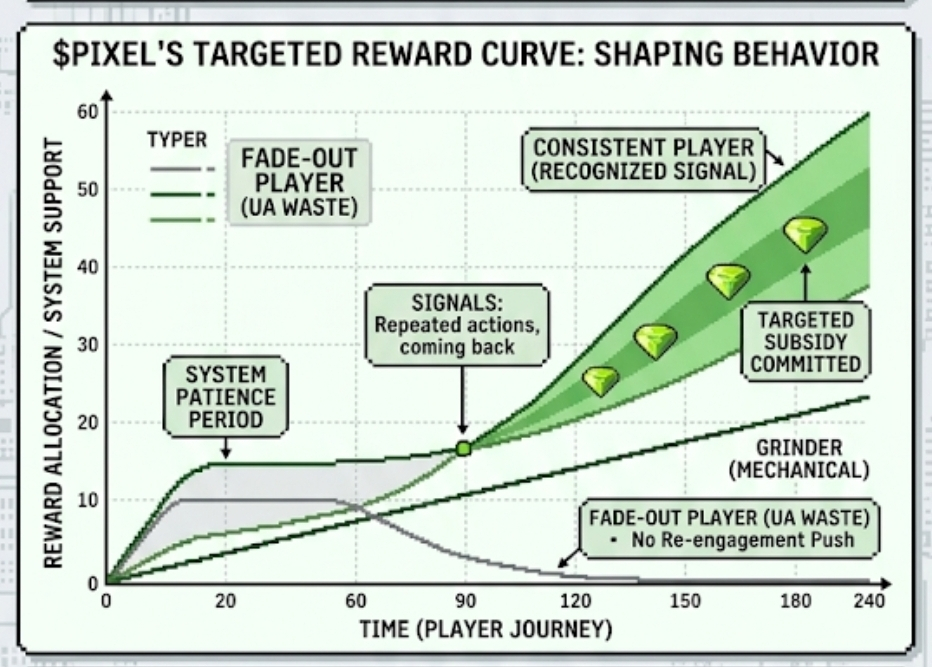
And I don’t mean in an obvious, unfair way. It’s quieter than that. Some players seem to get pulled deeper into the system, almost like the game starts leaning toward them. Others just fade out without resistance. No push to bring them back, no aggressive re-engagement tactics like you see in typical mobile games.
Which made me rethink what’s actually happening here.
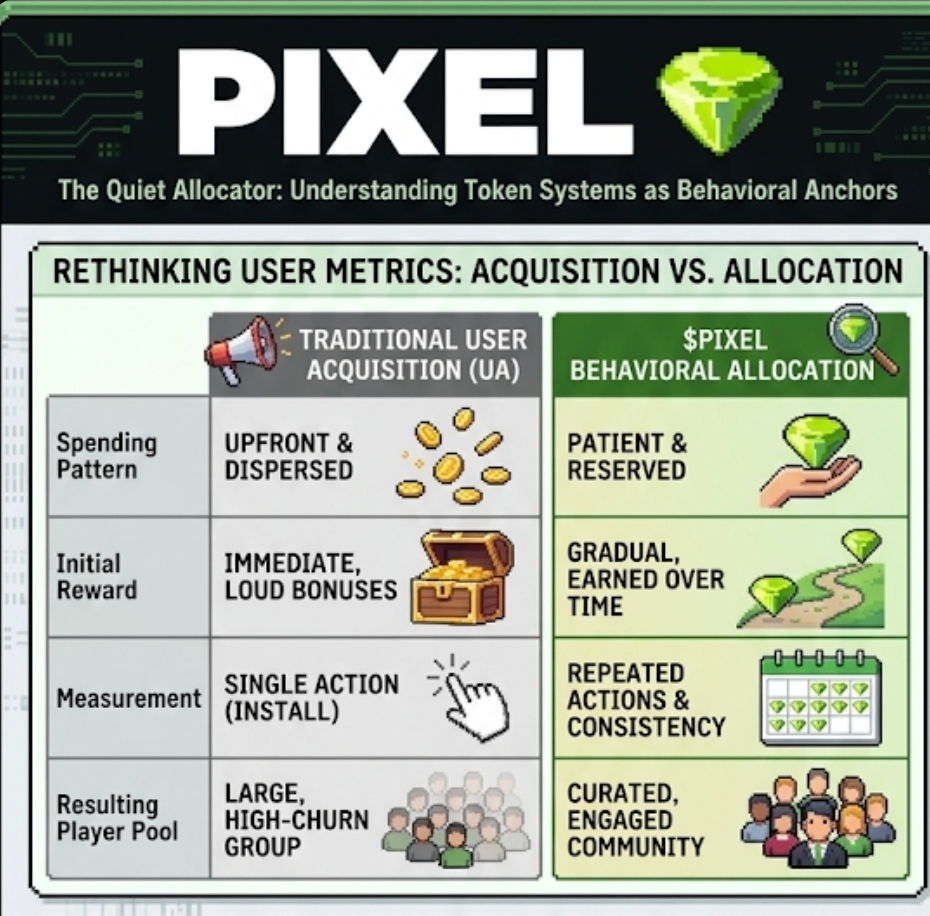
Traditional user acquisition is loud. Ads everywhere, bonuses upfront, sometimes even fake urgency. The idea is simple: bring in as many people as possible, then hope a small percentage stays. Most don’t. Everyone in the industry knows this, but it’s accepted as part of the cost.
$PIXEL doesn’t seem to follow that pattern directly. It doesn’t chase attention in the same way. Instead, it feels like it waits for a certain type of behavior to show up first. Small signals. Coming back the next day. Repeating actions. Not in a mechanical grinding way, but in a way that suggests the player is settling in.
And then the system reacts.
Not instantly. Not dramatically. But enough to be noticeable if you’re paying attention.
Rewards start to feel less like a flat distribution and more like… targeted support. That’s the closest way I can describe it. Almost like the system is deciding, “this player is worth extending a bit more value toward.” Not because they’re the best, but because they’re consistent in a way the system understands.
That’s where it starts to feel less like advertising and more like subsidy.
Which is a strange shift if you think about it. Instead of spending heavily to attract everyone, the system seems to reserve its “budget” for players who already show signs of sticking around. It’s not buying attention upfront. It’s reinforcing behavior after it appears.
I’ve seen something similar outside of gaming, actually. On Binance Square, for example. When I first started posting, I thought visibility was random. But after a while, patterns showed up. Certain types of posts, certain tones, even timing, they started getting picked up more by the system.
There’s no clear manual explaining it. But you feel it. The ranking system, the engagement metrics, the way AI seems to evaluate what counts as “valuable” content. It doesn’t push everyone equally. It leans toward what it can measure and recognize.
So people adjust. Not always consciously. But slowly, you start writing in a way that fits what the system rewards. Not because you’re forced to, but because the feedback loop is there.
$PIXEL gives me a similar feeling.
It’s not just rewarding players. It’s shaping them, a little at a time. Encouraging behaviors that are easy to track, easy to repeat, easy to build around. And maybe ignoring the ones that don’t fit neatly into those patterns.
That’s where things get a bit uncomfortable for me.
Because while this approach is probably more efficient, less wasted spending, more focused support, it also narrows the definition of what counts as “valuable.” And that definition is decided by the system, not the players.
So if your playstyle doesn’t align with what the system recognizes, you might just… not get pulled in. Not because you’re doing anything wrong, but because you’re harder to categorize.
And most players won’t even notice this happening. They’ll just feel that some paths seem more rewarding than others, and naturally drift toward them.
Which, over time, shapes the entire ecosystem.
So yeah, Pixel might still look like a simple in-game currency. But I can’t really see it that way anymore. It feels more like a quiet allocator. A system deciding where its support goes, based on behavior that fits its internal logic.
And I’m not fully sure if that makes the system more fair… or just more controlled in a way that’s harder to see.