
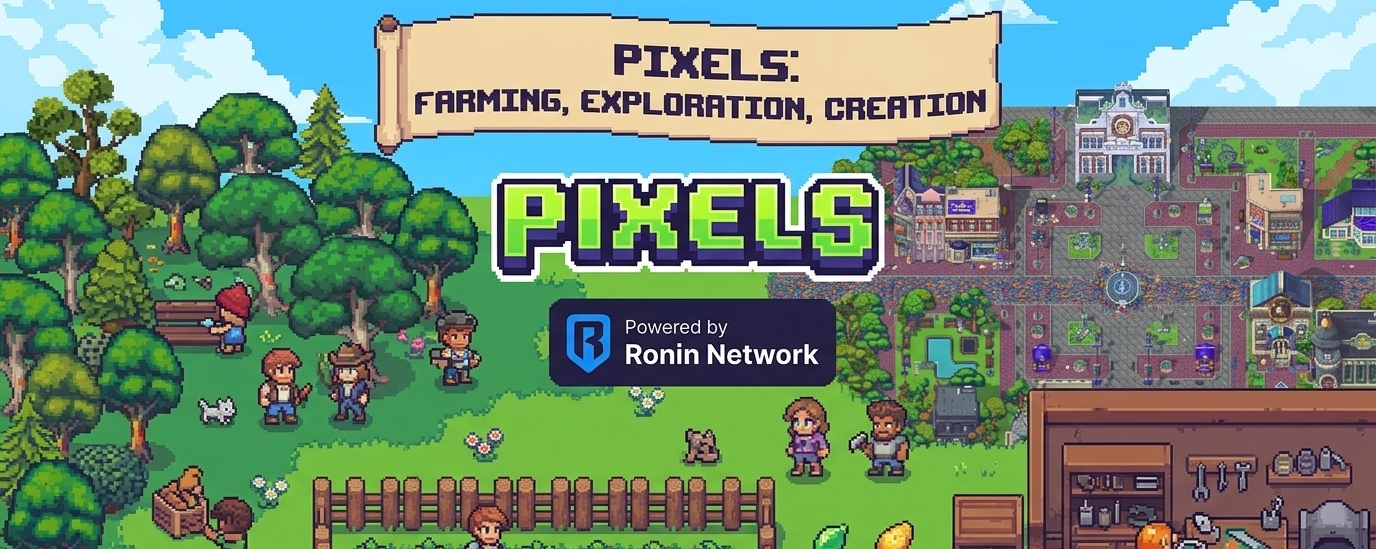

Why would anyone spend hours farming in a game if the harvest doesn’t stay inside the game? That question kept bothering me long after I logged out. I wasn’t confused about farming mechanics or progression systems—I’ve played enough games to recognize those patterns. What I couldn’t shake was the feeling that something else was happening underneath, something that made the act of planting digital crops feel… heavier than it should.
At first, I thought maybe it was just the novelty of earning something that had value outside the game. But that explanation didn’t go far enough. Plenty of games have rewards, currencies, even marketplaces. What felt different here was not the presence of value, but the way it changed how I approached every small decision. I wasn’t just playing anymore. I was calculating, even when I didn’t want to admit it.
That’s when I started noticing how quickly behavior shifts when outcomes are no longer contained. If what you earn can be traded, saved, or compared beyond the game, then your time stops feeling disposable. You hesitate before experimenting. You start optimizing routes, tracking returns, thinking in loops that resemble work more than play. It’s not that the system forces you to behave this way—it simply makes it possible. And once it’s possible, it becomes difficult to ignore.
So I tried to understand what exactly was being rewarded. Was it skill? Not entirely. There was some efficiency involved, but it wasn’t the kind of mastery you associate with competitive games. Was it time? Partly, but even time didn’t feel like the full story. The more I looked, the more it seemed like the system was rewarding awareness—knowing when to act, what to hold, what to convert, and when to step back. It felt less like farming and more like managing uncertainty.
That realization made me look at the structure differently. Farming wasn’t the point; it was the interface. Beneath it was a system where resources moved, values shifted, and decisions carried weight beyond immediate outcomes. The simplicity of planting and harvesting was just a surface layer masking something more dynamic. And once I saw that, I couldn’t unsee it.
But then another question followed almost immediately. If awareness and timing matter this much, what happens to fairness? It’s easy to assume that everyone starts from the same place, but that assumption doesn’t hold for long. Some players arrive earlier, when systems are less crowded and opportunities are easier to capture. Others arrive later, when paths are more defined and margins are thinner. The system doesn’t announce this difference—it just quietly rewards those who happen to align with its early phases.
That doesn’t necessarily make it unfair. It just means it’s optimized for something specific: participation at the right moment. And that optimization has consequences. It changes how people talk about the game, how they approach entry, how they measure success. It also creates a subtle pressure to not just play, but to keep up.
Ownership adds another layer to this. When I first encountered the idea of owning land or assets, it sounded straightforward—control, permanence, identity. But that idea becomes more complicated when ownership is also liquid. If you can exit at any time, if your assets can be sold or transferred with minimal friction, then ownership starts to behave less like a commitment and more like a position. Something you hold until it makes sense not to.
That shift is small, but it changes behavior in noticeable ways. People start thinking in terms of timing exits rather than building long-term structures. Utility competes with optionality. And over time, it becomes less clear whether assets are being used or simply positioned.
The more I paid attention, the more I saw how the surrounding market begins to influence the experience itself. If certain activities become more valuable, players naturally gravitate toward them. Diversity of play narrows, not because the system restricts it, but because incentives quietly guide everyone in the same direction. The game doesn’t lose its variety—it just becomes less visible in practice.
This is where scale starts to matter. With a small number of participants, these patterns feel manageable, almost invisible. But as more people enter, the system has to respond. Rewards adjust, balances shift, and what once felt stable begins to move. At that point, the role of the designer changes too. They’re no longer just shaping gameplay—they’re influencing an economy, whether they intend to or not.
That realization made me pause. Because if adjustments affect value, and value affects behavior, then every change carries weight beyond design. It becomes a form of governance, even if it isn’t framed that way. And once that layer exists, the system is no longer just something you play—it’s something you navigate.
Not everyone will find that comfortable. Some people will enjoy the flexibility, the sense of control, the ability to adapt and respond. Others will find the uncertainty distracting, even exhausting. Neither reaction feels wrong. They just reflect what the system prioritizes and what it leaves behind.
I’m still not sure what to make of it. There are parts that feel intuitive, even compelling, and others that feel unresolved. I don’t know how it behaves over longer periods, or what happens when early advantages fade and new patterns emerge. I don’t know whether the balance between play and strategy stabilizes or continues to shift.
What I do know is that I can’t look at it the same way anymore. I don’t see just a farming loop. I see a set of incentives, a flow of decisions, a structure that quietly shapes how people act without ever telling them how to act.
And maybe that’s the only useful way to approach it for now—not by deciding what it is, but by watching what it does. By asking what happens when rewards change, when participation grows, when expectations evolve. By paying attention to who stays, who leaves, and why.
The answers aren’t obvious yet. But the questions are getting sharper.
