
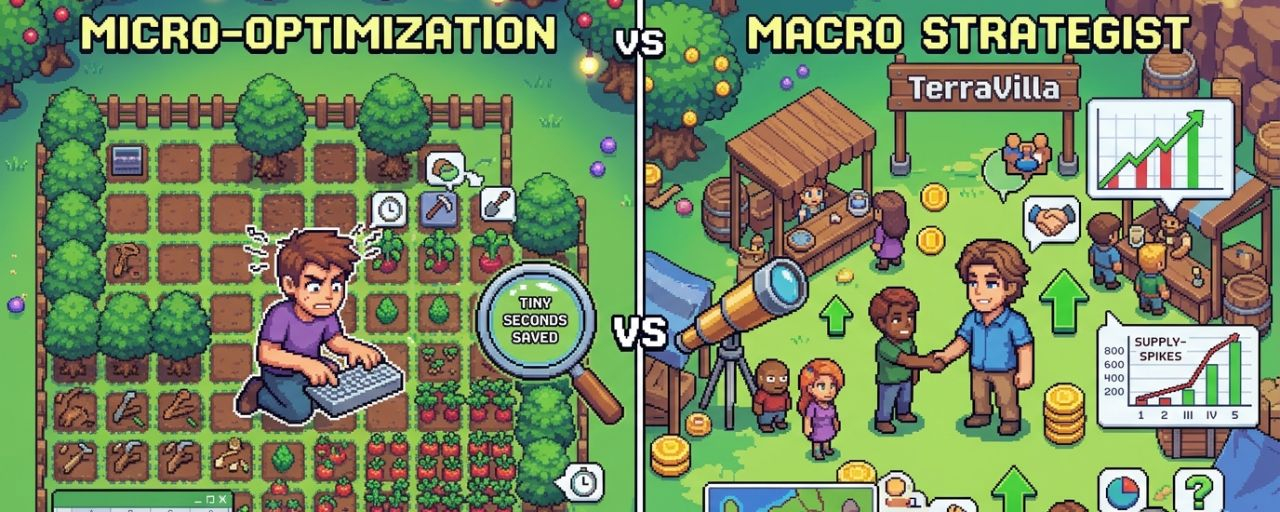

In any resource-based game like Pixels, players naturally want to be efficient. No one enjoys wasting time, energy, or in-game currency. So they dive into forums, watch tutorial videos, and learn small tricks to save a few seconds here or a few berries there. These small improvements are called micro-optimizations, and they feel great. You learn to click faster, arrange your farm in a tighter grid, or water your crops in a specific pattern that saves two steps per row. Over a single gaming session, these tiny gains add up to maybe five or ten minutes saved. That feels like progress, and it is. But here is the trap that most Pixels players fall into: they spend all their mental energy on micro-optimizations while completely ignoring macro strategy, and that mistake costs them far more than any misplaced crop ever could.
To understand why, imagine you are running a small farm in real life. Micro-optimizations would be things like sharpening your hoe to cut cleaner furrows or arranging your tools on a pegboard so you grab them faster. Useful, yes. But macro strategy would be deciding what crop to plant based on market prices, when to sell for the highest profit, and whether to expand your land or rent it out to others. In Pixels, micro-optimizations are about clicking efficiency, inventory management, and reducing travel time. Macro strategy is about understanding the game's economy, your own long-term goals, and where the real value is being created. Most players ignore the big picture because it is harder to see and requires thinking beyond the next harvest.
Let us start with a concrete example from Pixels. A typical player might spend hours researching the perfect placement of their trees and soil plots to minimize walking distance. They rearrange their entire farm to save three seconds per harvest cycle. That is a micro-optimization. And it works. Over one hundred harvests, they save five minutes. That feels like a win. But in that same time, they never stopped to ask whether planting those trees was even a good idea. Maybe the current market price for wood is at an all-time low because everyone else is also chopping trees. Maybe the berries they spent on seeds could have been used to buy a tool that unlocks a completely different resource with higher margins. The micro-optimizer saves three seconds per harvest but loses thousands of berries by choosing the wrong crop entirely.
Another common trap involves energy management. In Pixels, your character has limited energy that regenerates slowly or requires consuming food. Many players micro-optimize their energy usage by calculating exactly which food gives the most energy per berry spent. They make spreadsheets comparing berry smoothies to carrot juices to mushroom stews. This is detailed, careful work that feels very strategic. But macro strategy asks a different question: should you even be spending your own energy at all? Perhaps you could hire another player to do the manual labor on your land while you focus on a higher-value activity like crafting rare items or trading on the marketplace. The micro-optimizer saves five percent on energy costs. The macro thinker doubles their income by changing what they do with their time.
The marketplace in Pixels is where macro strategy truly separates successful players from the struggling ones. Most players treat the marketplace as a simple shop: they sell what they have and buy what they need. They might micro-optimize by checking prices at different times of day to catch small dips. But macro strategy involves understanding supply and demand cycles. For example, when a new crafting recipe is announced, smart players buy up the required resources before the crowd does, then sell them at triple the price a week later. Or they notice that most players only farm during their own evening hours, so resource prices drop at certain times and rise at others. A macro player does not just react to prices; they anticipate them.
Time is the most overlooked resource in Pixels, and this is where micro-optimizations can actually become harmful. A player who spends an hour rearranging their farm to save three seconds per harvest will need hundreds of harvests just to break even on that hour. That hour could have been spent exploring a new zone, completing a quest chain that unlocks a permanent passive income upgrade, or building relationships with other players who share valuable market information. Micro-optimization often steals time from activities that have much higher long-term returns. It feels productive because you are actively doing something, but in reality, you are trading a large chunk of time now for a tiny trickle of time savings later.
The social dimension of Pixels is another area where macro thinking crushes micro-optimization. A player who focuses on clicking efficiency might never talk to anyone. They solo their way through the game, proud of their self-sufficiency. But the macro player joins a guild, makes friends with a high-level crafter, and negotiates a deal: they supply raw materials in exchange for a share of the crafted items' sale price. Suddenly, they are earning without doing any crafting themselves. Or they find a player who hates farming but loves mining, and they set up a trade agreement. These relationships are not measured in seconds saved. They are measured in entire new income streams. No amount of clicking faster can compete with a good partnership.
Quest progression is another classic blind spot. Many players micro-optimize each individual quest, trying to complete it in the fewest steps possible. They look up guides, follow strict paths, and check off tasks efficiently. But they never ask whether they should be doing those quests at all. Some quest lines lead to dead ends, offering small one-time rewards that are worthless compared to the time invested. Other quest lines unlock game-changing abilities, like the ability to craft a rare tool or access a hidden zone with better resources. The macro player reads ahead, prioritizes high-impact quests, and skips or delays the rest. They might take longer on each individual task, but they finish the important ones first and leave the busywork for later or never.
Inventory management is a perfect case study in this tension. Micro-optimizers obsess over bag space. They arrange their inventory in specific grids, discard cheap items immediately, and run back to storage the moment they have a free slot. They save maybe thirty seconds per inventory run. Macro players ask a different question: why am I running back at all? Perhaps they should invest in a storage expansion early, even if it costs a lot of berries, because it saves hundreds of future trips. Or perhaps they should stop collecting low-value items entirely. If an item sells for one berry each, picking it up is almost never worth your time, regardless of how efficiently you manage your bags. The macro player does not optimize the act of carrying junk; they simply stop picking up junk.
The concept of opportunity cost is central to understanding this problem. Every minute you spend in Pixels doing one thing is a minute you are not spending doing something else. Micro-optimizations try to make your current activity take less time, which is good. But macro strategy asks whether you should be doing that activity at all. If farming wheat earns you ten berries per minute and trading earns you one hundred berries per minute, it does not matter how efficiently you farm wheat. You will never catch up. The most perfectly optimized wheat farm is still worse than a sloppy, inefficient trading session. Most players never calculate these opportunity costs. They do what feels familiar and comfortable, then wonder why they are falling behind.
The game's updates and patches are another place where micro-optimizers get trapped. When the developers change a recipe or adjust a resource spawn rate, micro players panic and recalculate their exact clicking patterns. They adapt quickly to the new numbers. Macro players, however, read the patch notes and ask what the developers are trying to encourage. If the developers nerf wood prices, they are probably trying to push players toward a different resource. The macro player follows that signal, moving into the newly valuable area before the crowd catches on. They do not fight the game's design; they flow with it. This requires stepping back from the details and seeing the broader direction of the game's economy.
Beginners in Pixels are especially vulnerable to micro-optimization traps. They see experienced players moving fast and clicking precisely, so they assume that speed and precision are the keys to success. They practice their clicks, memorize keyboard shortcuts, and copy farm layouts from online guides. But what they do not see is that those experienced players already made their macro decisions months ago. They already chose which skills to level, which land to buy, and which social networks to join. The fast clicking is just the visible surface. The real advantage is invisible, baked into choices made long before the first seed was planted. Beginners copy the surface and ignore the foundation, which is like copying a champion's shoe-tying technique without understanding their training regimen.
Burnout is a real risk for micro-optimizers. When you focus on tiny efficiency gains, you turn the game into a job. Every second feels wasted. You stress over small mistakes, reload saves, and constantly compare yourself to theoretical maximums. The game stops being fun. Macro players, ironically, often have a more relaxed experience. They set broad goals, make strategic bets, and accept that small inefficiencies do not matter in the big picture. They might spend ten minutes just talking to other players or exploring a new area without calculating the berry-per-minute ratio. That exploration might lead to discovering a hidden resource node that becomes their main income source for weeks. Relaxation can be strategic.
Let us look at a real numbers example. Suppose a micro-optimizer spends ten hours perfecting their farm layout and clicking pattern, increasing their berry income by five percent. If they were earning one thousand berries per hour before, they now earn one thousand fifty. Over one hundred hours of gameplay, that extra fifty per hour adds up to five thousand extra berries. That is real. Now consider a macro player who spends that same ten hours not on optimization but on research. They discover that a specific rare resource is about to spike in price because a new recipe is coming. They invest their one thousand berry per hour income into buying that resource early. When the price doubles, they sell for a profit of ten thousand berries in a single trade. The macro player did not earn more per hour; they earned more per decision. And that is the core difference.
The sad truth is that most players will never escape micro-optimization because it feels safe. Macro strategy requires taking risks, making bets, and sometimes being wrong. You might invest in a resource that never spikes. You might join a guild that falls apart. You might skip a quest that turned out to be important. Micro-optimization has no risk. If you save two seconds per harvest, that gain is guaranteed. So players cling to tiny, certain gains while ignoring the large, uncertain ones. But in a game like Pixels, where the economy is driven by player behavior and developer updates, the large uncertain gains are where the real wealth is created. Playing it safe is the riskiest strategy of all.
So how do you stop being a micro-optimizer and start thinking macro? The first step is to track your time honestly. Do not ask how many berries you earned per hour. Ask what you would have done if you could not play the game at all for a week. That reveals what actually matters. The second step is to set a goal that is not measured in berries. Maybe you want to own a piece of land in the best zone, or unlock a rare crafting skill, or build a trading reputation. Micro-optimizations rarely help with big goals. Macro moves do. The third step is to spend ten percent of your playtime doing nothing productive. Talk to strangers. Explore the edges of the map. Read patch notes from six months ago. That is where the real opportunities hide.
In the end, @Pixels rewards macro thinking far more than micro perfection. The players who build wealth and influence in the game are rarely the ones with the fastest clicks or the neatest farms. They are the ones who understand the economy, anticipate changes, build relationships, and make big bets. They accept small inefficiencies as the price of seeing the larger picture. The micro-optimizer saves three seconds per harvest and feels clever. The macro player changes what they harvest entirely and becomes rich. Both are playing the same game, but only one is playing the real game. The other is just moving pieces on the board while ignoring the rules of the match. Do not let that be you. Step back, look up, and ask not how to do what you are doing faster, but whether you should be doing it at all.