
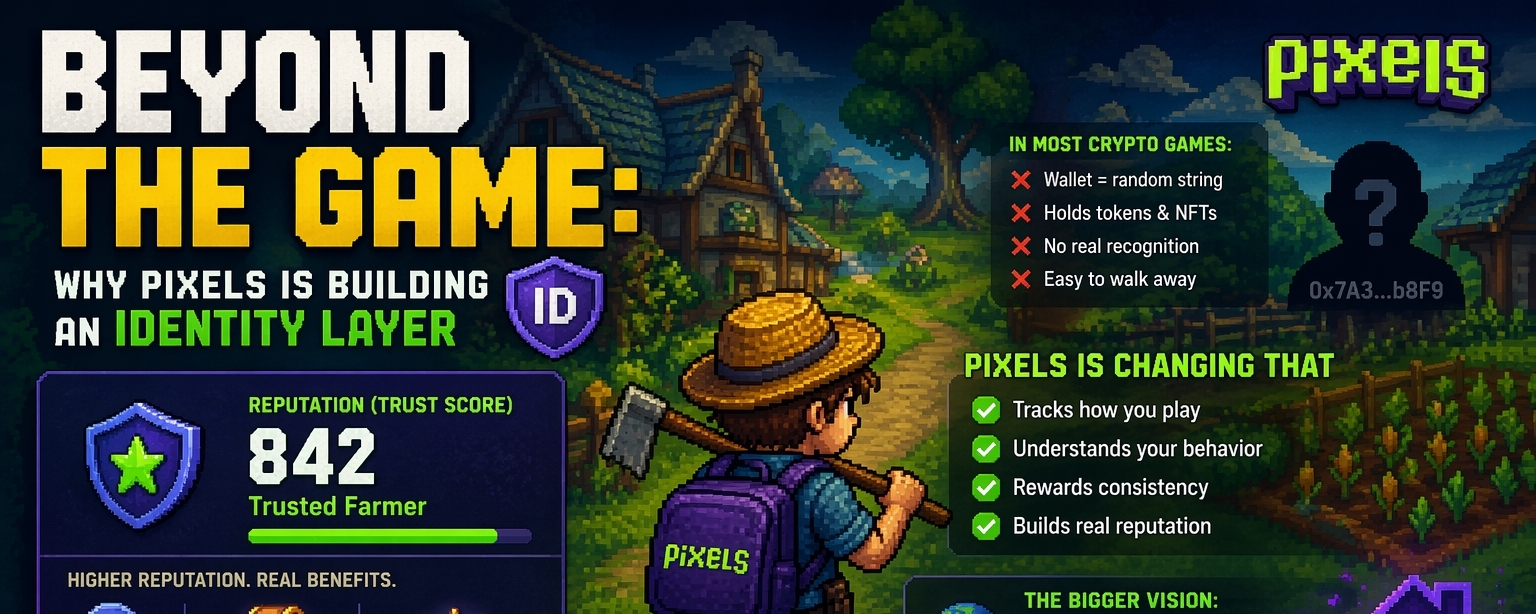
We usually talk about farming, land prices, or token swings. But something quieter and more important has been taking shape in Pixels for a while now.
In most crypto projects, your wallet is just a random string of characters. It holds your coins or NFTs, and that's pretty much it. Your history, your effort, and how you actually behave inside the project barely matter.
Pixels is trying to change that.
Through Stacked and its underlying systems, the game doesn't just track what you own. It starts to understand who you are as a player. How consistent you are. How long you stick around. How you interact with the land, with quests, with other people. All of that is slowly building into something bigger than a simple profile.
They call it Reputation (sometimes referred to as Trust Score). You can see your own score right on the dashboard. It isn't just a vanity number. Higher reputation already gives real benefits — lower fees on certain actions, better reward rates, and recognition that loyal players actually get treated differently.
This is where it gets interesting.
In the real world, trust and reputation are everything. Banks give better rates to long-term customers. Employers hire people with proven track records. Communities give more weight to those who show up consistently. Pixels seems to be bringing that same logic into a digital farming world.
Right now, it's still early. Your reputation mostly reflects activity inside Pixels itself — consistent farming, quest completion, positive interactions, and avoiding behaviors that look like bot farming or short-term extraction. But the bigger vision is clear: make this identity portable. So your reputation and progress can travel with you across different games and experiences in the ecosystem instead of resetting every time.
If that actually works, $PIXEL stops being just another tradeable token. It becomes the fuel that powers reputation, access, and opportunity inside a growing network of games and tools.
Think about it. Most GameFi projects treat players as temporary visitors who come for rewards and leave when the yields drop. Pixels is betting on something different — turning players into citizens with a real stake and a visible history. Builders get recognized. Active contributors get rewarded differently. People who are just passing through get less.
That shift from "wallet = user" to "reputation + history = identity" is subtle, but it's one of the most ambitious things happening in Web3 gaming right now. It tries to solve the old problem of throwaway accounts and short-term thinking.
Of course, there are risks. If the system becomes too rigid, it might punish new players or feel unfair. If reputation becomes too easy to game, it loses all meaning. And if the whole thing feels like constant surveillance instead of fair recognition, people will push back.
Still, the direction feels deliberate. Pixels isn't just building prettier farms or flashier quests. It's quietly laying the groundwork for a system where your digital actions actually matter over time.
In a space full of quick pumps and faster dumps, that kind of patient infrastructure is rare.
So here's the real question I keep coming back to:
If your reputation and identity inside Pixels become more valuable than the tokens in your wallet... will you still treat this like just another game — or will it start feeling like a real digital home you actually care about protecting and growing?@Pixels $PIXEL $RAVE
