
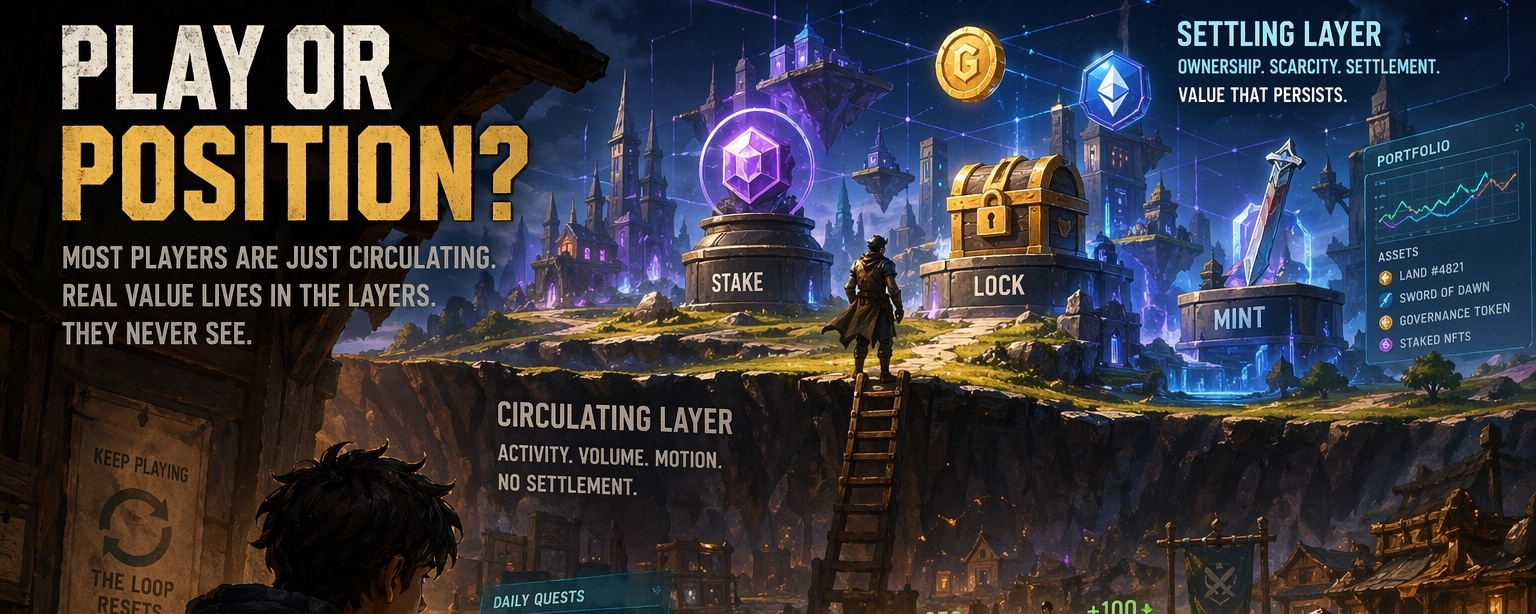
I didn't take dual-token economies seriously for a long time. They always looked the same from the outside. Two currencies, one soft and one hard, one that flows freely inside the game and one that costs something real to touch. The pattern is obvious once you've seen it twice. You earn the cheap one constantly, feel productive, feel like you're building toward something, and then eventually the thing you actually want requires the expensive one.
But somewhere in 2026 that framing started feeling insufficient.
Crypto gaming has shifted its focus away from speculation and token farming and toward gameplay quality, sustainability, and interoperability.
That's the official narrative, at least. And parts of it are true. The games look better. The loops are tighter. But I kept noticing something underneath all of that which the narrative doesn't really address.
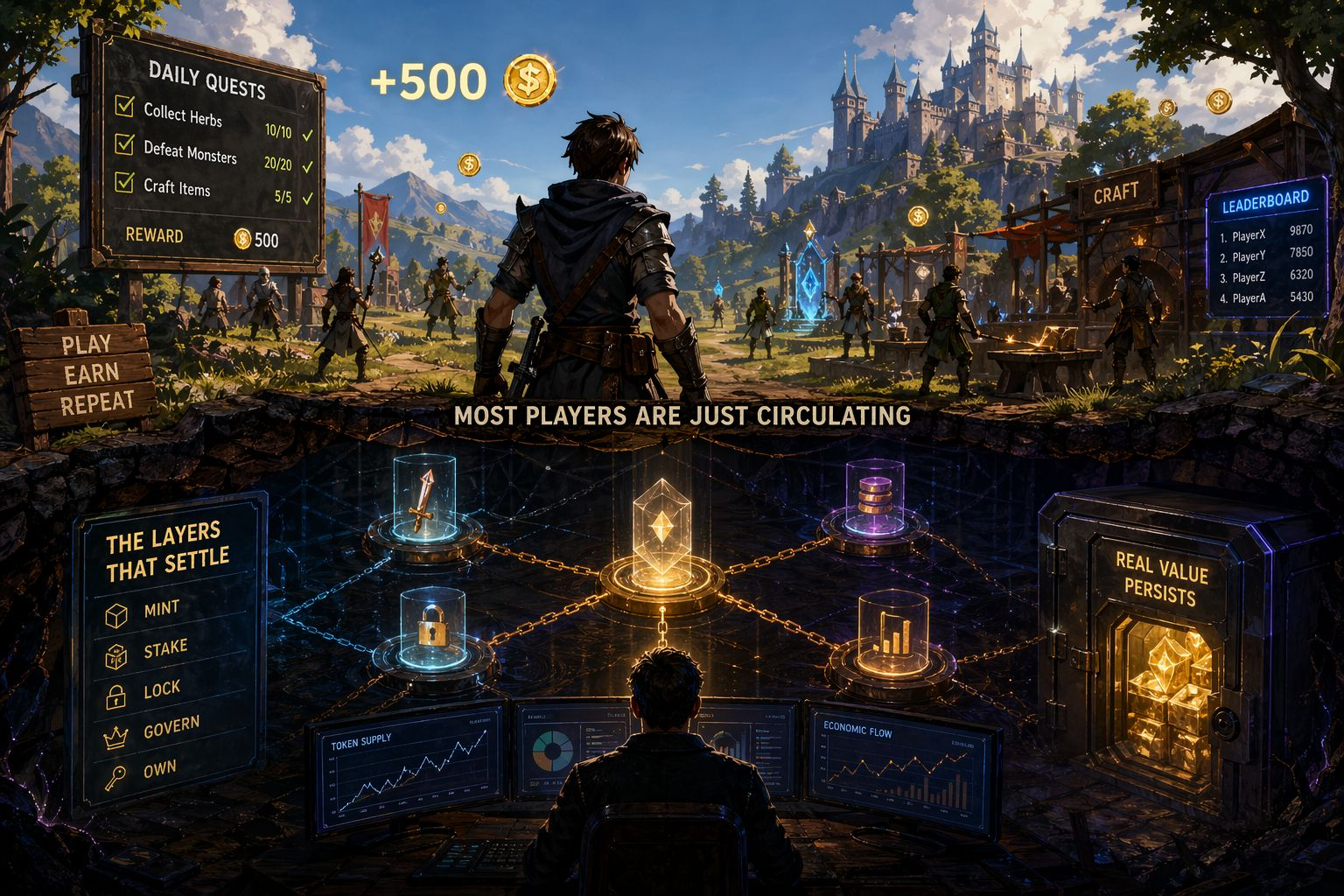
Most players in these ecosystems aren't earning. They're circulating.
There's a difference, and it took me a while to feel it clearly. Circulation means your activity is real, your time is real, the numbers move and respond to what you do, but nothing actually accumulates in a way that persists. You complete a quest, tokens arrive, tokens leave, the loop resets. It's motion without settlement. And for a long time that feels like progress because the feedback is immediate and the system never stops responding to you.
The earning part is somewhere else.
Once rewards touch DeFi layers, players are exposed to price swings, bugs in the code that hold funds, and rules that can lock tokens for a set time.
That's framed as a warning, but it's also quietly describing where the actual value mechanics live. Not in the gameplay loop itself. In what survives after the loop ends.
I started paying attention to which actions in these systems produce something that carries forward and which ones just keep the session alive. Most gameplay falls into the second category. It's activity that justifies the existence of the in game economy without putting real pressure on the on chain token. Which is by design, probably. The system needs volume to look healthy. Volume is easy when the soft currency has no friction.
But then something specific happens in certain places. Minting. Staking. Locking an asset into a structure that exists outside the daily loop. And suddenly the token behaves differently. Not more aggressively, just… weightier. Like it's connected to something that doesn't reset when you close the game.
Tokenized in-game assets now represent a large portion of blockchain gaming revenue, with rental and passive income mechanics continuing to grow.
That line sounds straightforward. But think about what it actually means for player experience. It means the economy that most players participate in, the visible one, the one with daily quests and craft loops and reward boards, isn't where the majority of value is being generated or stored. It's elsewhere, slightly above the surface players spend their time on.
And most players never look up.
This isn't a criticism exactly. It's just what layered economies do. The real earners in crypto gaming are those who treat it like an investment, diversifying across multiple titles.
That observation sounds like practical advice, but it also describes a structural split. One group plays. Another group positions. Both are inside the same system, both interacting with the same interface, but they're operating in fundamentally different layers of it.
In 2026, play to earn gaming continues shifting toward quality gameplay first, with crypto and NFT rewards as meaningful enhancements rather than the core attraction.
I understand why that framing exists. It makes the space sound mature. Less extractive. And in some ways it is. But it also quietly relocates where extraction actually happens. If the rewards aren't the point, then the point is something else. Ownership. Positioning. Being anchored inside the ecosystem in a way that soft-currency players aren't.
The uncomfortable version of this is that the game is not neutral about where you operate inside it. Two players can spend identical hours. One stays in the circulating layer, active, consistent, numbers always moving. The other steps occasionally into the parts that settle, that persist, that connect outward to something with a market behind it. The gap between those two players doesn't announce itself. It just accumulates quietly underneath.
And here is where the supply side matters more than the design does.
Even an elegant structure doesn't survive bad timing. If the parts of the system that consume governance tokens, staking slots, minted assets, don't grow alongside emission schedules, then pressure builds somewhere the design didn't plan for. I've seen this happen slowly enough that most players don't notice until the exit feels different than it used to.

The question I keep returning to is simple but uncomfortable. When you finish a session and something stays behind, something that belongs to you in a meaningful sense, what actually produced that. Was it what you did inside the game. Or was it which layer of the game you happened to be standing in when the system decided to let something through.
Those aren't the same thing. And most players are never told that they're different questions at all.
