
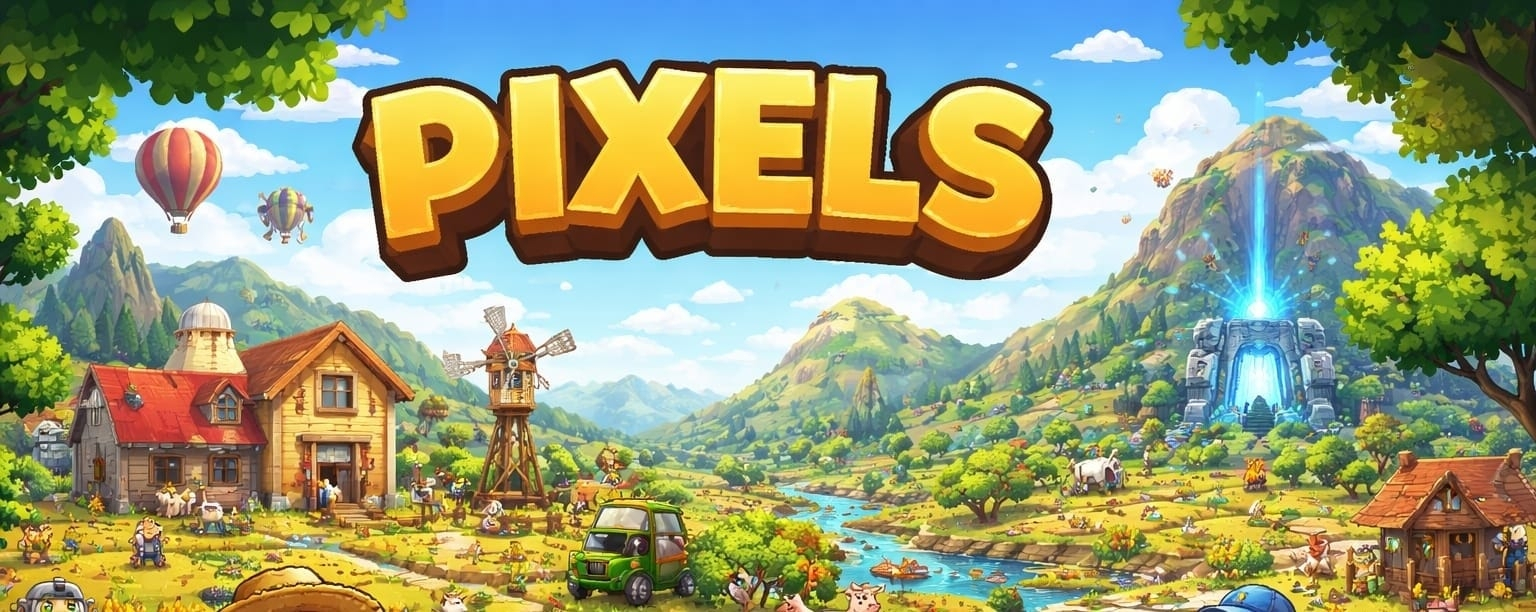
Honestly, it’s incredibly easy to write off Pixels if you just take a quick glance. I’ve watched it happen with so many projects. People see the farming mechanics, the token, the usual hype about rewards, and immediately toss it into the "just another GameFi fad" pile—the same pile full of projects that inflated themselves into irrelevance last cycle.
But I really don't think that's the whole story here.
What actually keeps me coming back is that Pixels isn't just built around gameplay. Sure, the game is the storefront. But look under the hood, and you'll see a system that is laser-focused on managing reward flows, slowing down the cash-grab extraction, and giving players actual reasons to stay in the ecosystem instead of just farming it dry and ghosting. In this market, that distinction is huge.
We've all seen this space confuse mere activity with actual strength. A spike in wallets and claimed rewards isn't traction; it's usually just the same capital bouncing around. A few months later, the momentum stalls, and everyone acts shocked. Pixels actually seems to get this trap.
I don't look at it as a basic play-to-earn setup. To me, it’s a system designed to manage human behavior. It’s about how you nudge users toward genuine participation instead of pure extraction. How do you keep the economy afloat when the initial hype dies down and the daily grind sets in? Most teams never solve this; they just slap on more token emissions to delay the inevitable until the chart tells the ugly truth. Pixels shows a lot more discipline than that. Not perfection, but real discipline.
It leans heavily on things like progression, digital identity, and reputation, which makes it feel way less random than the GameFi graveyard we’ve all witnessed. Don't get me wrong, it's not risk-free. But the team understands that financial rewards alone don't build loyalty. If the only goal is to extract value, players will drain it to zero—no matter how slick the branding is.
This is where Pixels starts to stand out for me. They know a sustainable ecosystem needs routine, belonging, and a reason to care. That’s harder to build, and definitely slower. Most teams simply don’t have the patience for it. I think Pixels might.
The social layer is so much more important than people realize. In weaker projects, "community" is just a buzzword for pitch decks while token emissions do all the heavy lifting. Once the emissions dry up, you realize the community was never really there. Pixels is trying to make the social experience actually matter—shared activity, a real sense of identity, and a feeling that you're part of a living world rather than just a temporary tourist chasing yield.
That approach gives the whole economy room to breathe. I've seen too many projects die from hyper-rewarding early adopters, faking growth, and hollowing out from the inside. Pixels isn't completely immune to that, but it’s actually fighting it at the fundamental design level instead of just praying the market won't notice.
That’s why I don't buy the "it's just a farming game" narrative. That’s a lazy read. The game is just the front layer; the real project is the underlying economy—the pressure points, the pacing, and the way value actually circulates instead of leaking out.
I’m not ignoring the risks; I’m actively looking for them. I want to see where the system might break. I’m looking for the moment the friction stops being useful and starts being annoying, or when users decide the loop just isn't worth the effort anymore. That’s the real test. Attracting attention is easy—plenty of dead projects did that.
What I care about is whether Pixels can keep people around without relying on the same tired, recycled reward loops that ruined the last wave of games. Can the economy actually carry its own weight once the easy-money crowd gets bored?
I don’t see Pixels as another throwaway token. I see an ambitious attempt to balance gameplay, social dynamics, and a sustainable economy without letting one element crush the others. That is an incredibly hard thing to pull off. Usually, it's too hard.
Still, this one feels far from careless. And in a market like this, sometimes that’s enough to keep my attention.