
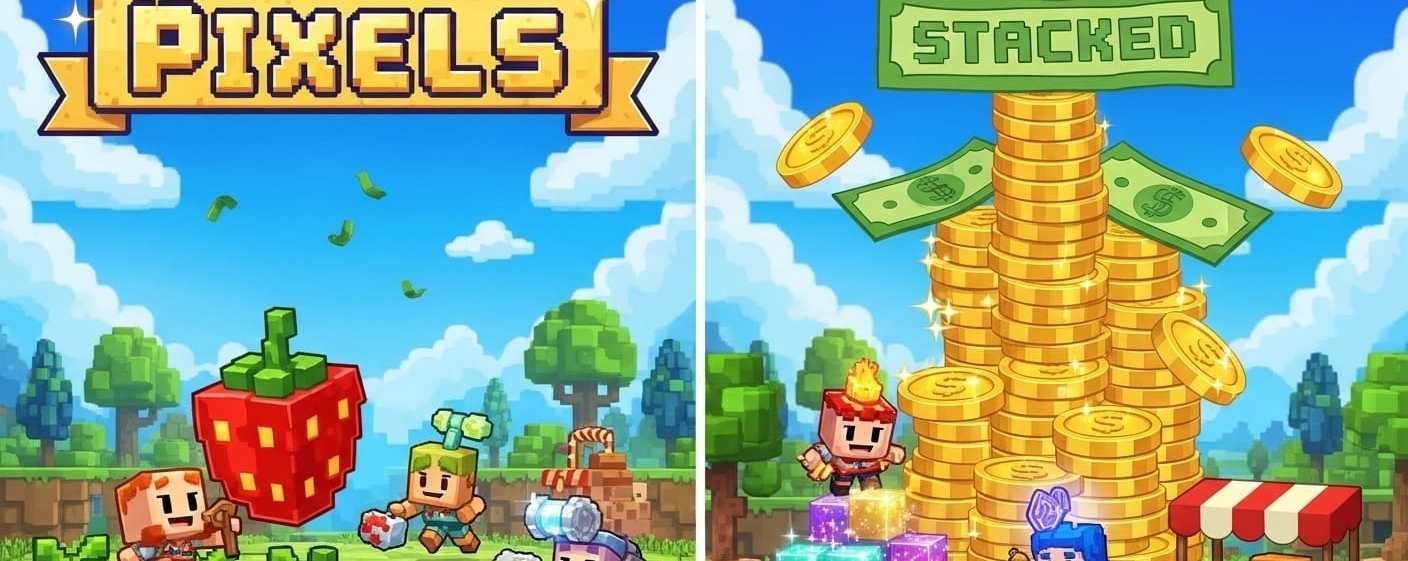
Let me be honest. I've seen so many play-to-earn games crash and burn. Bots flood in. Rewards get farmed. The economy collapses. Then the team disappears. Rinse and repeat.
So when I first heard about Stacked from @pixels, my reaction was – "Yeah, sure. Another rewards thing."
But then I actually looked into it. And I was wrong.
Stacked isn't some whitepaper dream. It's already running. Right now. On real games with real players.
What actually is Stacked?
In simple words – Stacked is a rewards engine for games. But not the dumb kind. There's an AI game economist sitting on top that figures out which player should get what reward and when. Not everyone gets everything. That's how economies die.
The AI asks smart questions like – "Why are your whales quitting between day 3 and day 7?" Or "What are your most loyal players doing before day 30 that others aren't?"
And here's the kicker – once you get the answer, you can act on it immediately inside the same system. No waiting. No separate tools. Insight to action.
This isn't theory. It's already proven.
The Pixels team lived through every single problem you can imagine. Bots. Farmers. Economy drains. Everything. Instead of giving up, they reverse-engineered what actually works.
The proof? Stacked-powered systems helped generate over $25 million in Pixels revenue. Hundreds of millions of rewards processed across millions of players. Not numbers from a deck. Real receipts.
This is battle-tested infrastructure. Not a concept.
The ad spend thing is genius.
Here's something most people don't think about. Gaming studios spend billions of dollars every year on ads – Facebook, Google, TikTok, influencers. All to bring new players in.
Stacked flips this completely. What if that same money went directly to players? Real players who actually play the game, engage with it, and add value to the ecosystem?
Instead of paying ad platforms, you pay your own community. The ROI is measurable. The fraud is controlled. And players feel valued. That's a fundamental shift in how game economies work.
Where does $PIXEL fit?
$PIXEL used to be just the token for one game – Pixels. Now it's becoming something bigger. It's turning into a cross-ecosystem rewards currency.
More games join Stacked. More demand for $PIXEL. One game failing doesn't kill the whole thing because Stacked is infrastructure, not a single title. That's a completely different risk profile than most crypto gaming projects.
The moat is real.
Anyone can build a quest board. My little cousin can do that in a weekend. But building a reward system that survives real adversarial usage at scale? That's insanely hard.
Fraud prevention. Anti-bot systems. Behavioral data across millions of players. Reward design wisdom earned through years of mistakes. You can't copy that overnight. Stacked already has it.
Real rewards. Real money.
Players will earn cash, crypto, or gift cards for doing things that genuinely matter inside games. Not idle time. Not "watch an ad." Not spam quests. Real engagement equals real rewards.
Marketing budgets that studios used to hand to ad platforms now flow directly to players who actually show up and play. That's not just an upgrade. That's a whole new way of thinking.
My honest take.
Look, I'm still cautious about Web3 gaming. I've seen too much vaporware. Too many promises. Too many "to the moon" posts followed by silence.
But Stacked feels different because it's built in production, not in a deck. The Pixels team made mistakes along the way, sure. But those same mistakes taught them exactly what not to do.
If you hold $PIXEL or care about the Pixels ecosystem, this is genuinely good news. If you run a game studio, Stacked deserves a serious look.
And for everyone saying "Web3 gaming is dead" – dead things never lived in the first place. Stacked is live. It's processing rewards. It's helping players earn. Right now.