
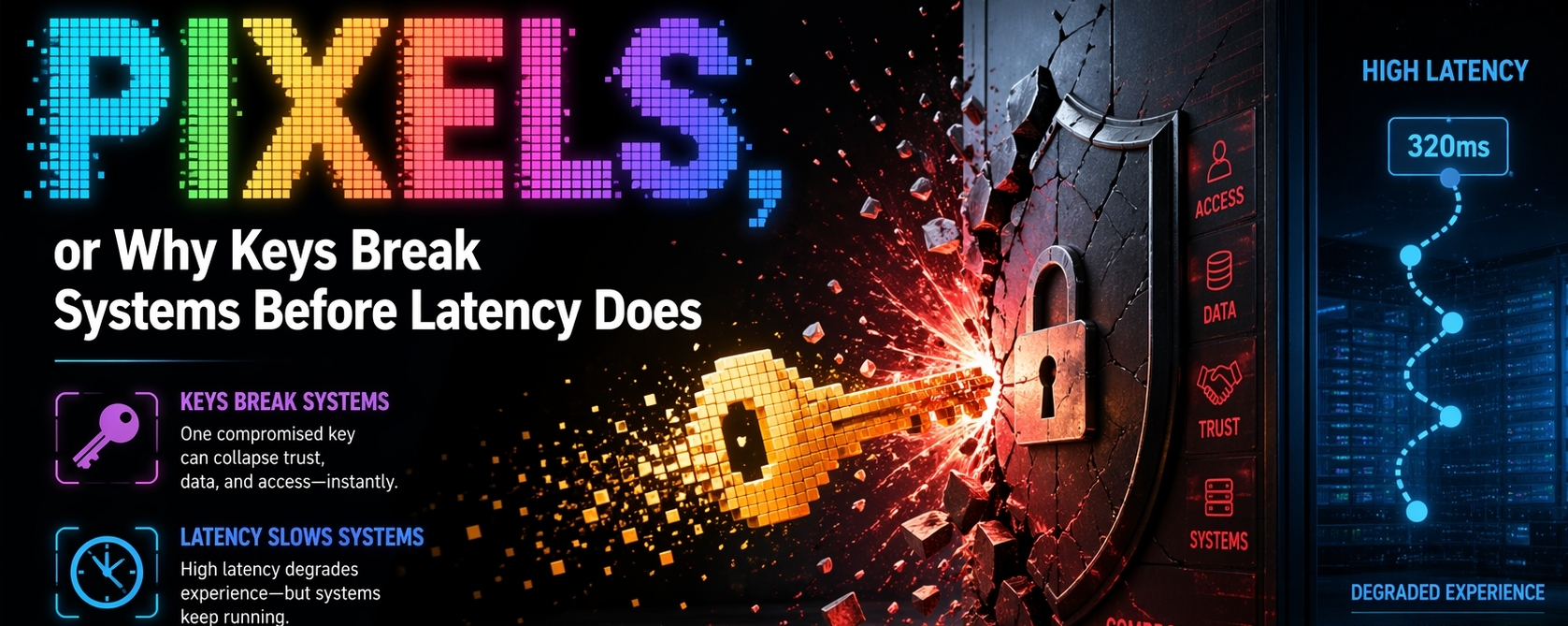
i wrote this after the third alert of the night, the kind that doesn’t spike adrenaline so much as confirm a pattern. The dashboards were green. Throughput looked excellent. Latency was within targets. The chain was, by every performance metric we celebrate, healthy. And still, the conversation on the bridge call wasn’t about blocks or bandwidth. It was about approvals, scopes, and whether we had quietly made it too easy for a key to do too much.
In the risk committee notes, speed rarely appears as a primary hazard. It shows up as a multiplier. The root causes are duller and more human: permissions that outlive intent, keys that outlive context, signatures that outlive attention. We audit code, but we also audit behavior—the ways interfaces invite a click, the ways defaults become policy. At 2 a.m., nobody argues about transactions per second. They argue about whether a wallet should have been able to do that at all.
PIXELS presents itself as a social, casual world—farming, wandering, crafting—but under the surface it behaves like a system that learned from those calls. It runs as a high-performance L1, SVM-based, but the performance is not the point. The guardrails are. The idea is not simply to move fast, but to constrain what “fast” is allowed to touch. Because a system that accelerates unbounded authority only accelerates failure.
The internal debates tend to orbit a single friction: signatures. Every additional signature is a moment for the user to pause, but also a moment to fatigue. Reduce signatures, and you reduce friction. Reduce them too far, and you risk compressing oversight into a single irreversible gesture. The answer PIXELS leans toward is not fewer checks, but better-shaped checks. “Scoped delegation + fewer signatures is the next wave of on-chain UX.” That line circulated in one of the audits, not as a slogan but as a constraint: if you remove prompts, you must narrow power.
PIXELS Sessions are where that constraint becomes concrete. Delegation is enforced to be time-bound and scope-bound. Authority is lent, not granted; it expires, it is specific, and it cannot wander. The session can farm, trade within limits, perform actions that are expected of play—but it cannot, by design, generalize into a universal permission. This is not a feature layered on top; it is a posture. The session is the boundary between convenience and custody, between fluid interaction and irreversible authority.
From an architectural standpoint, PIXELS separates concerns in a way that reads conservative to people obsessed with headline speed. Execution is modular and sits above a settlement layer that behaves like it distrusts everything—including itself. The fast path handles intent, batching, and game-like responsiveness. The slow path insists on finality, on rules that don’t bend when the interface is smooth. This split is not about elegance; it’s about containment. When something goes wrong—and it always does—the blast radius is determined by where authority actually settles.
There is EVM compatibility, but it is treated like a bridge for developers, not a thesis for the system. It reduces tooling friction, shortens the path from idea to deployment, and invites a familiar ecosystem. It does not define the trust model. In the incident logs, compatibility is rarely what saves you. Clear boundaries do.
The native token appears in the documentation once in a way that matters: as security fuel. It pays for the right to be processed, yes, but it also underwrites the incentives that keep validators aligned. Staking is framed less like yield and more like responsibility—an admission that someone, somewhere, must have skin in the outcome of every accepted state transition. In a fast system, that admission matters more, not less.
Bridges remain the quiet anxiety. They are necessary, and they are brittle. They concentrate value and compress assumptions across domains that do not share failure modes. Every audit gives them extra pages. Every incident report gives them extra scrutiny. The sentence that keeps resurfacing is blunt and accurate: “Trust doesn’t degrade politely—it snaps.” When it snaps, it rarely cares how fast your base layer was.
So the question that lingers after the alerts are resolved is not whether PIXELS is fast enough. It is whether it is willing to refuse. Whether it can look at a validly signed request and decide that the scope is wrong, the session is stale, the permission is too broad for the context in which it is being exercised. Whether the system has the discipline to say no, even when everything technical says yes.
Speed is easy to measure and easier to market. Safety is mostly the absence of headlines. In the quiet between them, the real work happens: defining what a key can do, for how long, and under which assumptions. PIXELS treats that work as first-order, not auxiliary. It assumes that users will be tired, that interfaces will be persuasive, that mistakes will be made under pressure. It builds not to eliminate those realities, but to bound them.
A fast ledger that cannot refuse is a liability with excellent metrics. A fast ledger that can say “no” is something else entirely. It prevents the failures we already know how to predict. And most nights, that is the only kind of safety that matters.
