
Honestly, the reason I'm still paying attention to Pixels isn't because I'm hyped. I think we've all seen enough of that to know that hype is cheap. Every crypto cycle spits out shiny new projects with polished stories, promising to fix everything, and most of them end the exact same way: a slow fade. The liquidity dries up, the community starts recycling the same tired talking points, and everyone just pretends not to notice.
But Pixels actually feels a bit different to me lately—and not in that over-marketed, easy-to-sell kind of way. It feels heavier.
A lot of people are still looking at the game through the old play-to-earn lens. Players show up, grind, farm, craft, extract a little profit, and move on. That worked for a while. It got foot traffic through the door. But if you look closely at what the project is actually trying to become, that framing just doesn't hold up anymore.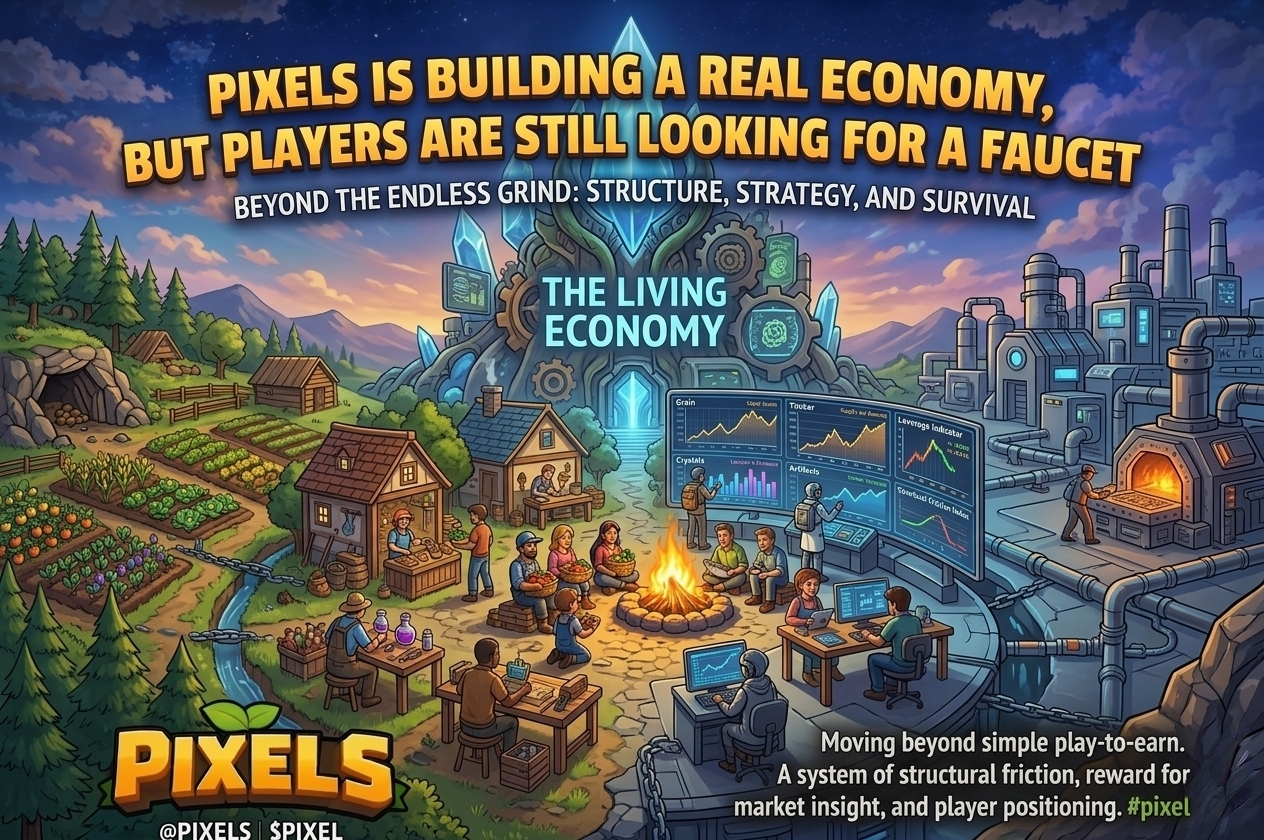
For me, it’s not really about the basic gameplay loop right now. I’m watching to see if Pixels can build a system with enough internal friction that people stop treating it like a crypto faucet and start treating it like a living, breathing ecosystem. That’s the dividing line. Most projects never cross it. They stay permanently stuck in extraction mode: more users, more rewards, more emissions, more noise. Same cycle, same ending.
Pixels, at least from where I’m sitting, looks like it’s genuinely trying to push past that endless grind. And I respect that—cautiously.
What I’m seeing is a project leaning away from simple participation and moving toward actual structure. They are creating pressure points. They are building a world where not every player is doing the exact same thing or getting rewarded in the exact same way. That matters infinitely more than whatever short-term excitement people try to force onto the token.
Let's be real: flat economies die fast.
If everyone can just mindlessly follow the same path, produce the same outputs, and chase the same rewards, the value gets crushed. It always does. The system becomes too predictable, players optimize the fun out of it, and then they drain it dry. I’ve watched it happen too many times to get sentimental about it.
But Pixels seems aware of that trap. That’s what keeps me watching.
The devs seem less interested in rewarding blind activity and more focused on rewarding players who can actually read the market. People who understand where supply tightens, where pressure builds, and where the real leverage sits. That is a much harder thing to build. It’s messier. It creates more doubt in the community. But it also creates a much better chance that the economy doesn't just collapse into a pure recycling bin.
At least, in theory.
Obviously, the real test is whether this new depth is actually sustainable, or if it’s just added clutter disguised as "complexity" that people pretend to care about for a few weeks. I’ve seen that happen, too. Projects add more mechanics and moving parts, and call it a deep economy when really it’s just more grind with better packaging.
So no, I’m not giving Pixels a free pass here.
I’m just saying their current direction is a lot smarter than the low-friction reward machines that most Web3 games turn into. It feels like the project wants players to actually think. To position themselves strategically. To stop acting like tourists. That’s a good thing. Honestly, it's probably necessary for survival.
But it brings its own risks. The more layered an economy gets, the easier it is for hardcore, sharp players to pull ahead while casuals get stuck doing the obvious, low-paying tasks. That wealth gap can get ugly fast, and I’m keeping an eye out for it. I’m watching for the moment the game starts feeling closed off instead of deep. There’s a fine line there, and a lot of teams don't figure it out until it’s too late.
That’s where Pixels still has something to prove.
I don’t care if a game can just keep people busy. I care whether it gives players room to evolve inside the system. Can a new player come in small, learn the ropes, adapt, and work their way into better positions over time? Does understanding the market actually matter more than raw, repetitive clicking? Does the project reward actual growth instead of just endurance?
That’s a tough balance to strike.
And honestly, that’s exactly why I find Pixels so much more fascinating now than I did back when its story was simpler. Back then, sure, it was easier to explain and easier to market. But simple stories in this space age terribly. They get repeated until they turn into background noise.
This current phase? It feels less clean. Less marketable. But it feels better.
I’m not watching Pixels because I think it’s a perfect game. Far from it. I’m watching because it looks like a project that finally realized the old model is a dead end, and now they are trying to prove they can build something with real weight behind it.
Maybe it works out. Maybe it just adds too much friction and burns the player base out entirely.
But for now? I’m still watching. That’s probably the most honest thing I can say about it.
