
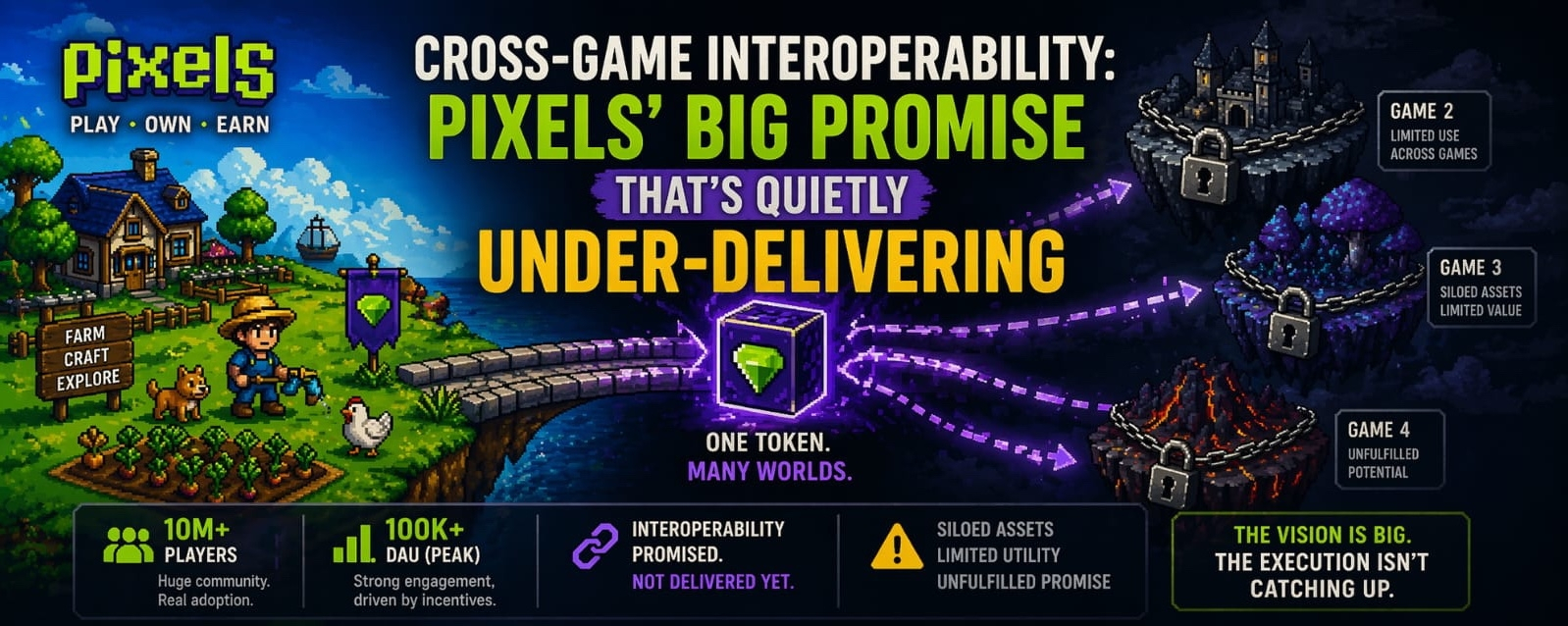
I’ve been watching Pixels closely for a while now—not just as a player or observer, but as someone trying to understand where GameFi is actually heading. And there’s one narrative that keeps coming up again and again: cross-game interoperability. It sounds powerful. It sounds like the future. But the deeper I look into Pixels, the more I start questioning whether this promise is truly being delivered—or just carefully marketed.
At a glance, Pixels has done a lot right. Millions of users have passed through the ecosystem. Daily active users have crossed into the tens of thousands, even touching over 100K during peak periods. On-chain activity, especially after moving to Ronin, gave it a massive boost. Compared to most Web3 games that fade out after a few months, Pixels has managed to stay relevant. That alone deserves attention.
But interoperability isn’t about survival. It’s about expansion. It’s about creating a connected ecosystem where assets, identities, and economies move freely across multiple games. And this is where things start to feel… incomplete.
The idea is simple: you earn something in one game, and it carries value into another. Your assets aren’t locked. Your time compounds. Your identity persists. In theory, Pixels is positioning itself as a hub for this kind of system—a kind of Web3 “Steam,” where multiple games plug into a shared economy powered by $PIXEL.
But in reality, what I see today is far more limited.
Most of the activity is still heavily centered around a single core experience—the Pixels farming game itself. Yes, there are mentions of expansion, hints of multiple games, and talk about developers building within the ecosystem. But actual, meaningful cross-game integration? It’s still thin.
If I earn in Pixels today, where else can I meaningfully use that value? Not conceptually—actually. Not in theory—right now.
That gap matters.
Because without real interoperability, what we’re left with is just a single-game economy wrapped in a multi-game narrative. And those are two very different things.
Even the token design reflects this tension. $PIXEL is meant to be the glue—the currency that connects everything. It’s used for premium features, NFTs, upgrades, and more. But its utility still feels largely confined within the same ecosystem loop. The introduction of mechanics like vPIXEL and sink systems shows that the team is actively trying to control inflation and reduce sell pressure, which is smart. But it also signals something deeper: the economy is still being stabilized internally, not expanded externally.
And that’s the core issue.
Interoperability only works when there are multiple active endpoints. You need several games, each with their own player bases, economies, and reasons to exist. You need assets that feel native across environments, not just transferable in theory. You need developers building, not just players consuming.
Right now, Pixels has strong player activity—but limited ecosystem diversity.
I think about platforms like Roblox or Steam, where value isn’t tied to one experience but spreads across thousands. That’s what Pixels is aiming for. But getting there isn’t just about vision—it’s about execution at scale. And that scale isn’t fully here yet.
There’s also a behavioral layer that often gets ignored. Players don’t just move assets because they can—they move them because it makes sense. If the second game isn’t compelling, or if the utility of an asset drops outside its original context, interoperability becomes friction instead of freedom.
So even if Pixels opens the door technically, the question becomes: will players actually walk through it?
Another thing I’ve noticed is how much of the growth still depends on incentives. Rewards, events, token distributions—these are powerful tools, but they can blur the line between real demand and temporary engagement. If interoperability is meant to create long-term value, it can’t rely on short-term incentives to sustain itself.
Because once the incentives slow down, the system gets tested.
And that’s where many GameFi projects have historically struggled.
To be clear, I’m not saying Pixels is failing. In fact, I think it’s one of the few projects that has actually learned from past mistakes in the space. The shift away from pure play-to-earn, the focus on fun-first design, the attempt to balance tokenomics—these are all signs of maturity.
But interoperability is a different challenge entirely.
It’s not just about building a better game. It’s about building an ecosystem where games don’t compete for attention—they reinforce each other.
And that requires more than just infrastructure. It requires adoption from developers, alignment of incentives, and a level of coordination that most Web3 projects haven’t yet achieved.
From where I stand, Pixels is somewhere in the middle of that journey.
The promise is there. The foundation is partially built. But the actual delivery—the part where multiple games are live, interconnected, and actively sharing value—is still catching up.
Maybe that’s expected. Maybe we’re early. But that doesn’t change the current reality.
Right now, interoperability in Pixels feels more like a direction than a destination.
And until that gap closes, the biggest narrative around the project will remain its most under-delivered feature.