
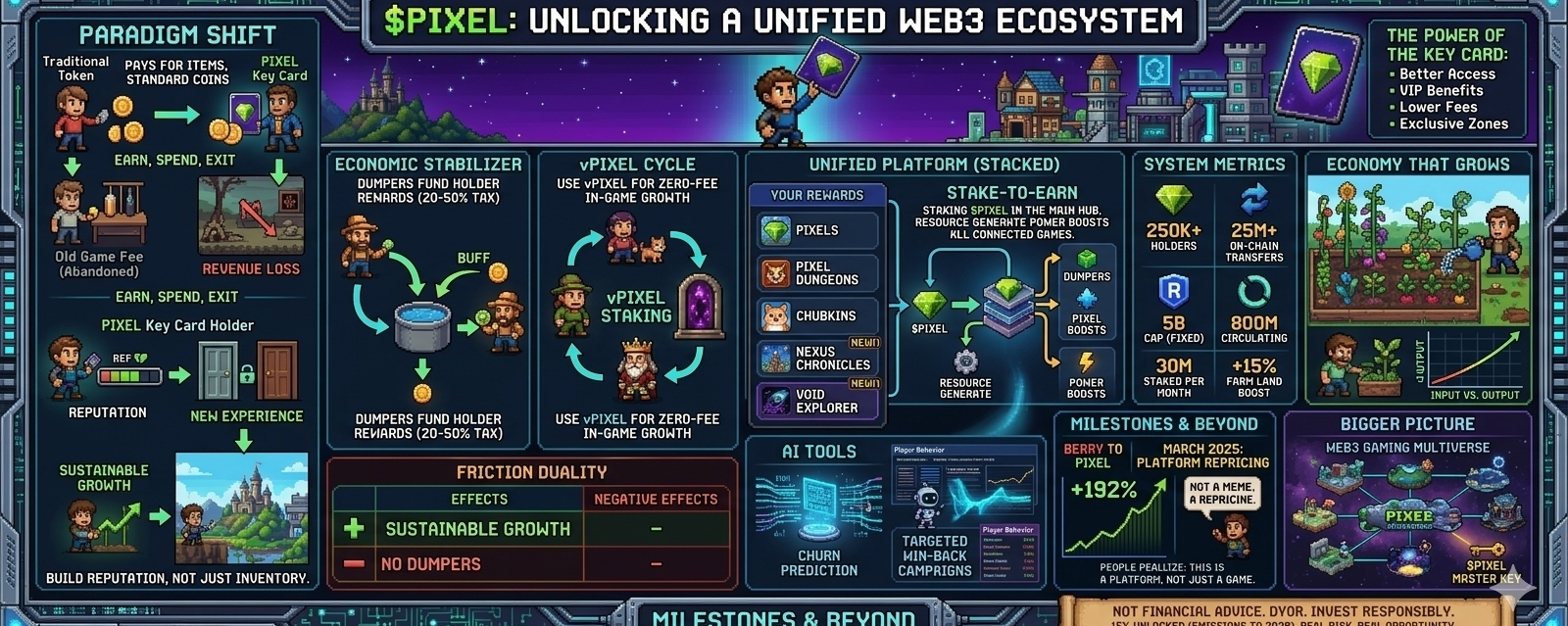
I keep thinking about this. Something about $PIXEL doesn't fit the way I think about game tokens. And it's been bugging me for weeks.
Every time I try to put pixel in the same box as other Web3 game coins, the comparison falls apart. I tried comparing it to $AXS. Doesn't work. Tried comparing it to $GALA. Doesn't work either. Took me a while to figure out why. $PIXEL doesn't act like game money. It acts like an access pass. And those are two very different things with two very different ceilings.
Let me explain what I mean because this is the part that rewired my thinking. In most Web3 games, the token buys you stuff. Swords. Skins. Items. You earn it, you spend it, done. Pixel does that too but honestly that's the boring part. The interesting part is what $PIXEL lets you skip. Pixels has a Trust Score system that tracks your $PIXEL holdings and how you interact with other players. Higher scores get you better rewards and lower fees in the marketplace. $PIXEL gives you VIP memberships with access to exclusive areas and premium features that regular players don't see. 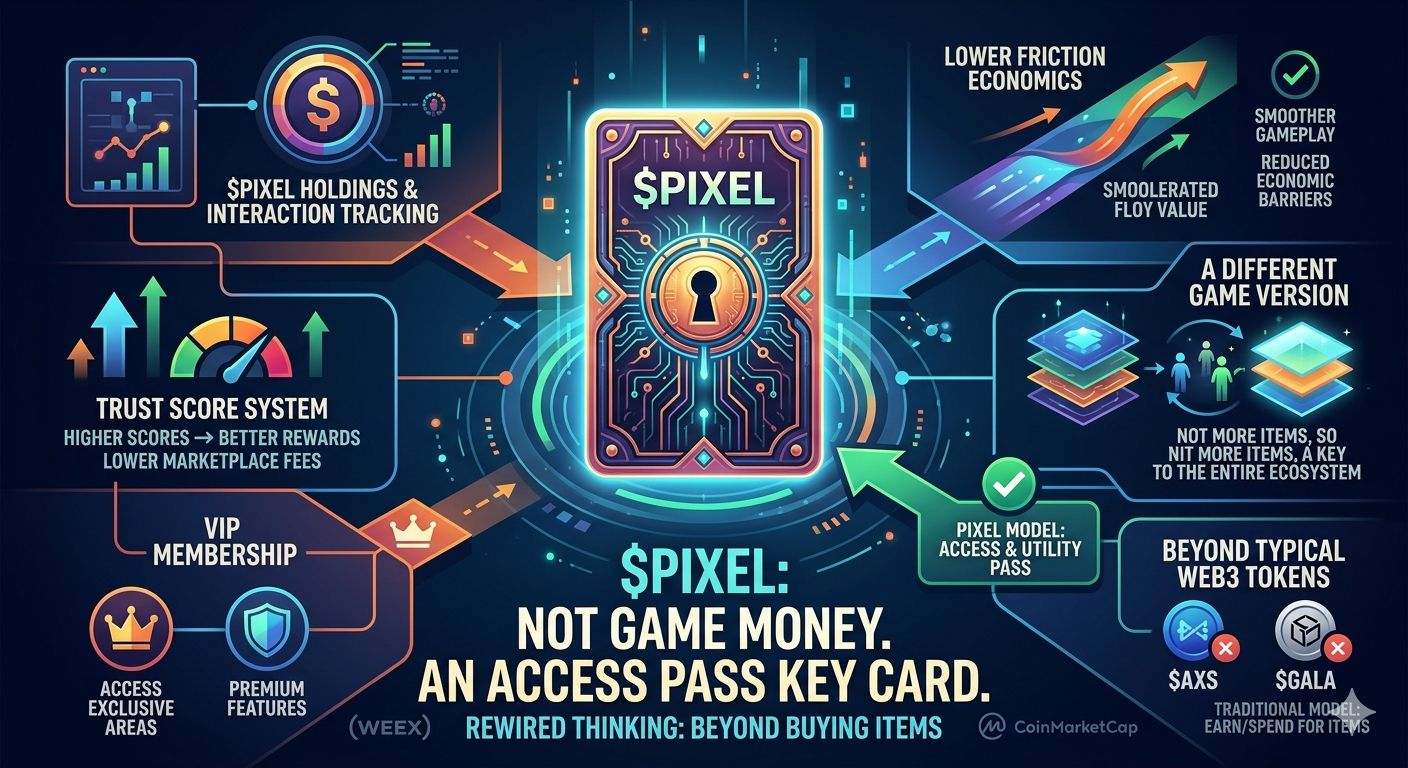
So holding pixel doesn't get you more items. It puts you in a different version of the game entirely. Lower friction. Better economics. Doors that most players don't know exist. That's not money. That's a key card. And once I saw it that way, I couldn't go back to thinking about it as a regular game token.
Now here's the mechanic that really got under my skin. When you withdraw pixel directly from the game, you pay a Farmer Fee between 20% and 50%. That fee goes straight to people staking $PIXEL. Read that one more time. The people who dump get taxed. The people who hold get paid from that tax. Every single time. But there's another option. You take $vPIXEL instead, which has zero fees, and spend it on in-game upgrades, pets, and staking.
I've played enough Web3 games to know what kills them. Zero friction on selling. Token launches, farmers drain everything, price craters, real players quit. Done. Game over. Pixels made selling expensive and staying free. The system constraints exist for everyone. But pixel holders get to move around them while extractors pay a premium that funds the loyal players. I've never seen a Web3 game design friction this deliberately and then turn it into a reward for the people who stick around.
Then Stacked happened and my whole mental model broke.
The Pixels team built Stacked on Ronin. One app. Multiple games. Earn and track rewards from a single dashboard. Player side is simple. But the developer side is where I went "oh wait." Stacked gives game studios AI tools that track player behavior, identify who's about to quit, and run targeted reward campaigns based on real retention data.
Stacked is a powerful shared rewards layer that seamlessly connects the $PIXEL ecosystem, turning every action into meaningful rewards.
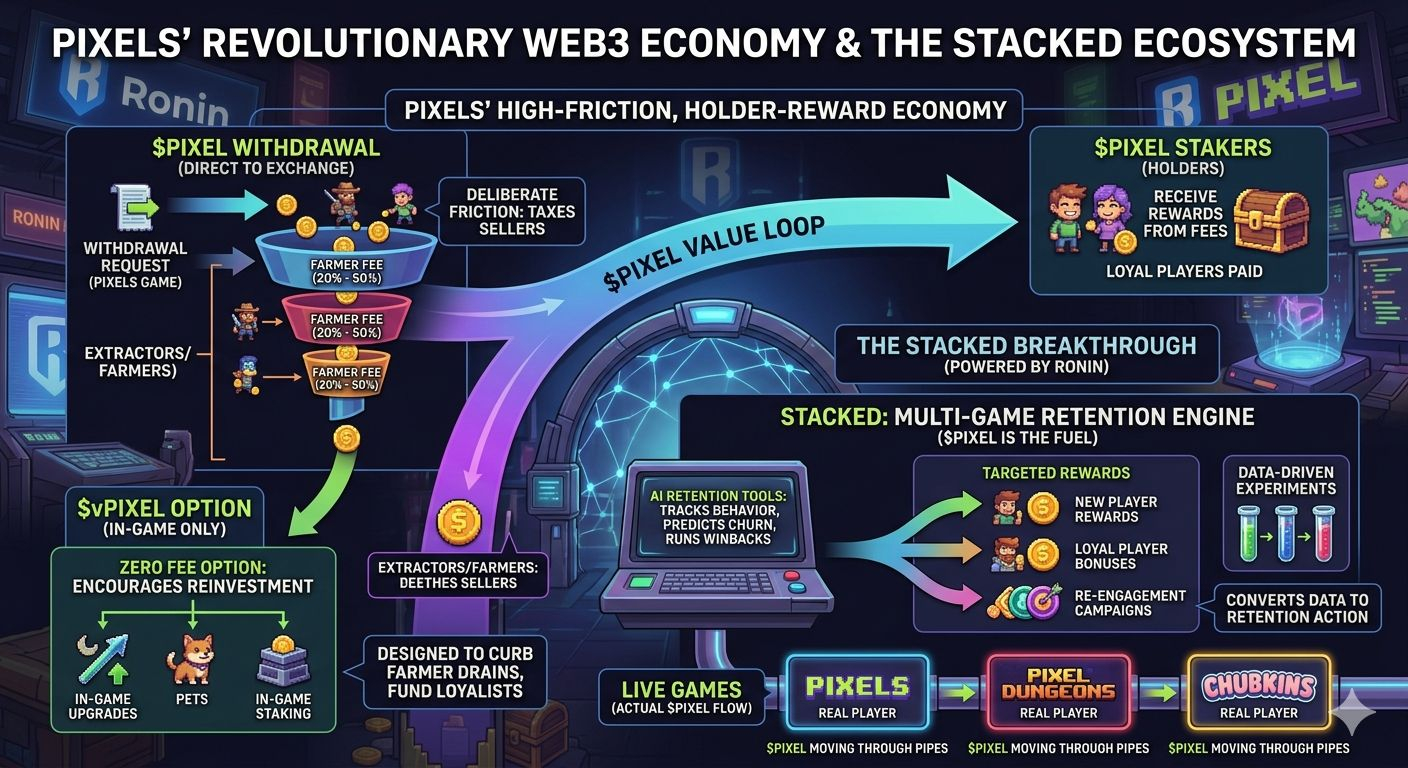
what nobody seems to be connecting. Pixel runs through all of it. Every reward Stacked sends out. Every winback campaign a studio fires at a player who's losing interest. Every data-driven retention experiment. $PIXEL is the money moving through the pipes. Three games are running on it right now. Pixels, Pixel Dungeons, and Chubkins. Live. Not a test. Not a roadmap line. Live games with real players and real $PIXEL flowing through real transactions.
I stopped comparing pixel to game tokens after that. Started thinking about it more like the payment layer underneath an app ecosystem. The games are the storefronts. Stacked is the operating system. $PIXEL is the currency connecting everything. The founder wants Pixels to become a user acquisition engine for Web3 gaming. Normally I'd roll my eyes at that kind of statement. Founders say big things all the time. But this one already has the product built. If five more Ronin studios plug into Stacked next year, $PIXEL gets more valuable because more activity runs through it. Not because someone tweeted about it. Because more transactions need it to function.
The numbers are what moved me from curious to paying serious attention. Over 238,000 holders. More than 22 million on-chain transfers. Those aren't dead wallets sitting around from some old airdrop. That's people using the token. Regularly. Total supply capped at 5 billion. About 770 million circulating right now. Controlled emission. No infinite printing.
The staking system distributes 28 million pixel per month across game pools. Own a Farm Land NFT and you get a 10% boost on staking power. Selling the token means walking away from rewards in every game at once. Not one game. All of them. That's the kind of decision that makes you pause. And pausing is what keeps sell pressure down.
The team killed $BERRY and consolidated around pixel as the single token running the economy. Tough call. $BERRY was easy to earn and easy to dump. It served its purpose during growth but would have dragged things down long term. By May 2025, more tokens were flowing into the game than coming out. That number is everything to me. When players voluntarily keep value inside a system instead of draining it, the design is working. I've watched most Web3 game economies bleed out. Pixels built one that fills up.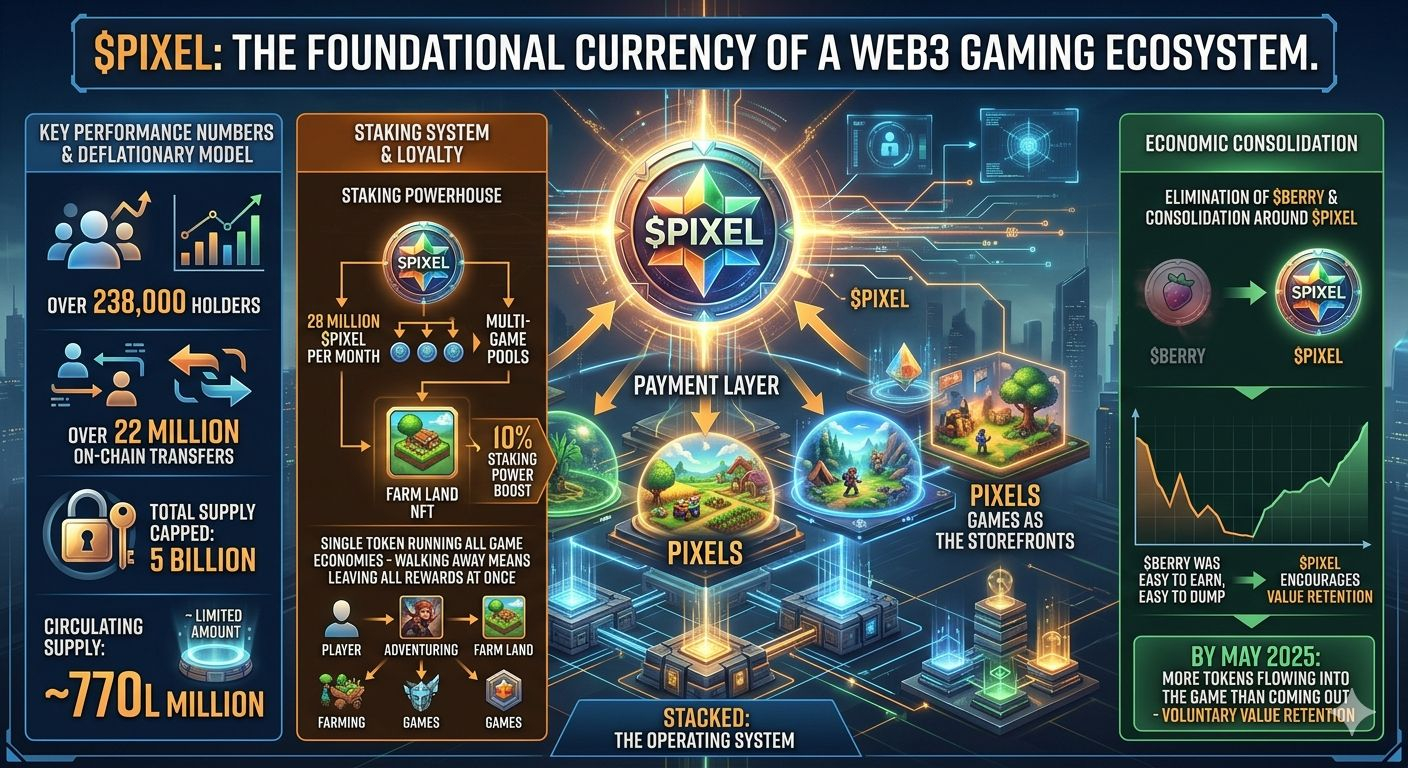
In March, pixel pumped 192% in a day. Volume hit $388 million. I've seen enough pumps to not get excited by numbers alone. But this one had something behind it. The rally came as people started realizing Pixels had grown from a farming game into a multi-game platform with $PIXEL as the utility engine underneath. That's not a meme pump. That's a repricing. People figured out they were looking at something different than what they assumed.
Now I'm not sitting here telling you pixel is a sure thing. I've been wrong about projects before. I'll be wrong again. Only about 15% of total supply has been unlocked so far and the schedule runs until 2029. That's real dilution on the way. Ignoring it would be stupid. But dilution hurts less when genuine demand grows at the same time. Stacked is live. Staking is active. The Farmer Fee sends sell pressure back to holders. Those aren't promises. Those are working systems creating demand today.
Most people still look at pixel and see a game coin with a tiny market cap. And by the old playbook, they'd be right to shrug. But I think the old playbook is wrong for this one. One token running through Stacked, through multi-game staking, through every reputation score and marketplace fee in the ecosystem. That's not a game coin anymore. That's a medium of exchange for an entire platform.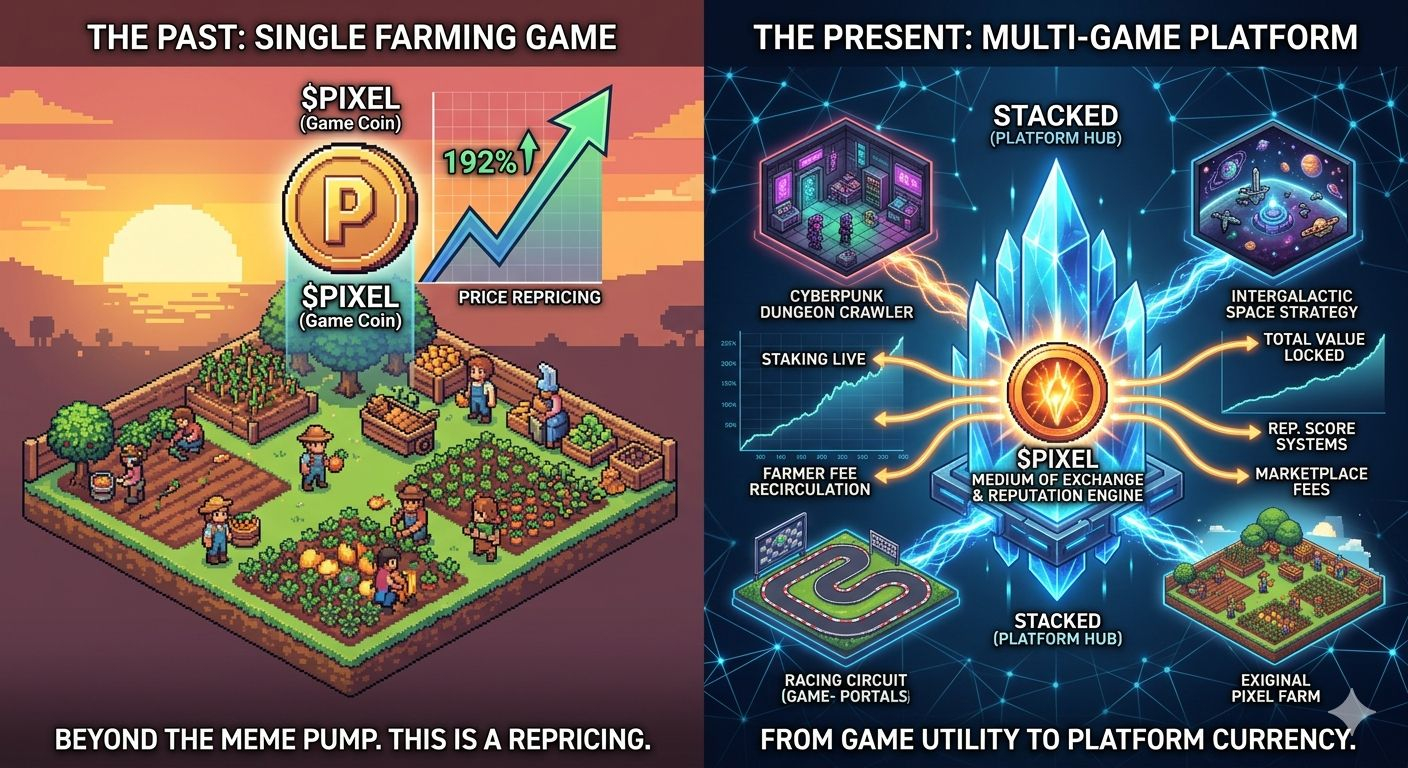
what I keep going back to. If every game that connects to Stacked adds another demand source for $PIXEL. And every player building reputation needs to hold more to maintain their status. Does $PIXEL quietly become the first Web3 gaming token where value comes from how deep you are in the system instead of how hard you believe in the chart?
