I Stumbled Upon Espresso $ESP at 2 AM — And I Couldn’t Stop Reading About It
It started with a simple tweet.
Someone I follow in the crypto space posted: “Espresso just listed on Binance. This might be the infrastructure play of 2026.”
I rolled my eyes at first. Every week, there’s a new “infrastructure play.” But something about the word “Espresso” made me click. Maybe it was the name. Maybe it was the fact that a16z, Sequoia Capital, and Polychain Capital had poured $60 million into it. Either way, I went down a rabbit hole that kept me awake longer than I’d like to admit.
Here’s what I found — explained simply, no jargon overload.
The Problem Nobody Talks About Enough
Most people in crypto focus on prices.
Which coin is up?
Which coin is down?
But behind the scenes, there’s a massive structural problem that developers and serious builders have been losing sleep over for years.
Here’s the simplest way to understand it.
Imagine the internet — but instead of websites talking to each other seamlessly, every website existed in its own bubble. You couldn’t click a link from Google to YouTube. You’d have to manually copy a piece of content, walk it over, and paste it somewhere else. That would be a nightmare, right?
That’s essentially what’s happening in blockchain right now.
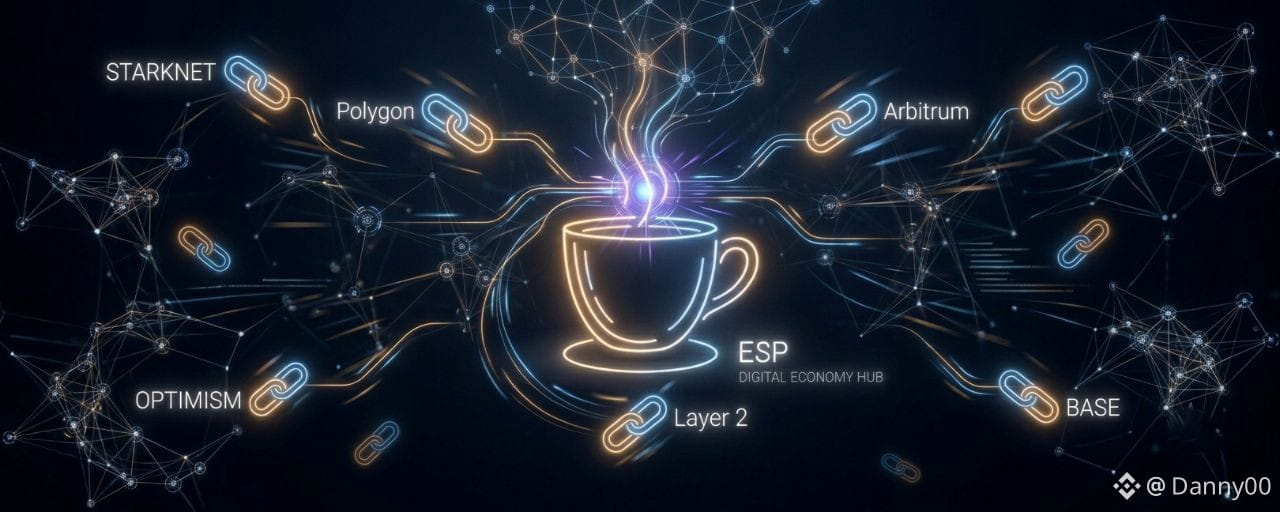
Ethereum has dozens of Layer 2 networks — Arbitrum, Polygon, Optimism, and many others. These networks were built to make Ethereum faster and cheaper. And they did. But they created a new problem: fragmentation. Each Layer 2 became its own isolated island. Moving assets between them is slow, complicated, and sometimes risky. They don’t talk to each other well. Liquidity gets split. Users get confused.
This is the problem Espresso was built to solve.
So What Is Espresso, Exactly?
The Espresso Network is a base layer purpose-built to provide rollups and app-specific chains with fast finality and secure cross-chain composability. It operates as a decentralized consensus protocol able to confirm rollup blocks in a few seconds, providing order consistency and data availability, but without executing transactions itself.
In plain English: Espresso doesn’t replace Arbitrum or Polygon. It sits above them, like a traffic controller — making sure all these different chains are talking the same language, confirming transactions in real time, and working together instead of against each other.
Think of it like the SWIFT network in traditional banking. SWIFT doesn’t hold your money. It doesn’t replace your bank. It just ensures that when your bank in Lahore needs to send money to a bank in London, they can do so reliably and quickly. Espresso does the same thing for blockchains — but decentralized, faster, and open to everyone.
The Technology That Makes It Work
This is where it gets genuinely interesting.
Researchers from Stanford and Yale founded Espresso. These aren’t typical crypto founders who slapped a whitepaper together overnight. Ben Fisch, the CEO and co-founder, is a Yale professor and co-creator of the Filecoin protocol with extensive experience in zero-knowledge proofs. Benedikt Bünz, the Chief Scientist, is a Stanford PhD and co-creator of Bulletproofs — a leading voice in cryptographic research.
These are people who built foundational crypto technology before most of us knew what a blockchain was.
Their main invention inside Espresso is a consensus protocol called HotShot.
HotShot is Espresso’s engine — a state-of-the-art Byzantine Fault Tolerant consensus protocol. Unlike traditional systems that slow down as more nodes join, HotShot uses a specialized architecture to scale to tens of thousands of nodes while maintaining sub-2-second finality. It features optimistic responsiveness, meaning the network commits blocks as fast as the internet allows, rather than waiting for fixed, pessimistic block times.
To put that in perspective: Espresso currently finalizes rollup blocks in about six seconds on average, compared with Ethereum’s 12-minute-plus finality window. CoinDesk
Twelve minutes versus six seconds. That’s not a small improvement. That’s the difference between sending a letter and sending a WhatsApp message.
Alongside HotShot, Espresso uses a data availability system called Tiramisu, which handles how transaction data is stored and retrieved across the network efficiently. Together, these two technologies make Espresso one of the most technically serious infrastructure projects currently being built in the crypto space.
The Moment I Realized This Was Different
Here’s the thing that really got my attention.
Most crypto projects talk about partnerships the way startups talk about “synergies” — a lot of noise, very little substance. But Espresso’s integrations are real and operational. As of early 2026, Espresso has transitioned to a decentralized Proof-of-Stake network, providing real-time confirmations for industry giants like ApeChain, Celo, Arbitrum, and Polygon.
These aren’t pilot programs or letters of intent. These are live, working integrations with some of the biggest names in the Ethereum ecosystem.
And then there’s Presto — a product built on top of Espresso. Presto is a framework that enables one-click cross-chain transactions. Users can pay for an item on ApeChain using funds located on Arbitrum without manually bridging assets. BingX
If you’ve ever tried moving crypto between chains — setting up bridges, paying multiple fees, waiting anxiously for confirmations — you know how painful that process is. Presto makes it invisible. One click and it’s done.
That’s the kind of user experience that actually brings normal people into crypto.
The Binance Listing — And What It Means
Binance officially listed Espresso (ESP) on February 12, 2026, following its transition from the Binance Alpha pre-listing pool. Exchange officials applied a “Seed Tag” to the token, requiring users to pass specialized risk quizzes every 90 days to maintain trading access. NFT Plazas
The Seed Tag is important to understand. Binance doesn’t slap that label on projects to punish them. It’s a transparency signal — essentially, Binance saying: “This project has strong technology, but it’s early. Understand the risk before you trade.”
On the same day, Coinbase also simultaneously listed ESP, providing crucial liquidity and access alongside Binance. CoinMarketCap
Getting listed on both Binance and Coinbase on the same day is exceptionally rare for a new project. It signals that both exchanges did their due diligence and found the fundamentals solid.
For readers in Pakistan and South Asia, this matters practically too. Binance supports local payment options in many regional markets. Platforms like Binance P2P allow users to buy crypto using local bank transfers in Pakistani Rupees or Indian Rupees, even when direct fiat support is limited. So if you want to explore ESP, you don’t necessarily need PayPal or a US bank account. You can start through Binance P2P with a local transfer, which is how many beginners in this region access new crypto assets.
What the ESP Token Actually Does?
ESP is more than just a digital asset — it plays a direct role in the operation of the Espresso network. Token holders can help maintain network security by becoming validators or delegates. ESP tokens also function in decision-making on the network, allowing holders to participate in determining the direction of development, including system changes or updates. The token is used as an incentive to reward validators who help process and secure transactions, and to pay data processing fees within the protocol. Indodax
The total supply is 3.59 billion ESP tokens, with 10% allocated to a fully unlocked community airdrop aimed at early ecosystem participants and users of Espresso-integrated rollups. NFT Plazas
The honest thing about ESP right now is that the price is still in early discovery. At the time of writing, it’s trading around $0.059. Some early Kaito Launchpad investors who bought at a higher valuation are underwater. That kind of early volatility is completely normal for infrastructure projects — and it doesn’t reflect the technology’s merit. It reflects market emotion, which almost always corrects over time when the fundamentals are real.
Why This Actually Matters — Even If You Never Buy a Single Token
Here’s my honest take after all that research.
Espresso is not a meme coin. It’s not a hype project. It’s plumbing.
Nobody gets excited about plumbing. But without good plumbing, nothing works.
The more blockchains that exist — and there will be thousands — the more critical a coordination layer like Espresso becomes. Every DeFi app, every NFT marketplace, every crypto payment service that operates across multiple chains will eventually need something like what Espresso is building.
The team is credible. The backers are serious. The technology is working. The integrations are live.
Whether you’re a developer curious about building on Layer 2 infrastructure, an investor looking for long-term infrastructure plays, or simply someone trying to understand where blockchain is headed, Espresso is worth understanding.
Not because of the price today. But because of the problem, it’s quietly solved while everyone else is watching the charts.
$ESP $ETH