Hello everyone
Financial analysts and investors are closely watching the upcoming Core Personal Consumption Expenditures (Core PCE) Price Index because it is the Federal Reserve's preferred measure of inflation and plays a critical role in shaping U.S. monetary policy. In the current June 2026 market environment, inflation remains a major concern, making the next Core PCE release one of the most significant economic events of the year.
The Federal Reserve's Inflation Challenge
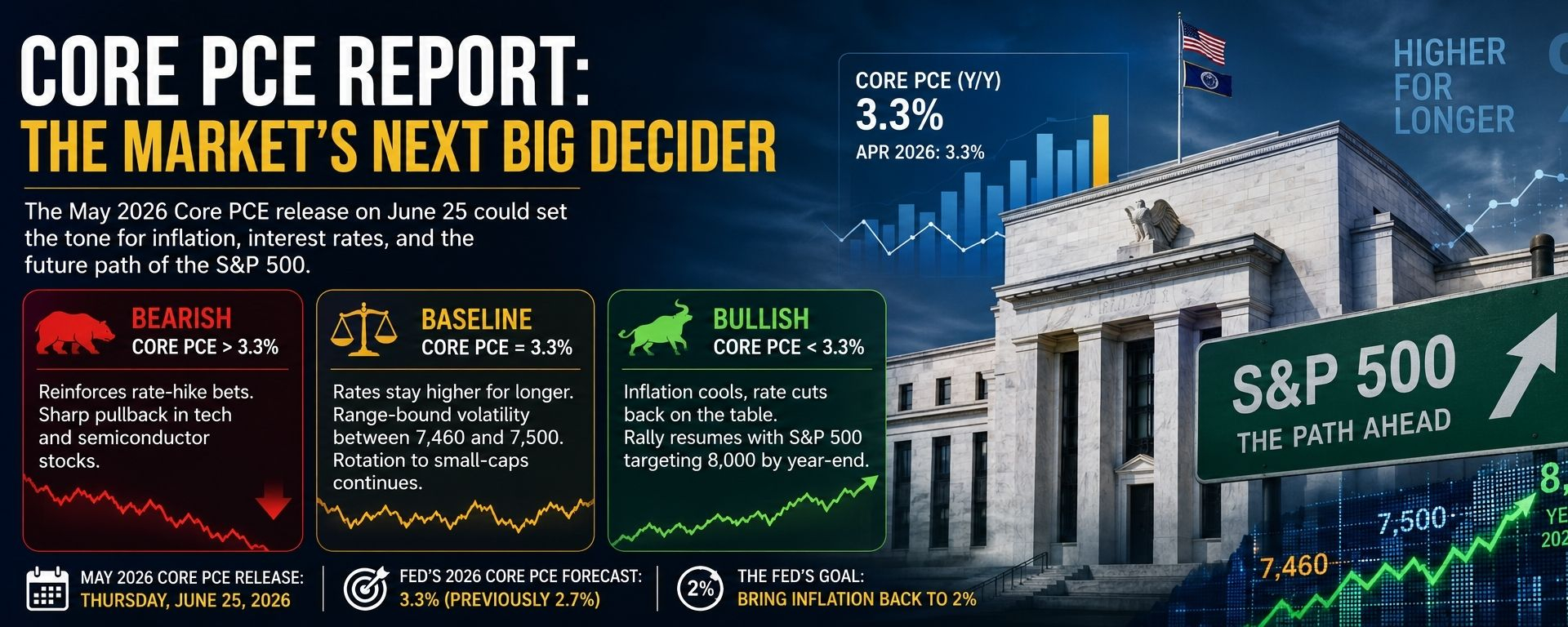
Persistent inflation pressures have pushed the Federal Reserve, under Chairman Kevin Warsh, toward a more aggressive policy stance. The Fed recently raised its year-end 2026 Core PCE inflation forecast from 2.7% to 3.3%, signaling its determination to bring inflation back to its long-term target of 2%.
As a result, interest rate expectations have become the dominant force driving financial markets. The upcoming May 2026 Core PCE report, scheduled for release on June 25, 2026, is expected to have a major influence on investor sentiment and short-term market direction.
Why Core PCE Matters More Than Headline Inflation
Unlike headline inflation, which can be heavily influenced by volatile food and energy prices, Core PCE excludes these categories to provide a clearer picture of underlying inflation trends.
Economists pay particular attention to "sticky" inflation components such as:
Housing costs
Healthcare services
Insurance expenses
Other service-sector categories
These areas tend to change more slowly and therefore provide a better indication of long-term inflationary pressures.
Current Inflation Outlook
The previous Core PCE reading for April 2026 came in at 3.3% year-over-year. Market forecasts suggest that May's reading will remain unchanged at 3.3% annually, with a monthly increase of approximately 0.4%.
Many economists believe that May could represent the peak inflation reading for 2026. The recent de-escalation of tensions in the Middle East and the temporary U.S.-Iran negotiation framework are expected to gradually reduce energy and transportation costs during the second half of the year.
If these trends continue, inflation pressures may begin to ease over the coming months.
How Different Core PCE Outcomes Could Affect the S&P 500
1. Bearish Scenario: Inflation Runs Hot
Core PCE Above 3.3% Year-over-Year
A higher-than-expected inflation reading would reinforce the Federal Reserve's hawkish stance and increase speculation that additional interest rate hikes may be necessary later in 2026.
For equity markets, especially technology and semiconductor companies, this could trigger a significant pullback. Higher interest rates reduce the present value of future earnings, placing pressure on growth-stock valuations.
2. Baseline Scenario: Inflation Meets Expectations
Core PCE Exactly 3.3% Year-over-Year
An in-line reading would validate the Federal Reserve's revised inflation outlook and support a "higher-for-longer" interest rate environment.
Under this scenario, the S&P 500 may remain range-bound, facing technical resistance between 7,460 and 7,500. Investors may continue rotating capital away from large technology companies and toward small-cap stocks and other value-oriented sectors.
3. Bullish Scenario: Inflation Cools
Core PCE Below 3.3% Year-over-Year
A lower-than-expected reading would suggest that restrictive monetary policy is successfully reducing inflation.
Such a result could revive expectations for future rate cuts, easing pressure on growth-oriented sectors. Technology and AI-related stocks would likely benefit the most, potentially helping the S&P 500 resume its broader upward trend. Some analysts continue to project a move toward the 8,000 level by the end of 2026 under favorable economic conditions.
Key Market Risks Investors May Be Overlooking
The AI Funding Shift
One of the most important developments in today's market is the changing way artificial intelligence projects are being financed.
Initially, many AI investments were funded through corporate free cash flow. However, companies are increasingly relying on debt issuance and equity offerings to finance AI infrastructure expansion.
This creates a direct link between interest rates and AI valuations. If inflation remains elevated and bond yields rise, borrowing costs increase, potentially reducing the attractiveness of AI-related investments and putting pressure on stock prices.
The "Supercore" Services Problem
Another major challenge is the persistence of inflation within service industries.
Strong wage growth and a relatively tight labor market continue to support elevated prices in sectors such as:
Healthcare
Insurance
Professional services
Hospitality
Even if commodity and energy prices decline, these service categories may keep Core PCE inflation above 3%, making it more difficult for the Federal Reserve to achieve its inflation target.
Conclusion
The May 2026 Core PCE report is likely to serve as a critical turning point for financial markets. With inflation currently sitting at 3.3%, investors are looking for signs that price pressures are finally beginning to ease.
A hotter-than-expected report could strengthen expectations for tighter monetary policy and trigger weakness in technology and AI stocks. An in-line reading would likely keep markets range-bound, while a cooler report could reignite optimism for future rate cuts and support a continuation of the bull market.
For investors, the report represents far more than an inflation update—it is a key indicator that could determine the direction of interest rates, AI valuations, and the broader S&P 500 for the remainder of 2026.
#HYPEFalls17%FromRecordHigh #USPCEInflationHits4.1%
Trade here 👇 👇 👇