
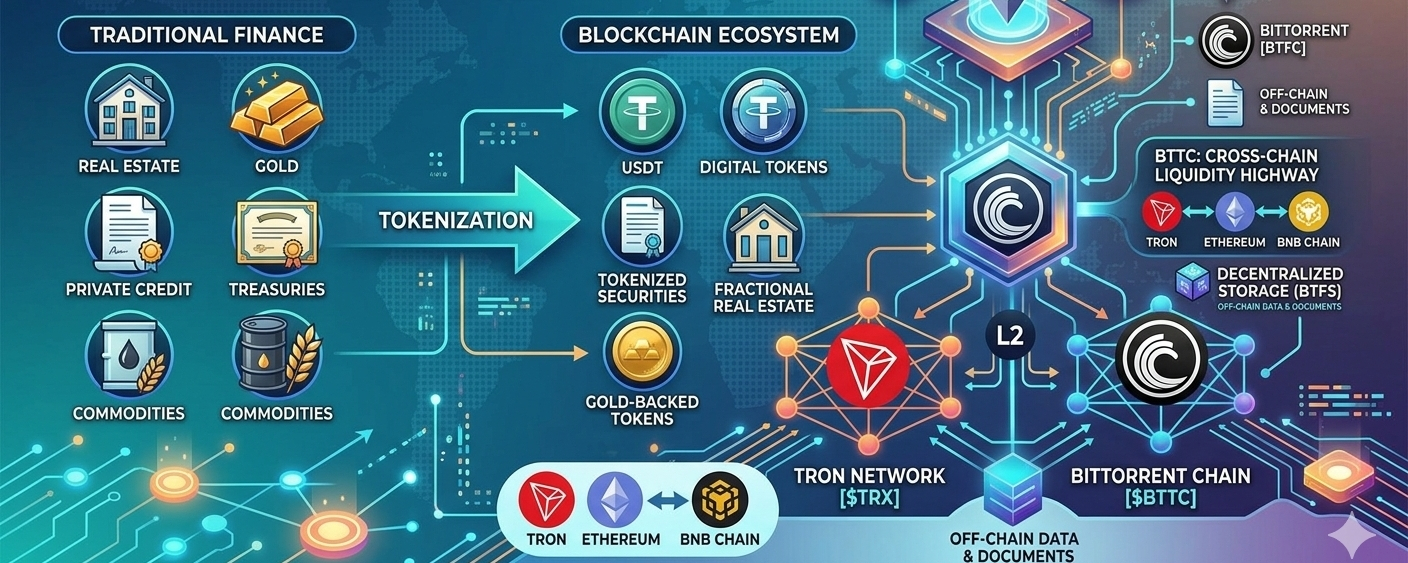
Real-World Assets (RWAs) represent one of the fastest-growing sectors in blockchain technology, moving trillions of dollars of traditional financial instruments into on-chain tokens. This trend intersects deeply with the TRON network [$TRX] and BitTorrent Chain [$BTTC].
Here is how the RWA landscape breaks down generally and how it directly impacts the TRON and BTTC ecosystem:
What is the RWA Sector?
RWAs are blockchain-based digital tokens that represent tangible physical or traditional financial assets. Instead of trading purely speculative crypto assets, users buy tokens backed by real-world value:
Tokenized Treasuries & Bonds: High-yield US government debt put on-chain.
Private Credit: Institutional business loans handled via DeFi protocols.
Precious Metals: Gold-backed tokens like PAXG.
Real Estate & Commodities: Fractional ownership of property, art, or agriculture.
TRON's Dominance in the RWA Foundation
Before complex assets like real estate are tokenized, they require a highly scalable, cheap foundation for settlement. TRON provides exactly that:
The Ultimate Stablecoin Layer: Over $60+ billion in USDT moves natively on TRON. Stablecoins are technically the world's first and largest RWA class, backed by off-chain fiat currency and treasury reserves.
On-Chain Liquidity: TRON’s massive daily active user base and liquidity make it highly attractive for RWA issuers who need deep capital pools to buy and sell tokenized funds.
Institutional Entry: Major financial players favor networks with high transaction throughput and ultra-low fees, putting TRON in a prime position to expand past stablecoins into tokenized private credit and corporate bonds.
How $BTTC Directly Benefits from RWA Adoption
As tokenized treasuries, private credit, and commodities grow rapidly, BitTorrent Chain ($BTTC) acts as the infrastructure layer enabling its velocity:
Cross-Chain RWA Bridges: Traditional institutions do not lock themselves into a single blockchain; they deploy multi-chain strategies. Because BTTC seamlessly bridges TRON, Ethereum, and BNB Chain, it acts as the literal highway moving RWA liquidity from Ethereum’s DeFi protocols over to TRON's cheap settlement layer.
Handling High-Velocity Microtransactions: Trading fractional real estate or tokenized stocks requires high throughput. BTTC functions as TRON's Layer-2, executing these quick, low-cost micro-trades before permanently settling them back onto the main layer.
Decentralized Storage (BTFS) for Off-Chain Proof: Every RWA token must point to real-world documentation (legal deeds, regular audits, bank statements). The BitTorrent File System (BTFS) provides the decentralized, immutable storage required to hold this sensitive institutional data securely.