
Why do we spend so much time improving artificial intelligence while paying far less attention to the environment where its decisions are actually executed? That question became more interesting to me while exploring projects that combine blockchain infrastructure with AI. Many discussions revolve around making models more accurate, increasing computational efficiency, or developing better trading algorithms. Yet the infrastructure responsible for transforming those decisions into verifiable actions often receives much less attention.
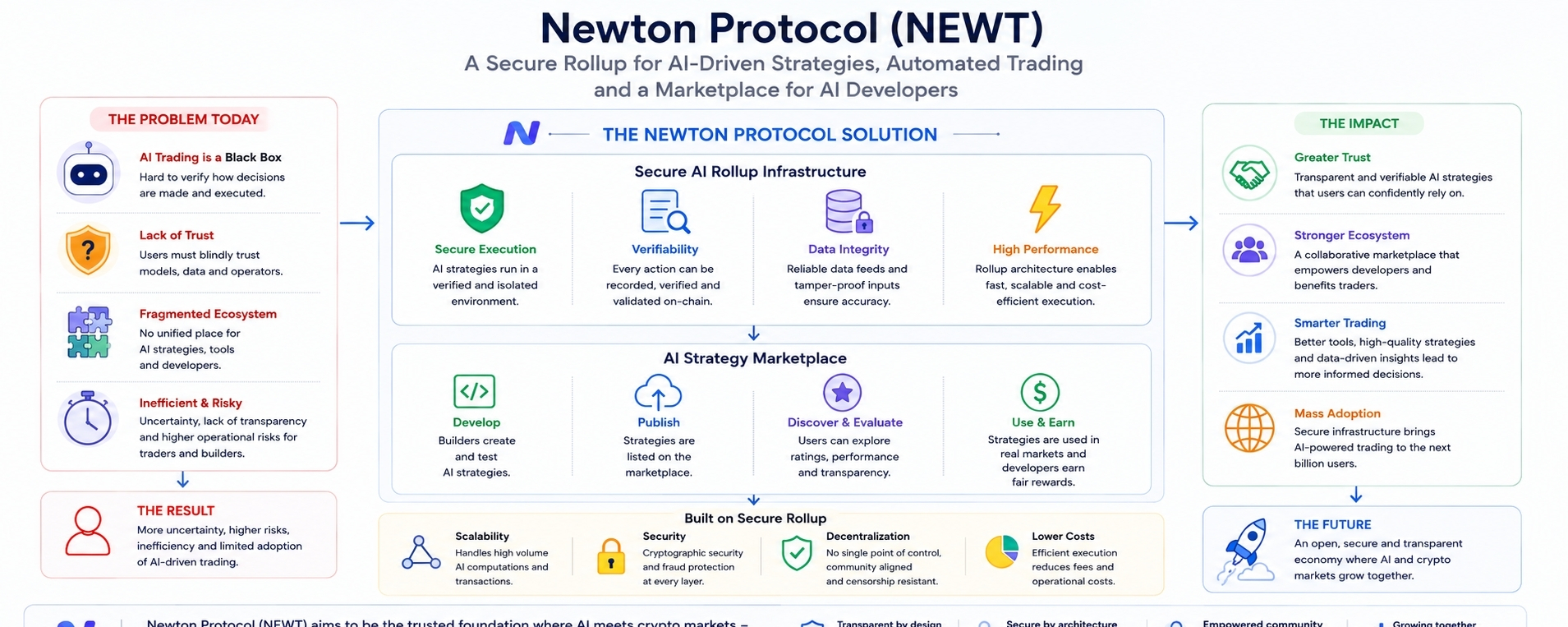
Newton Protocol (NEWT) approaches this challenge from an infrastructure perspective. Instead of treating AI as an isolated intelligence layer, it considers the complete lifecycle of automated decision-making. An AI model may identify an opportunity, but execution, verification, transparency, and accountability remain equally important if that decision is expected to interact with financial markets or decentralized applications. The protocol attempts to create an environment where AI-generated actions can move through secure execution processes while remaining observable and verifiable.
One aspect that stood out during my research was the emphasis on secure rollup architecture. Rollups are commonly associated with blockchain scalability, but in this context they also contribute to creating structured environments where automated actions can be processed efficiently while maintaining data integrity. Rather than relying entirely on off-chain assumptions, execution records can become part of a system that supports verification and auditing. This distinction may appear technical at first, but it changes how trust is established.
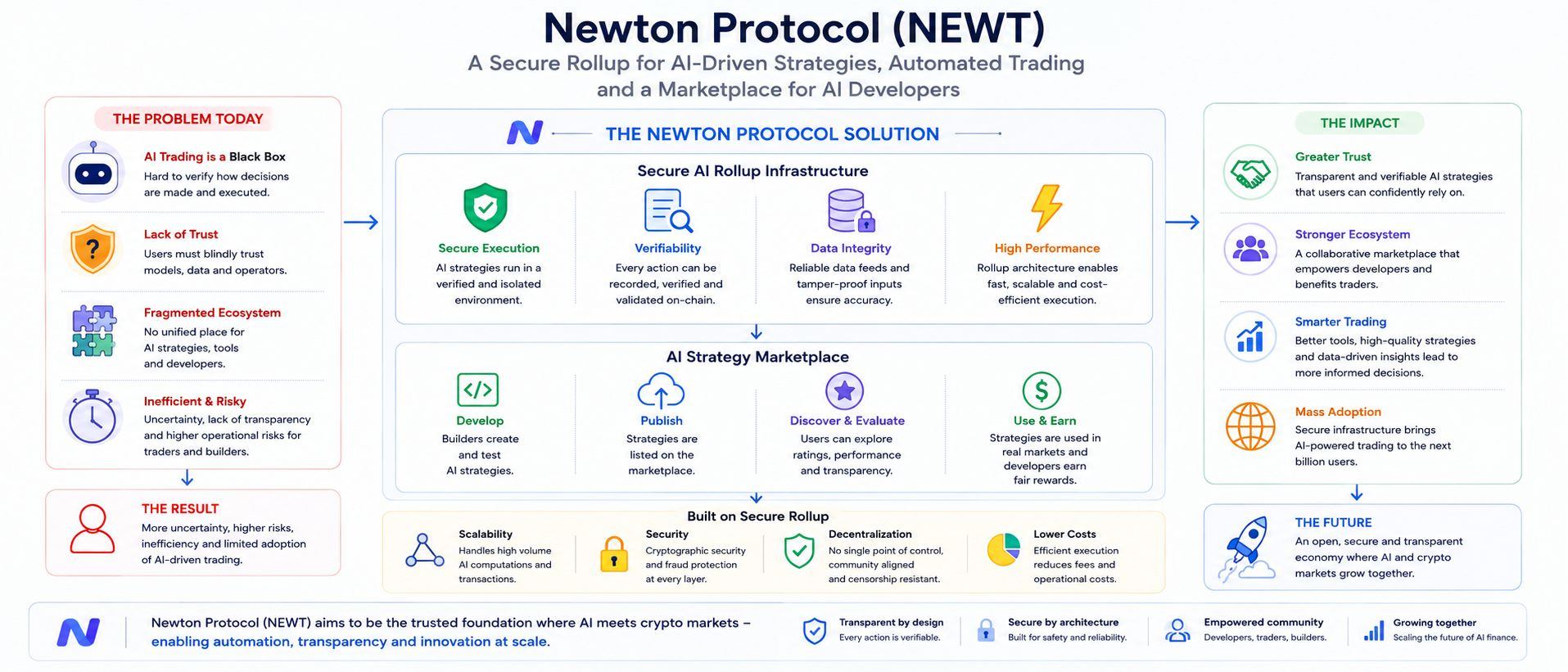
Traditional AI systems often operate like closed environments. Users can observe results but rarely gain insight into the sequence of events that produced those outcomes. When AI begins executing financial strategies, allocating assets, or interacting with decentralized protocols, this lack of visibility becomes increasingly important. Questions naturally arise about whether a decision followed predefined rules, whether execution remained consistent with the original strategy, and whether records can be independently validated later. These questions are difficult to answer when infrastructure is fragmented.
Newton Protocol attempts to reduce that uncertainty by connecting AI strategies with blockchain-based execution mechanisms. Instead of separating intelligence from infrastructure, the protocol creates a framework where execution becomes part of a transparent process rather than an isolated event. Verification layers help establish confidence that actions occurred according to defined conditions instead of relying solely on assumptions about system behavior.
Another interesting dimension is the marketplace for AI developers. Building sophisticated AI strategies requires considerable effort, yet distribution and evaluation remain challenging across fragmented ecosystems. A marketplace creates a structured environment where developers can publish, improve, and potentially monetize strategies while allowing users to compare available solutions through transparent performance information. This transforms isolated development into a collaborative ecosystem supported by common infrastructure.
The relationship between developers and users also changes in such an environment. Instead of simply downloading software and trusting marketing claims, participants may gain access to measurable execution histories, verifiable records, and standardized evaluation mechanisms. This does not eliminate risk, but it shifts decision-making toward observable evidence instead of reputation alone.
I also found myself thinking about the broader direction of AI within decentralized finance. Most debates concentrate on whether autonomous systems will outperform human decision-making. While that discussion remains important, another question may deserve equal attention: how should autonomous systems prove that their actions occurred exactly as intended? Intelligence without accountability can create uncertainty, particularly when financial value depends on reliable execution.
Infrastructure rarely attracts the same attention as user-facing applications because it operates quietly in the background. Yet history repeatedly shows that dependable infrastructure often determines whether larger ecosystems remain sustainable over time. Security, verification, transparency, and consistent execution usually become noticeable only when they fail.
After exploring Newton Protocol, I came away with the impression that future AI ecosystems may depend as much on trustworthy execution environments as on increasingly capable models. As autonomous systems continue expanding across blockchain networks, perhaps the real conversation will gradually shift away from asking how intelligent AI can become and toward understanding how confidently its decisions can be verified once they enter the real world.