
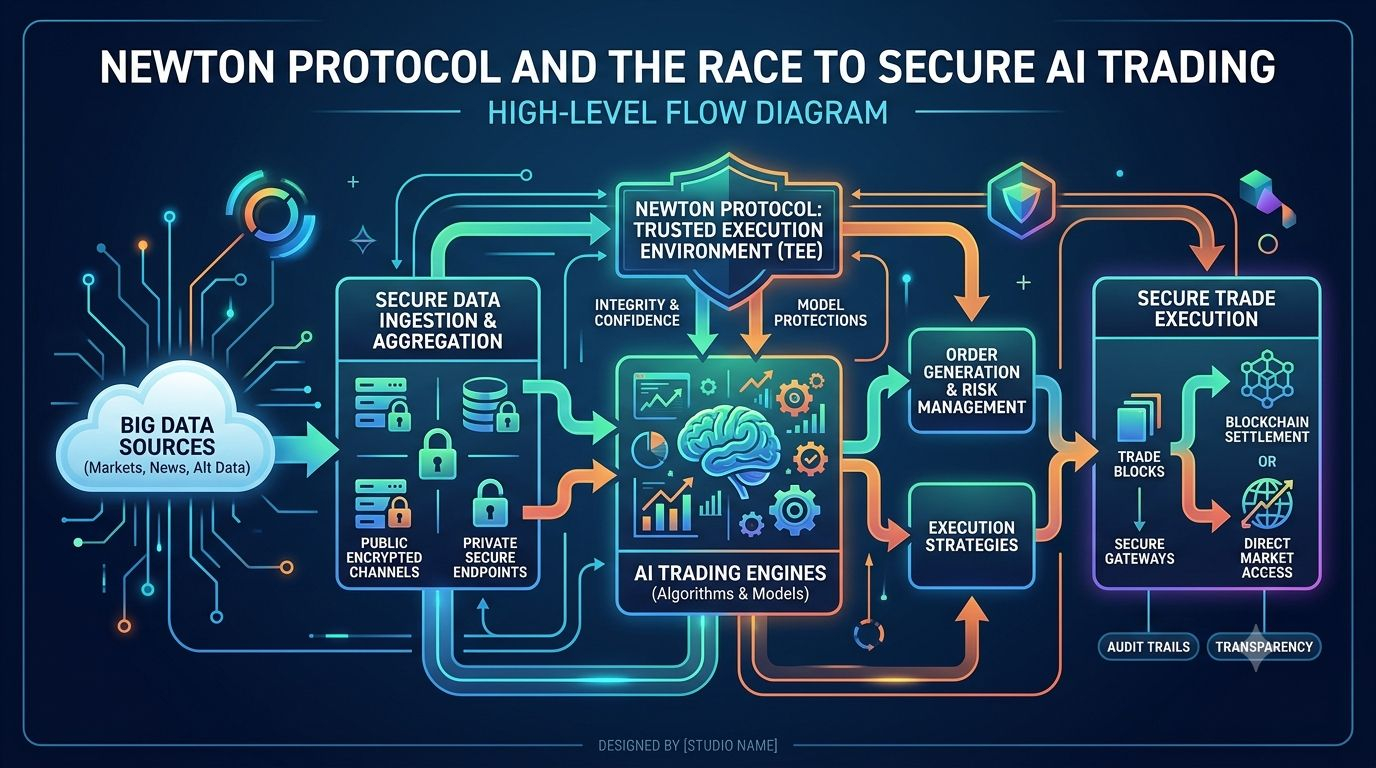
 When you stop and really look at what’s happening in the intersection of artificial intelligence and blockchain, it feels like we’re standing on the edge of a very steep cliff, doesn't it? Everyone is talking about AI agents, these autonomous little bots that are supposed to manage our portfolios, execute complex trades, and basically make us money while we sleep, but the infrastructure underneath them is terrifyingly flimsy. It’s like building a skyscraper on a foundation of jello. We have these incredibly sophisticated AI models that can analyze market sentiment, parse through thousands of data points in a split second, and devise these brilliant, high-frequency trading strategies, yet we are trusting them with private keys and wallet access in the most reckless way possible. That’s the part that keeps me up at night. It’s not the AI I don’t trust, necessarily, it’s the conduit. It’s the fact that giving an AI agent full control over a hot wallet is basically handing the keys to your car to a toddler who happens to be really good at video games. Sooner or later, something is going to crash. And that is exactly where Newton Protocol comes in, or at least, that’s the promise it’s making to a market that is desperate for a safety rail.
The whole premise of NEWT is built around this idea of a "secure rollup," which sounds like another piece of crypto jargon until you dig into why it actually matters for AI-driven strategies specifically. You see, most blockchains right now, even the fast ones, aren't really designed for the way AI operates. AI doesn't just make a transaction and leave; it needs to think, it needs to iterate, and it needs to operate in an environment where a mistake doesn't mean losing the entire treasury in a single, silent transaction. The way I see it, Newton is trying to be the operating system for these agents, a specialized layer where the rules of engagement are different. It’s not just about speed, though that’s part of it. It’s about verifiable security. When an AI agent on Newton executes a trade, it’s doing so within a framework that is built to handle the nuances of automated logic. It’s a rollup, so it inherits security from a base layer, likely Ethereum, but it optimizes the execution environment for the specific, weird needs of non-human actors. We are talking about a marketplace where AI developers can deploy their strategies without asking users to simply "trust me, bro."
Think about the current landscape for a second. If you are an AI developer and you’ve built a killer algorithm that predicts price movements based on social sentiment and on-chain volume, how do you actually sell that to people? Right now, you’re stuck. You either have to run the bot yourself and take custody of user funds, which is a regulatory nightmare and a security risk, or you have to ask users to hand over their API keys or private keys to your server. Both options are terrible. They are friction points that kill innovation. Newton Protocol aims to dismantle that wall by creating a marketplace where the strategy is decoupled from the custody of the assets. This is a massive shift. It allows developers to upload their "brains"—their trading logic—into a secure environment where the protocol itself ensures the bot can’t run off with the money. The user stays in control, the developer gets paid for their performance, and the blockchain acts as the impartial arbiter. It sounds simple, but the technical lift to make this happen is staggering.
But let’s be real for a minute. The road to getting this adopted is going to be a brutal grind. Convincing traders, especially the big institutional whales who have the capital to make these protocols work, to move their liquidity to a new rollup is a hard sell. They are creatures of habit, and they care about one thing above all else: liquidity. If the liquidity isn't deep on Newton, the AI strategies won't work because their slippage will eat up all the profits. It’s a chicken-and-egg problem that kills more projects than any hack ever could. So, the real test for NEWT isn't the tech; the tech seems sound on paper. The test is whether they can bootstrap an ecosystem where there is enough liquidity to make the high-frequency trading strategies viable. If the bots can’t execute efficiently, the marketplace dies. It’s that simple.
There is also this fascinating philosophical layer to what Newton is attempting. We are slowly moving into an era where "code is law" is being replaced by "AI is lawyer, judge, and executioner." By creating a dedicated rollup for AI strategies, we are essentially building a court system for algorithms. If an AI agent goes rogue or starts acting erratically, the protocol needs to have mechanisms in place to pause, reverse, or mitigate the damage. This isn’t just about smart contracts anymore; it’s about managing autonomous intent. The "secure" part of the secure rollup isn’t just a buzzword; it’s the entire value proposition. It implies that there are checks and balances. Maybe it’s through zero-knowledge proofs that validate the AI’s off-chain computation before it touches the chain, or maybe it’s through a system of decentralized validators that monitor agent behavior in real-time. Whatever the mechanism, it has to be bulletproof. In a world where an AI can hallucinate a trade and drain a wallet in milliseconds, the protocol has to be the safety net that catches the fall.
I was looking at the tokenomics the other day, and honestly, that’s usually where my eyes glaze over because most tokens are just glorified governance coupons with no real utility. But for NEWT, the token seems to be the fuel for this entire machine. It’s not just voting on the color of the website background. If this is truly a marketplace for AI developers, then the token likely acts as the payment rail for accessing these premium strategies. You want the top-tier, institutional-grade trading bot? You pay in NEWT. You want to stake your assets to allow an AI to manage them? There’s probably a fee mechanism in NEWT involved. The utility is there, but again, it depends on the marketplace actually taking off. If nobody is building killer bots on Newton, the token is just another speculative asset. The team has to focus obsessively on developer experience. They need to make it so easy for an AI engineer to deploy their model that it would be stupid not to use Newton. That means SDKs, documentation, and a testing environment that doesn't cost a fortune in gas fees just to see if your bot works.
And let's not ignore the competition. There are other players sniffing around this space. You’ve got general-purpose L2s trying to position themselves as AI-friendly, and you’ve got other niche projects trying to tokenize trading signals. But Newton feels different because it’s not trying to be everything to everyone. It’s laser-focused on the intersection of AI strategies and DeFi execution. That focus is a double-edged sword. It means they can tailor their infrastructure specifically for trading—optimizing for latency, block times, and parallel processing of transactions—which gives them a technical edge over a generalist chain. But it also means they are fighting in one of the most competitive trenches of the crypto war. DeFi is saturated. Trading bots are a dime a dozen. To win, Newton has to prove that its "secure rollup" isn't just marketing fluff. It has to prove that it can stop the hacks, the rugs, and the exploits that plague the current generation of trading bots.
The whole concept of an "AI Marketplace" within the protocol is what really grabs me, though. Imagine an app store, but instead of games and calendars, it's filled with risk-adjusted trading algorithms. You could have a conservative bot that focuses on yield farming stablecoins, and right next to it, a high-volatility arb bot that hunts for liquidations. As a user, I could browse these bots, see their verifiable track record on-chain, and with a few clicks, delegate a portion of my capital to them. It changes the role of the crypto user from being a stressed-out day trader to being a manager of capital. You become the venture capitalist, and the AI bots are your portfolio companies. That’s the dream, isn't it? But to get there, the transparency has to be absolute. If I can’t see exactly what a bot is doing with my money, or if the performance metrics can be gamed, the whole thing falls apart. Trust is the scarcest resource in crypto, and Newton is trying to manufacture it through code.
I keep circling back to the security aspect because I think that’s the make-or-break feature. We’ve seen too many "autonomous" projects fail because they forgot that autonomy implies a lack of human oversight. If a human isn't there to pull the plug when the market crashes 50% in an hour, the code has to be resilient enough to handle it. A secure rollup for AI implies that the chain itself understands what the AI is trying to do. Maybe it imposes limits. Maybe it forces the AI to simulate its trades in a sandbox before executing them on the mainnet. These are the kinds of constraints that actually make autonomous trading viable for the mainstream. Without them, you’re just gambling with a fancy interface.
So, where does this leave us? Newton Protocol is a bold bet. It’s betting that AI agents will become the primary actors in financial markets, and it’s betting that those agents need a home—a secure, efficient, and transparent home. It’s a bet against the status quo of reckless key management and black-box trading bots. The potential upside is massive. If they crack the code on how to safely monetize and deploy AI strategies, they won’t just be another DeFi protocol; they’ll be the infrastructure layer for the next generation of finance. It’s a long road ahead, filled with technical hurdles and the skepticism of a market that has been burned a thousand times before. But for the first time in a while, looking at the architecture of what they are trying to build, I actually think they might be onto something real. It feels like the missing piece of the puzzle we’ve all been trying to find.
