Man, I've been digging into AI infrastructure in crypto lately, and honestly, one thing keeps bothering me.
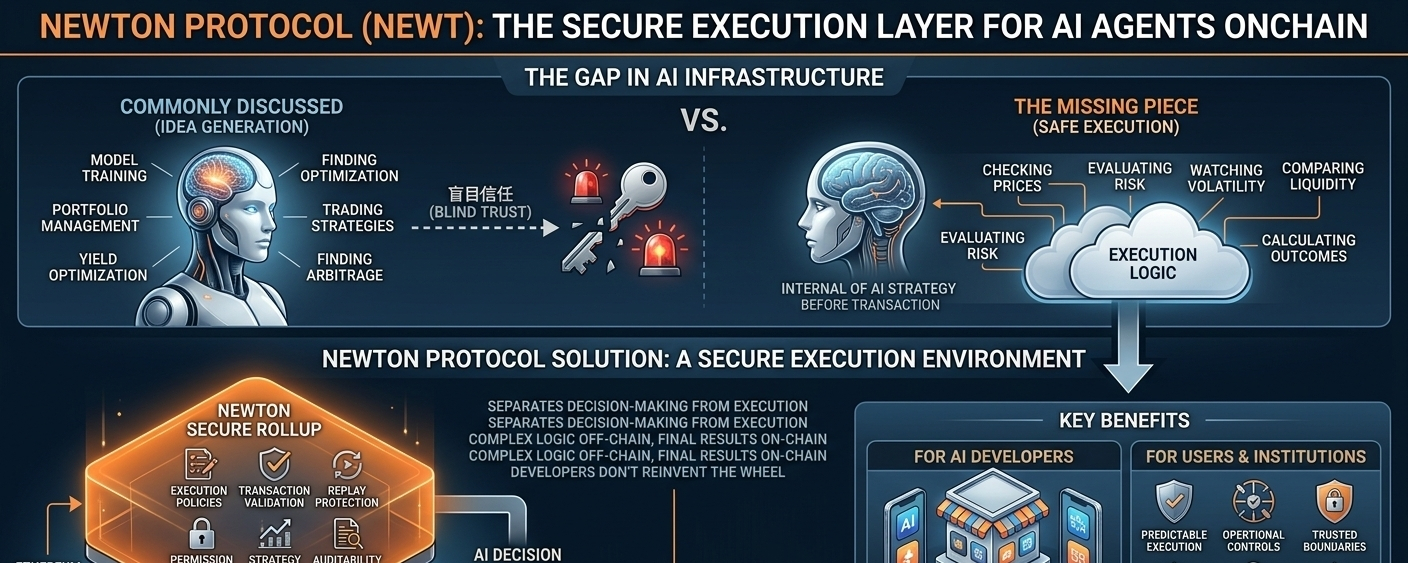
Everyone loves talking about AI agents. They'll manage portfolios, find arbitrage, optimize yield, automate trading... you've heard the pitch a hundred times.
But here's the thing.
Almost nobody talks about what happens after the AI makes a decision.
Who actually makes sure that decision gets executed safely?
That's the part people skip over, and I think it's the harder problem.
Right now, most AI-powered automation still leans on centralized servers, private APIs, hidden execution logic, and infrastructure users can't really inspect. Sure, the model might come up with a brilliant strategy. Cool. But once real assets are involved, blind trust starts looking like a terrible security model.
That's exactly why Newton Protocol caught my attention.
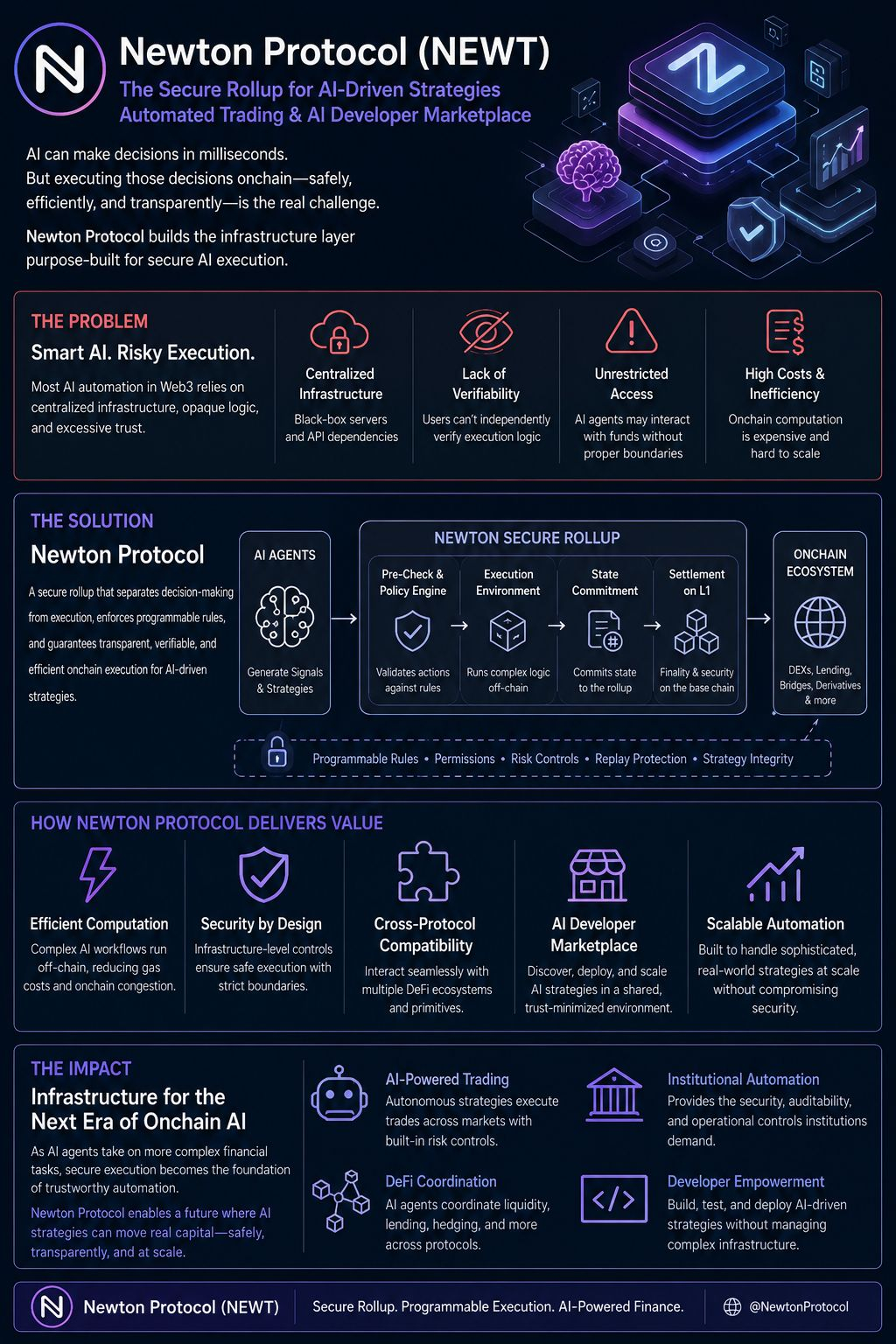
What I like is that Newton isn't trying to build another AI model. It's focused on something lower in the stack: the execution layer. More specifically, it's building a secure rollup designed for AI-driven strategies, automated trading, and a marketplace where developers can deploy AI-powered applications.
That difference matters more than people realize.
Generating an idea and executing that idea safely aren't the same job.
Not even close.
An AI can detect an arbitrage opportunity in seconds. It can rebalance a portfolio, react to market conditions, or coordinate liquidity across multiple protocols faster than any human could.
None of that guarantees safe execution.
Money moves because infrastructure allows it to move. If that infrastructure isn't secure, the smartest AI in the world won't save you.
That's where Newton takes a different approach.
Instead of giving an AI unlimited freedom, the protocol separates decision-making from execution. Every action still follows predefined security rules before it touches onchain assets.
I actually think that's one of the smartest design choices here.
People don't talk about this enough, but unrestricted automation sounds exciting... until it's your funds.
Once you add programmable limits around what an AI can and can't do, the whole system starts making a lot more sense.
The secure rollup architecture also stood out to me.
We've already seen how rollups reduce costs by moving computation away from the base layer while still settling securely onchain. Newton applies that same idea to AI execution.
That means complicated strategy logic doesn't have to compete with every other transaction happening on the network.
Honestly, that's practical.
Everyone gets obsessed with gas fees, but efficiency isn't only about paying less.
Sometimes it's about avoiding unnecessary work altogether.
Think about how an AI strategy actually operates.
It isn't just placing a trade.
It's checking prices, comparing liquidity pools, evaluating risk, watching volatility, calculating different outcomes, deciding whether the opportunity is even worth taking... and only then does it submit a transaction.
Why should every one of those internal calculations happen directly on the blockchain?
They shouldn't.
Running all that inside a dedicated execution environment means the blockchain mostly sees the final result instead of every intermediate step.
Cleaner. Cheaper. More scalable.
Security gets even more interesting.
The second you let AI interact with real capital, your threat model changes.
You're not only thinking about smart contract bugs anymore.
Now you're thinking about permissions, execution policies, transaction validation, replay protection, strategy integrity, and making sure an AI doesn't do something completely outside its intended boundaries.
That's a much bigger engineering challenge.
Newton builds those controls into the execution infrastructure itself instead of asking every developer to reinvent the wheel.
Personally, I think that's the right way to build this kind of system.
Developers already have enough problems to solve.
The marketplace angle also deserves more attention than it's getting.
Right now, AI developers often build strategies that only work inside their own environment. Different deployment methods. Different execution setups. Different infrastructure.
Everything feels fragmented.
A shared marketplace backed by a consistent execution layer could remove a lot of that friction.
Developers spend less time worrying about infrastructure.
Users get a more standardized experience.
Seems like a win for both sides.
And let's be real...
AI isn't going to stay inside one blockchain forever.
It'll interact with lending markets, decentralized exchanges, bridges, liquidity protocols, and whatever new financial primitives show up next year.
That's just where things are headed.
Infrastructure built for secure coordination across those interactions starts looking a lot more important when you think about it that way.
What I find most interesting is the bigger shift happening underneath all this.
For years, everyone argued about building smarter AI.
Smarter models.
Bigger models.
More capable models.
I've seen this pattern before.
Eventually, intelligence stops being the bottleneck.
Execution becomes the bottleneck.
Because once real money enters the picture, nobody cares if your AI sounds impressive.
They care whether it behaves predictably.
Whether its actions follow clear rules.
Whether someone can actually trust it.
Institutional players will probably care about this even more.
They're not looking for an AI that makes flashy predictions.
They need infrastructure that gives them operational controls, predictable execution, auditability, and security before they'll ever let autonomous systems touch serious capital.
That's a completely different standard.
And honestly, I think it's the right one.
That's why Newton Protocol feels interesting to me.
It isn't chasing the loudest narrative.
It isn't trying to convince everyone it has the smartest AI.
Instead, it focuses on something people usually ignore until something breaks: secure execution.
Maybe that's not the most exciting headline.
But I have a feeling it'll matter a lot more over time.
Because in the end, the future of AI onchain won't depend only on how smart an agent becomes.
It'll depend on whether that intelligence can operate safely, consistently, and within boundaries people actually trust.
That's the problem Newton Protocol is trying to solve.
And personally, I think that's the conversation we should be having more often.