

Over the past year, I’ve noticed something interesting about the AI narrative in crypto. The conversation has gradually shifted away from simply building bigger models or launching another chatbot. The more serious discussion is now about infrastructure. Everyone wants autonomous AI agents, automated trading systems, and machine driven financial strategies, but very few people stop to ask an obvious question: where can these systems actually execute safely without becoming another attack surface?
That question is what led me to spend time researching Newton Protocol (NEWT).
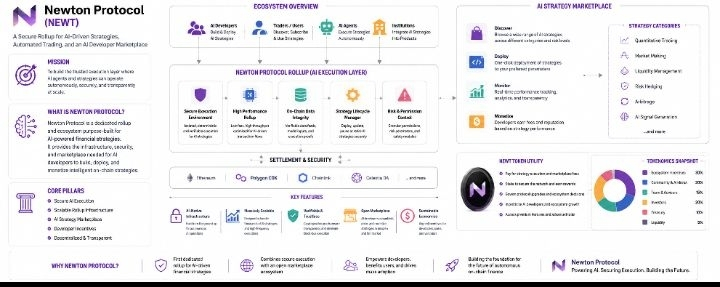
At first glance, it looked like another project trying to combine AI and blockchain, which is already a crowded narrative. We've seen countless teams attach "AI" to their branding because it attracts attention during bullish market cycles. But the deeper I researched Newton Protocol, the more I realized its primary objective isn't creating another AI application. Instead, it's attempting to build the infrastructure layer where autonomous AI strategies can operate securely through a dedicated rollup while also creating an open marketplace for AI developers.
That distinction matters much more than most investors realize.
One thing I always look for is whether a project is solving an existing bottleneck or simply creating a new product nobody asked for. AI-generated trading strategies are becoming increasingly sophisticated, but they introduce new risks that traditional blockchain infrastructure wasn't designed to handle. Permission management, execution verification, model integrity, transaction security, and coordination between multiple autonomous systems all become significantly more complex once software begins making financial decisions without continuous human involvement.
Newton Protocol seems to recognize that challenge.
Rather than competing directly with existing Layer 1 ecosystems, the protocol appears focused on becoming specialized infrastructure optimized for AI-native execution. That approach reminds me of how blockchain itself has gradually evolved from general-purpose networks into ecosystems with increasingly specialized roles. Instead of expecting every chain to excel at everything, we're beginning to see dedicated infrastructure built for gaming, DeFi, privacy, real world assets, and now potentially AI.
From an architectural perspective, the rollup approach is particularly interesting. Rollups have already demonstrated that scaling isn't simply about increasing transaction throughput. They're also about designing execution environments optimized for specific workloads. If autonomous AI strategies begin generating significantly higher transaction frequency than human users, dedicated infrastructure could become less of a luxury and more of a necessity.
What genuinely caught my attention, however, wasn't only the technical architecture.
It was the decision to combine execution infrastructure with an AI developer marketplace.
Crypto has often struggled with fragmented innovation. Talented developers create remarkable tools, but distribution remains difficult. Meanwhile, users struggle to evaluate quality, security, and reliability. If Newton Protocol succeeds in creating a marketplace where developers can publish, monetize, and continuously improve AI strategies while users gain access through transparent infrastructure, the network effects could become considerably stronger than a simple blockchain.
Of course, marketplaces are notoriously difficult businesses.
Technology alone rarely guarantees liquidity. Both developers and users must arrive simultaneously, otherwise the ecosystem becomes unbalanced. Too many developers without users leads to abandoned products. Too many users without sufficient quality applications creates disappointment. Achieving equilibrium is one of the hardest challenges any platform faces, regardless of how impressive its technology may be.
This is why I believe adoption metrics will ultimately matter more than technical documentation.
I've reached a point where whitepapers impress me less than developer activity. I pay closer attention to GitHub commits, ecosystem expansion, integrations, transaction growth, and actual application usage than polished marketing presentations. Infrastructure projects succeed because builders choose them repeatedly, not because investors temporarily become excited.
The token itself also deserves careful analysis.
Every infrastructure protocol eventually depends on sustainable token economics rather than narrative momentum. If NEWT functions as the economic layer securing execution, incentivizing validators, coordinating marketplace participation, and facilitating ecosystem activity, then long-term value becomes increasingly connected to actual network utilization rather than speculation alone.
That relationship is healthy in theory.
In practice, tokenomics always require deeper scrutiny.
Inflation schedules, unlock timelines, treasury allocations, ecosystem incentives, and circulating supply expansion all influence long-term price behavior far more than many retail investors appreciate. I've watched technically impressive projects struggle simply because supply entered the market faster than genuine demand could absorb it.
Even strong ecosystems cannot permanently outperform poor token design.
Liquidity presents another important consideration.
AI infrastructure remains one of crypto's strongest narratives today, attracting institutional attention alongside modular blockchain architectures, tokenized real-world assets, and stablecoin-driven financial infrastructure. Narrative strength can certainly accelerate adoption during favorable market conditions. However, narratives eventually mature. When they do, capital rotates toward projects demonstrating measurable utility rather than compelling stories.
Newton Protocol will likely experience that same transition.
Initially, investors may value potential. Eventually, they'll demand evidence.
That evidence might include transaction volume generated by autonomous agents, recurring marketplace activity, developer retention, validator participation, strategic partnerships, and sustained fee generation. Those are the indicators I'd personally monitor over the coming years.
Competition also shouldn't be underestimated.
The decentralized AI sector has become one of the most competitive areas across digital assets. Every month introduces another protocol focused on AI computation, decentralized inference, model marketplaces, verifiable execution, or autonomous agents. Standing out requires more than technical competence. It requires becoming indispensable to developers.
The encouraging aspect is that Newton Protocol isn't trying to replicate every existing AI project. Instead, it's positioning itself around secure execution infrastructure, which feels like a narrower but potentially more defensible market if adoption materializes.
Macro conditions also influence how I think about NEWT.
If global liquidity continues improving and institutional participation expands across digital assets, capital generally begins flowing beyond Bitcoin and Ethereum into infrastructure narratives supporting emerging technologies. AI remains one of the strongest secular investment themes globally, extending well beyond crypto itself. The intersection between blockchain verification and autonomous machine intelligence could become increasingly relevant as enterprises demand transparent, auditable AI systems.
Yet regulatory uncertainty remains impossible to ignore.
Whenever autonomous systems begin managing financial activity, questions surrounding accountability, compliance, liability, and governance naturally become more significant. Infrastructure providers may eventually operate within regulatory environments far more complex than traditional decentralized applications. That uncertainty isn't unique to Newton Protocol, but it certainly forms part of the long-term investment equation.
One thing I've learned after spending years in crypto is that markets often reward simplicity while infrastructure quietly compounds value beneath the surface. End users rarely think about settlement layers, consensus mechanisms, or execution environments until those systems fail. Ironically, the strongest infrastructure often becomes invisible because everything simply works.
Perhaps that's where Newton Protocol has its greatest opportunity.
If autonomous AI truly becomes a meaningful participant in decentralized finance, automated portfolio management, algorithmic execution, and machine-driven coordination, the industry will eventually require infrastructure specifically designed for those workloads rather than forcing entirely new behavior onto networks originally built for human interaction.
Whether Newton Protocol becomes that foundation remains uncertain, and I think acknowledging uncertainty is healthier than pretending conviction where none exists. The technology appears thoughtful, the market narrative is relevant, and the architectural direction makes logical sense. But execution has always separated lasting crypto infrastructure from ambitious ideas.
As I continue watching this project develop, I find myself less interested in short-term price action and more interested in a broader question. Years from now, if autonomous AI agents become normal participants across blockchain ecosystems, which protocols quietly enabled that future? Newton Protocol is attempting to place itself among those foundational layers. Whether it succeeds won't be determined by marketing campaigns or temporary market enthusiasm, but by whether developers choose to build, users choose to trust, and the network proves capable of supporting intelligence that increasingly acts on its own
