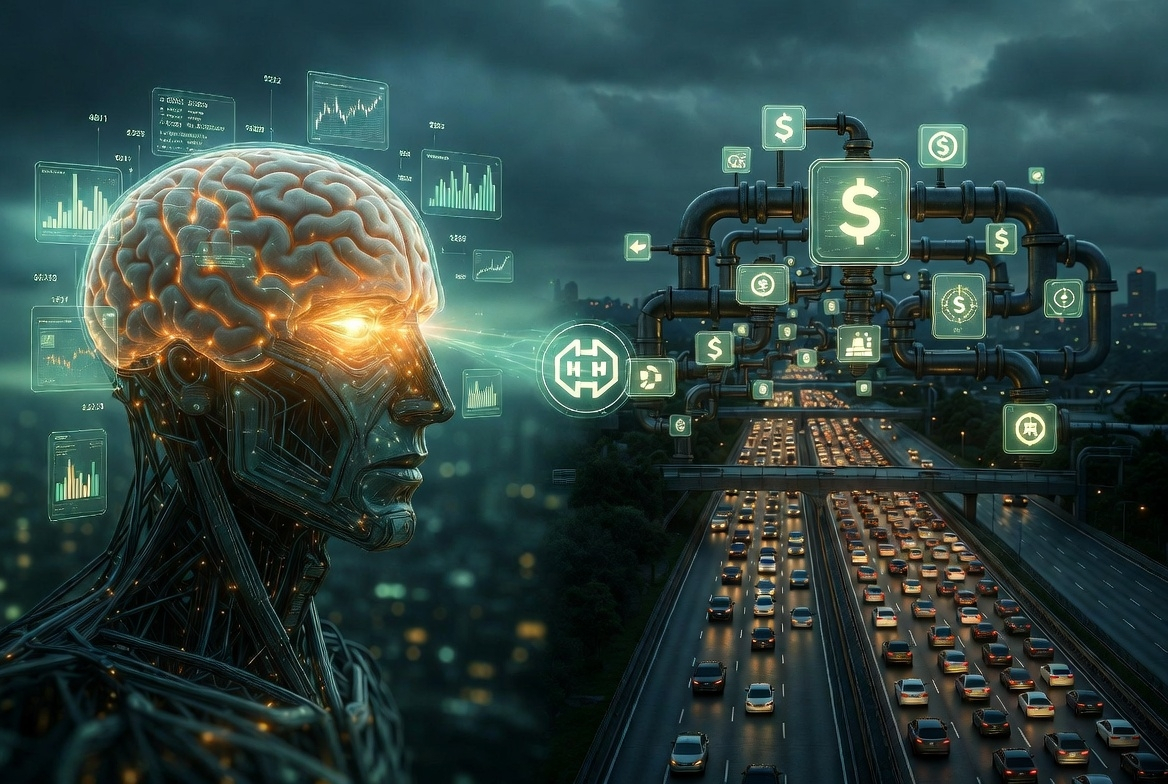
The Real Challenge for AI in Finance Might Not Be Intelligence
I used to think the biggest race in AI would be building smarter models.
Every few weeks, another model appears that can process more data, recognize patterns faster, or generate better predictions than the one before it. For a while, I assumed that was where the future of AI in finance would be decided.
The more I watched, the less convinced I became.
What caught my attention wasn't the quality of the predictions anymore.
It was everything that happened after those predictions left the model.
A trading strategy doesn't operate in isolation. It has to move through networks, compete with thousands of other transactions, deal with delays, and execute in an environment that's constantly changing. A model can reach the right conclusion and still produce a disappointing outcome if the system around it struggles under pressure.
That made me look at AI infrastructure differently.
The comparison that kept coming to mind was traffic.
Early in the morning, almost every road feels perfectly designed. Cars move smoothly, intersections stay clear, and reaching your destination seems effortless.
Then rush hour begins.
The roads haven't changed, but the environment has. Small delays start stacking on top of one another. Routes that looked efficient a few minutes earlier suddenly become congested, and reaching the same destination now produces a completely different experience.
Financial markets behave in much the same way.
When activity is low, almost every system appears fast and reliable. As demand increases, coordination becomes far more important than raw speed. Timing changes outcomes. Execution quality changes outcomes. Even trust begins influencing how participants behave.
That's the point where Newton Protocol started making more sense to me.
At first glance, it looks like another project combining AI with blockchain infrastructure.
The more I read, the more I felt it was trying to solve a different problem.
Instead of assuming smarter AI automatically creates better financial systems, Newton appears focused on the environment where those AI systems actually operate. Secure execution, predictable infrastructure, and coordination become part of the conversation rather than an afterthought.
That feels like a more realistic way of thinking about AI.
Of course, infrastructure doesn't solve everything.
It won't prevent poor strategies.It won't stop emotional decision-making.
And it certainly won't guarantee that markets behave rationally.
If thousands of AI agents reach similar conclusions, they'll still compete with one another for execution.
Technology can improve the environment.
It can't remove uncertainty from financial markets.
Ironically, that's one of the reasons I find the idea more believable.We've reached a stage where almost every project promises faster execution, smarter intelligence, or greater efficiency.Those improvements matter.But complexity doesn't disappear simply because the software becomes better.
Markets are still shaped by incentives, coordination, and confidence between participants.Sometimes I think infrastructure is a lot like plumbing.Nobody pays much attention to it while everything is working.
The moment pressure builds or something stops functioning properly, it suddenly becomes the most important part of the entire system.
AI will probably continue attracting the headlines.
The quieter story may be the infrastructure supporting it.
In the long run, I don't think the winners will be determined only by who builds the smartest models.
They'll also be determined by who builds environments where those models can continue operating reliably when markets become crowded, assumptions start breaking down, and uncertainty becomes part of every decision.Maybe that's what Newton Protocol is really exploring.
Not whether AI can make better decisions.
But whether the systems surrounding those decisions can remain dependable when the real world becomes far less predictable.