
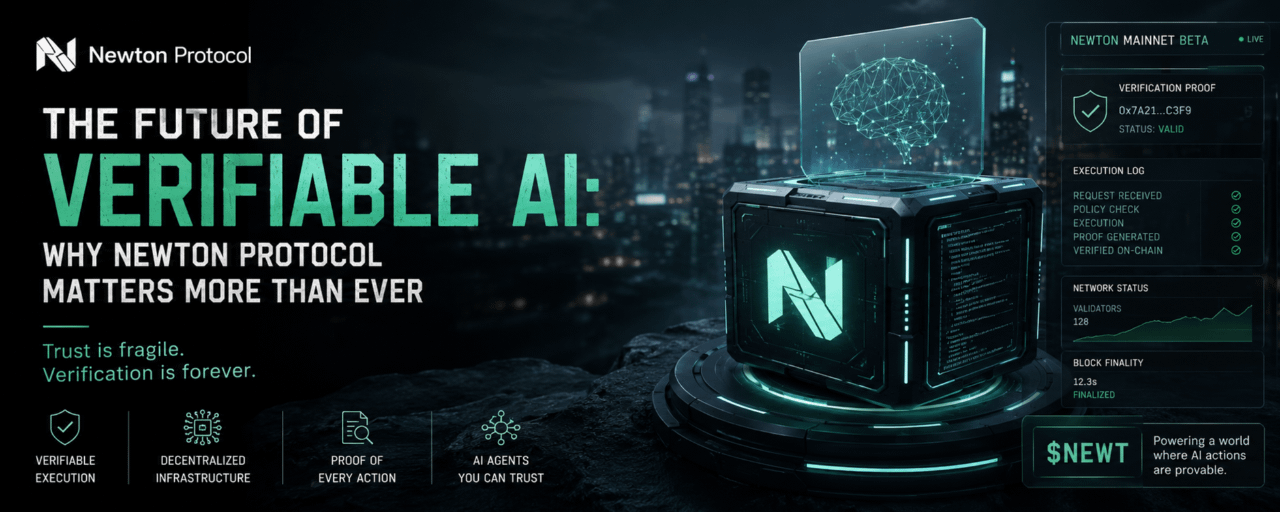
This morning I had one of those familiar habits that has quietly replaced checking price charts. Instead of watching candles, I watched transaction confirmations, validator activity, and the slow rhythm of network updates across several chains. It almost felt like monitoring a weather station rather than a financial market. After enough years in crypto, I have learned that the loudest signals usually matter the least. The quieter ones—the consistency of execution, the absence of unexplained failures, the ability to verify rather than simply trust—often reveal much more about where a project is actually heading.
That routine eventually led me back to @NewtonProtocol and the discussions surrounding the Newton Mainnet Beta. The more I watched the conversation evolve, the less interested I became in price speculation and the more interested I became in a different question. As #AI systems begin making increasingly important decisions, who verifies that those decisions happened exactly as claimed? It is a simple question, yet one that feels surprisingly underexplored compared to endless debates about model size or inference speed.
I suppose my skepticism comes from experience. Years ago, I chased what looked like a perfect decentralized trading opportunity. Every indicator aligned, liquidity appeared healthy, and the transaction looked straightforward. By the time the confirmation reached the chain, slippage had transformed a profitable trade into an expensive lesson. Later I learned how transaction ordering, latency, and MEV had quietly reshaped the outcome before I ever realized what had happened. Nothing technically "broke." The system behaved exactly as designed. My assumptions were simply wrong.
That experience permanently changed how I evaluate infrastructure. Since then, I have become less impressed by promises and far more interested in mechanisms that allow independent verification. Trust based on marketing has a remarkably short lifespan in crypto. Trust built through observable evidence tends to survive much longer.
This is partly why the broader discussion around verifiable AI has caught my attention. AI is steadily moving beyond answering questions into executing tasks, coordinating workflows, and interacting with digital assets. Once software begins acting on behalf of users rather than merely assisting them, transparency becomes much more important than convenience. If an AI agent submits a transaction, accesses private resources, or automates financial decisions, users eventually need more than confidence. They need proof that every step occurred according to predefined rules.
Watching the Newton Mainnet Beta through that lens makes it feel less like another network launch and more like an experiment testing whether cryptographic verification can become a practical foundation for AI-powered automation. That distinction matters. Crypto has produced no shortage of ambitious narratives over the years, but narratives rarely survive contact with production environments. Systems do.
I still remember dozens of projects that entered the market promising revolutionary architecture, limitless scalability, or entirely new economic models. Their communities were energetic, dashboards looked impressive, and social engagement exploded almost overnight. Months later, many quietly disappeared from my monitoring lists. Activity slowed. Developers moved elsewhere. Validators left. The infrastructure continued existing, but the original vision gradually dissolved into silence.
Those memories make me cautious whenever a new protocol receives widespread attention. Attention is temporary. Verification is measurable.
That is why I find myself looking less at announcements and more at operational behavior. Can a protocol consistently demonstrate that AI actions are authentic rather than merely claimed? Can independent participants verify execution without relying on centralized intermediaries? Can developers build applications where trust comes from evidence instead of reputation? These questions seem considerably more important than whether the market temporarily rewards $NEWT with higher valuations.
Perhaps the most interesting shift I notice is philosophical rather than technical. Early blockchain conversations focused heavily on removing trusted intermediaries from financial transactions. Today's conversations increasingly revolve around removing unnecessary trust from intelligent systems themselves. The problem has evolved. Instead of asking whether value transfers are legitimate, we are beginning to ask whether machine-generated decisions can remain transparent, accountable, and independently verifiable.
That transition feels inevitable if AI continues expanding into sensitive economic and operational roles. Verification may eventually become less of a premium feature and more of a baseline expectation.
Even so, I remain careful not to confuse possibility with certainty. Every new infrastructure project enters an environment where expectations are abundant but sustained adoption is exceptionally difficult. Building technology is only part of the equation. Maintaining reliability under unpredictable real-world conditions is often where promising ideas encounter their greatest tests. Crypto history has repeatedly demonstrated that surviving market cycles requires much more than technical elegance.
As I continued watching network activity today, the dashboards remained refreshingly uneventful. Blocks continued forming. Transactions continued settling. Logs updated one line at a time. Nothing spectacular happened, and perhaps that is exactly the point. Mature infrastructure rarely announces itself with fireworks. It quietly proves its value through consistency.
For now, I see @NewtonProtocol as an interesting case study in whether verifiable AI can become something practical rather than aspirational. The Newton Mainnet Beta offers an opportunity to observe those ideas under real operational conditions instead of treating them as theoretical concepts. Whether that ultimately translates into lasting utility for the ecosystem around $NEWT remains uncertain, and uncertainty has always been crypto's most honest companion.
Maybe that is the question worth returning to after the excitement settles and #Newt fades from the daily trend lists: can Newton Protocol continue earning trust through verifiable execution when real users, real workloads, and real economic pressure replace early curiosity?