
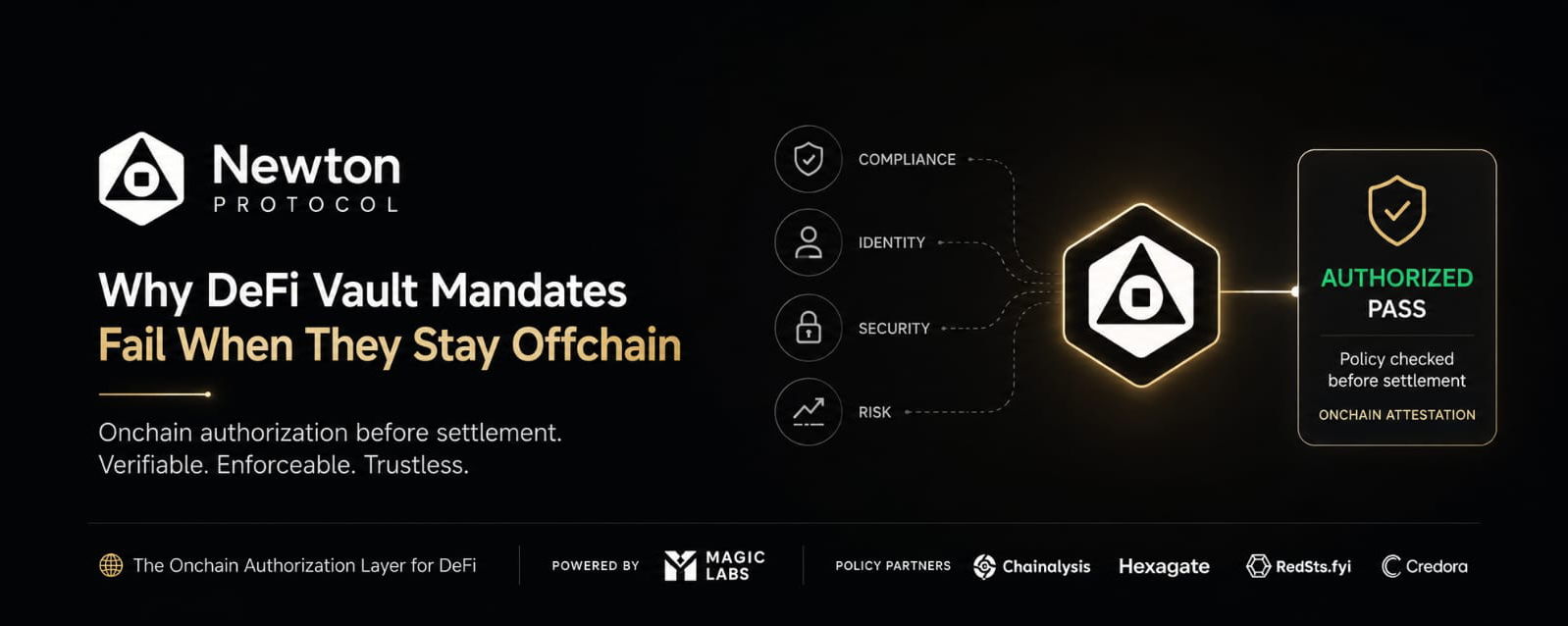
For a long time, I believed the biggest challenge facing DeFi vaults was finding higher yields. The more I explored how institutional capital actually moves onchain, the more I realized I had been looking at the wrong problem. Yield isn't usually what fails first. Trust does. And trust rarely disappears because a smart contract suddenly stops working. It disappears when the rules everyone assumes are protecting billions of dollars exist somewhere outside the blockchain.
I was reading about Newton Protocol's Mainnet Beta today, and one idea kept coming back to me. We constantly celebrate decentralization, yet many of the rules governing onchain finance still rely on offchain workflows, manual approvals, spreadsheets, dashboards, or centralized services. That feels like one of the biggest contradictions in DeFi. We trust code with our assets, but we often trust people and processes to enforce the rules before those assets move.
Imagine a DeFi vault that promises investors it will never interact with sanctioned wallets, will maintain healthy leverage limits, will reject unhealthy collateral, and will only allow eligible participants to deposit. On paper, those promises sound reassuring. But here's the real question: where are those promises actually enforced? If the answer is an internal compliance team, a monitoring dashboard, or software that checks transactions after execution, then those promises aren't truly onchain. They're expectations, and expectations don't stop transactions.
This is exactly where Newton Protocol introduces a different way of thinking. Instead of asking whether a transaction followed the rules after it settled, Newton evaluates every transaction against active policies before it executes. If the transaction satisfies every requirement, it receives a signed authorization attestation onchain. If it fails, the transaction can be rejected before funds move. That small shift changes the conversation from monitoring to enforcement.
The comparison that immediately made sense to me was Visa's payment network. Every time someone taps a credit card, an authorization decision happens before the payment is completed. Banks don't wait until tomorrow to decide whether the purchase should have been allowed. The decision happens first, then the money moves. Newton brings that same authorization mindset to blockchain transactions, adding a missing infrastructure layer that many DeFi applications have never had.
One statistic really caught my attention. Curated DeFi vaults now secure billions of dollars, and the sector continues to expand rapidly. Yet many of the risk limits governing those assets still live in fragmented offchain systems. That's a surprising mismatch. As more institutional money enters DeFi, the value protected by policies grows dramatically, but the policies themselves often remain disconnected from the blockchain.
I actually laughed at myself today because I reviewed one of my own trades from this week and realized I ignored one of my own risk rules. Thankfully the position still ended green 😅, but it reminded me of something important. Creating rules is easy. Following them consistently is much harder. That's true for individual traders, and it's equally true for billion-dollar protocols. Human judgment changes. Teams make mistakes. Dashboards send alerts after the fact. None of those prevent a risky transaction from happening in the first place.
Newton approaches this problem by turning policies into programmable infrastructure instead of operational guidelines. Rather than relying on multiple disconnected tools, policies become part of the transaction flow itself. Every transaction is checked before settlement, and every decision produces verifiable proof onchain that the policy was enforced. That creates accountability that can be independently verified instead of simply trusted.
What makes the system even more interesting is the breadth of policies it can evaluate. Compliance checks can screen sanctioned addresses and regulatory requirements. Identity policies can verify participant eligibility. Security policies can detect known threats before assets are exposed. Risk policies can evaluate leverage limits, oracle health, counterparty exposure, APY thresholds, and other conditions that institutions care about. Instead of separate teams and separate systems making independent decisions, Newton combines these checks into one authorization process.
The Newton Vault SDK, developed by Magic Labs, packages these compliance, security, identity, and risk checks into a single onchain enforcement layer. That means developers don't need to build every authorization workflow from scratch. They can integrate a framework that evaluates policies before execution while leaving behind cryptographic proof that those checks actually happened.
Another reason I think this matters is the ecosystem Newton is building around these policies. Integrations with organizations like Chainalysis, Hexagate, Vaults.fyi, RedStone, and Credora allow specialized intelligence to become part of the authorization process rather than remaining isolated services. Security infrastructure involving Eigen Labs, Succinct, Rhinestone, and Octane strengthens the broader ecosystem, showing that authorization isn't just one company's vision but a collaborative infrastructure effort.
The team behind Newton also deserves attention. Magic Labs has already helped onboard more than 57 million wallets and supports over 200,000 developers through its embedded wallet infrastructure. That experience gives credibility to the idea that simplifying secure blockchain interactions is something they've been solving long before Newton Protocol was introduced.
What I find most exciting isn't just today's vault use cases. Newton is starting with DeFi vaults, but the same authorization model can extend to stablecoins, tokenized real-world assets, autonomous AI agents, and many other blockchain applications. As AI agents begin executing financial decisions independently, programmable authorization may become one of the most important layers of infrastructure in Web3. Automation without enforceable policies can create speed, but not trust.
For years, the blockchain industry focused on making transactions faster, cheaper, and more scalable. Those achievements matter, but maybe they aren't the final destination. Maybe the next stage of blockchain infrastructure isn't about moving assets more efficiently. Maybe it's about deciding whether assets should move at all before execution ever begins.
That's the question Newton Protocol is asking. Instead of assuming every valid transaction deserves execution, it asks whether that transaction satisfies the policies defined by the application, institution, or vault. If the answer is yes, the blockchain records proof that authorization occurred before settlement. If the answer is no, the transaction never reaches the stage where damage needs to be explained afterward.
I think that's a subtle idea with enormous implications. In the future, the strongest DeFi vaults may not be the ones advertising the highest APYs or the biggest TVL. They may be the ones that can prove every single transaction respected compliance, identity, security, and risk policies before any capital moved.
If that becomes the new standard, Newton Protocol won't simply be another DeFi project. It could become one of the foundational infrastructure layers that allows institutional finance, AI-driven applications, and next-generation onchain economies to operate with the level of trust and enforceability they've been missing all along.