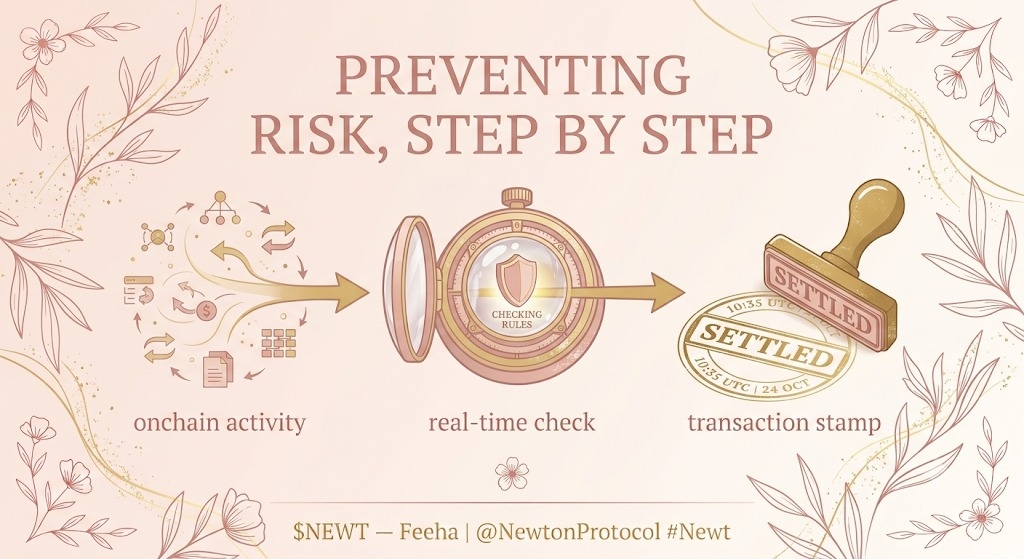
There's a sentence buried in how Hexagate plugs into Newton's security domain that I keep rereading, mostly because of what it implies rather than what it says. It says threat signals get evaluated before a transaction settles. Such a small phrase for something that changes everything about how a system decides to trust a moment in time.
I think about how most of what gets called security in this space is really just memory dressed up as protection — a contract drains, someone writes about it afterward, the writing becomes the lesson, and the lesson arrives too late to matter to the people who lost something. Hexagate's monitoring doesn't wait for that kind of memory to form. It watches onchain activity continuously, looking for the shape of things that have gone wrong before — a wallet that moved like one that caused damage somewhere else, a sequence of calls that resembles the opening moves of an exploit rather than the exploit itself. That shape becomes a signal, and the signal reaches Newton's policy engine before the transaction it's attached to ever gets the chance to settle.
What happens next is almost anticlimactic in how simple it sounds. If the signal is strong enough, there's no passing attestation. No flag for someone to review later, no queue, no waiting room. The transaction just doesn't move.
I keep sitting with what that simplicity costs somewhere I can't see yet. A model deciding in real time, with whatever partial picture it has in that instant, has to draw a line between something that looks like an attack and something that actually is one, and I don't know how forgiving that line gets to be when speed is the entire point of the system existing in the first place. A wallet behaving strangely for an honest reason and a wallet behaving strangely because it's three steps into draining a vault probably look identical in the first half second either one would need to be stopped.
Maybe that's not a flaw so much as the actual shape of the tradeoff — you can have a system that reacts after the fact with all the context in the world, or one that acts in the moment with almost none of it, and Hexagate inside Newton has clearly chosen the second one. I don't know yet which version of wrong I'd rather live with, a transaction that should have been blocked and wasn't, or one that shouldn't have been and was.