
I almost convinced myself there wasn't much left to think about.
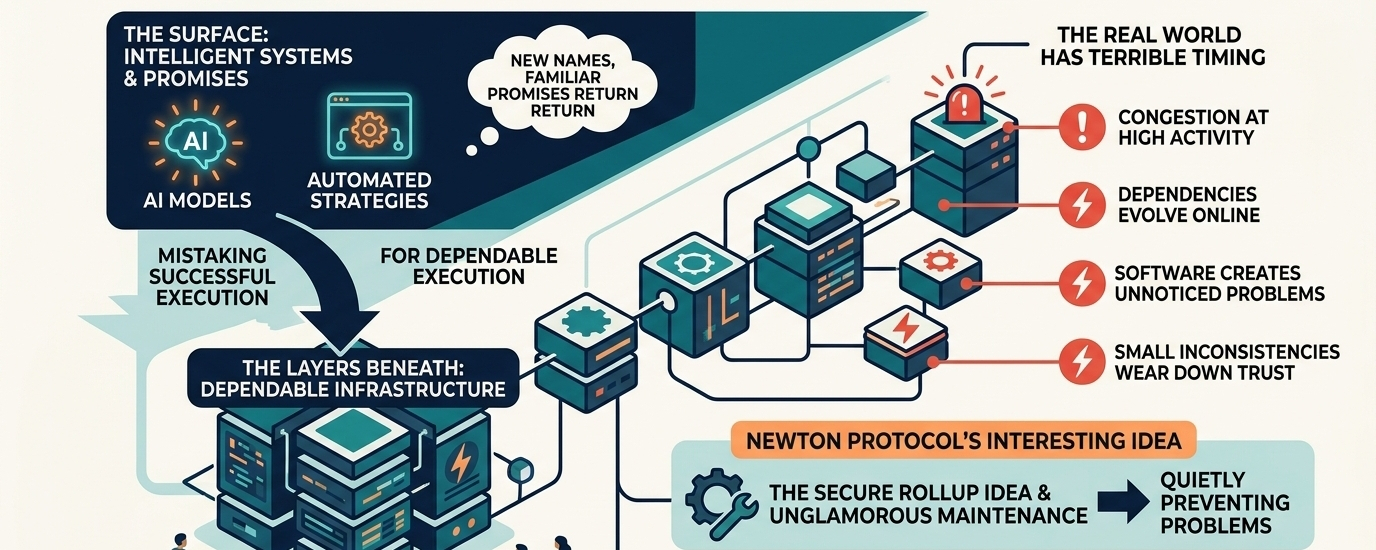
Not specifically about Newton Protocol but about the growing overlap between AI and crypto infrastructure. After seeing enough narratives rise and fade it's easy to become impatient. New names appear familiar promises return and before long the conversation starts sounding like one you've already had a few years earlier.
Then something about Newton Protocol kept lingering in my head.
It wasn't the automation. It wasn't even the idea of AI making decisions. What kept bothering me was the space around those decisions. The conditions they're expected to survive.
That's the part I rarely hear people spend much time on.
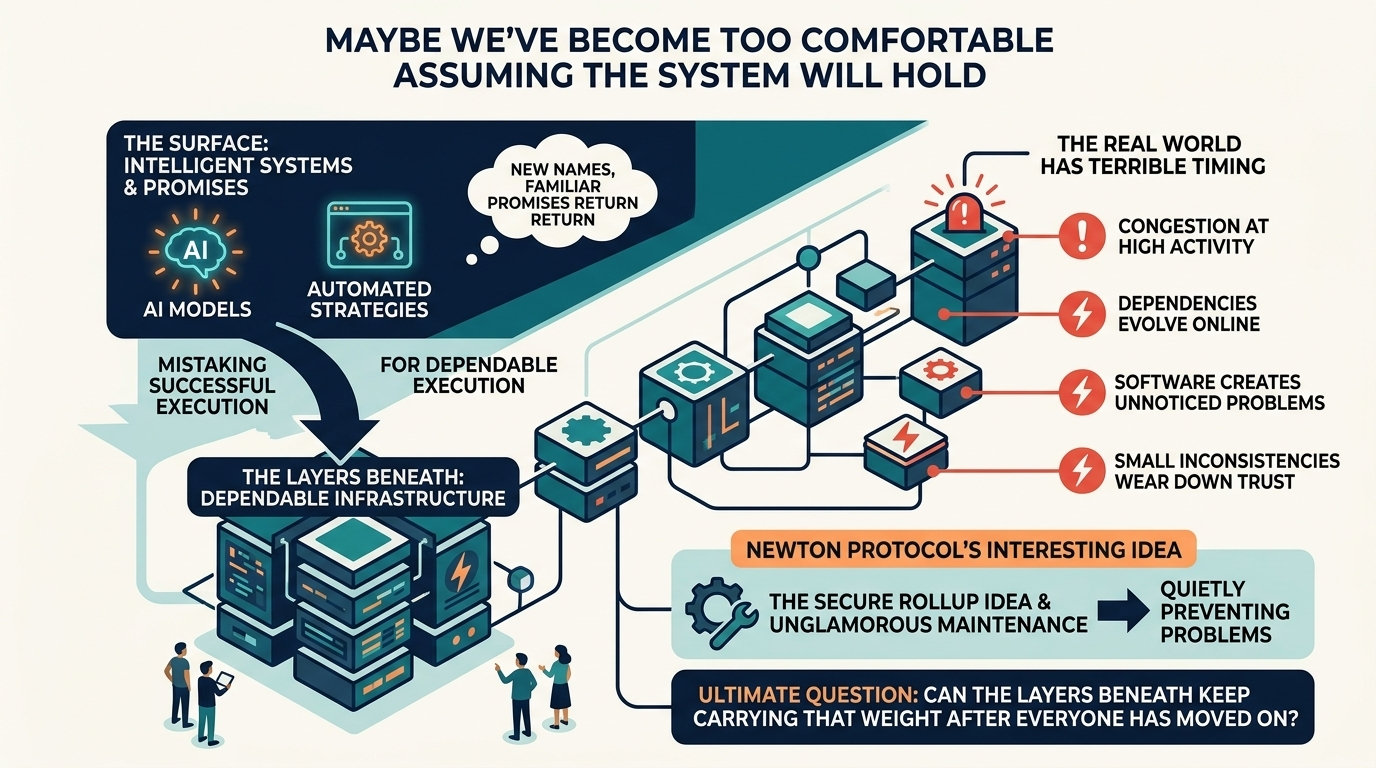
An automated strategy can look remarkably convincing while it's operating inside assumptions that quietly stop being true. Networks don't announce when they're becoming less reliable. Data doesn't always arrive in perfect order. Market conditions don't politely wait for infrastructure to catch up. Everything keeps moving at once and every layer is depending on another layer that might also be changing.
I've started wondering if we sometimes mistake successful execution for dependable execution.
They're close enough to confuse.
But they're probably not the same thing.
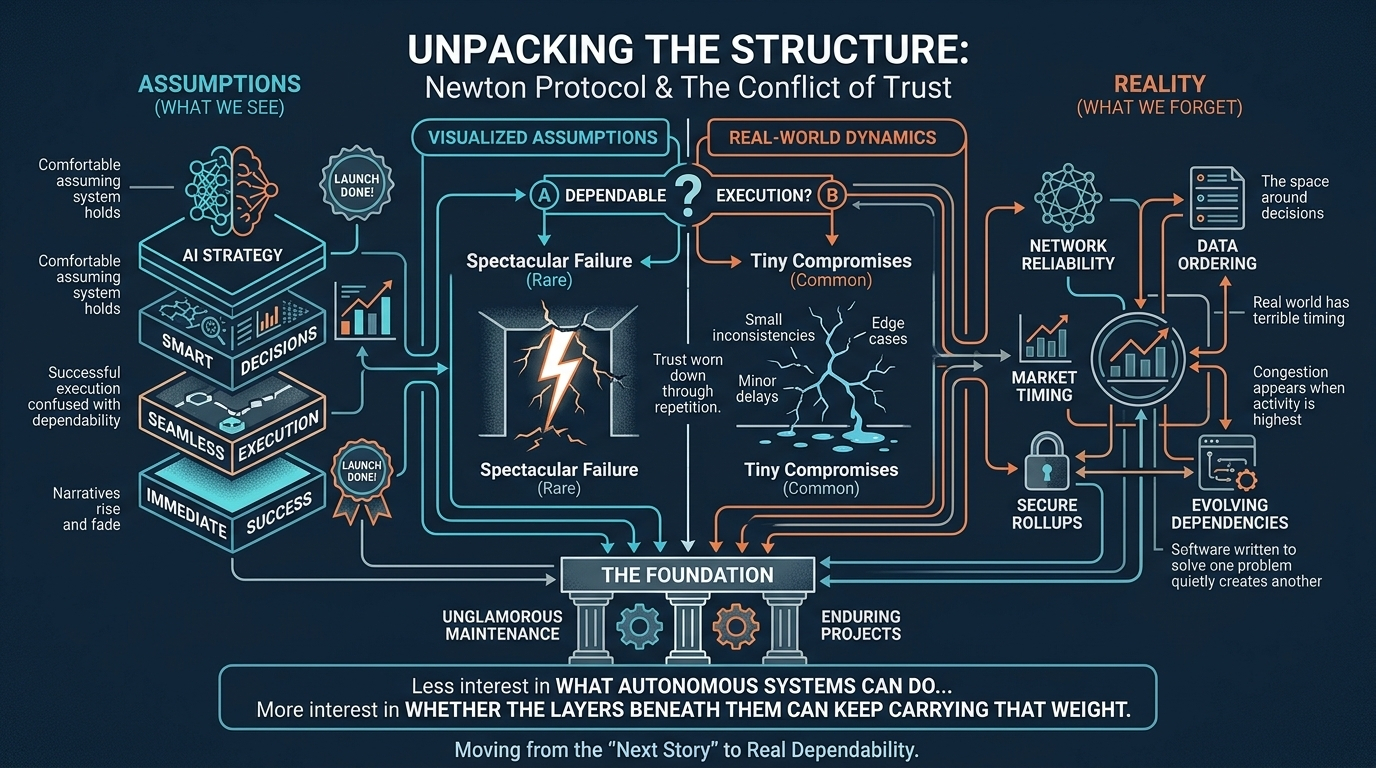
The longer I stay around this space the more I notice that trust isn't usually broken by spectacular failures. It's worn down through repetition. Small inconsistencies. Minor delays. Edge cases that seem harmless because each one is manageable on its own.
Then one day the collection of tiny compromises starts behaving like a much larger problem.
That's why the secure rollup idea feels more interesting to me than the strategies running on top of it. Intelligence can improve. Models can become more capable. None of that changes the fact that every automated decision still has to pass through infrastructure that exists in the real world instead of inside a whitepaper.
And the real world has terrible timing.
Congestion appears when activity is highest. Dependencies evolve while systems remain online. Software written to solve one problem quietly creates another that nobody notices until much later. None of those things sound dramatic enough to attract attention yet they seem to determine whether people continue trusting a protocol years after the initial excitement disappears.
Maybe that's why I keep circling back to maintenance.
It's an unglamorous word.
Nobody builds anticipation around maintenance. Nobody celebrates another year of uneventful operation. Yet whenever I look back at projects that actually endured that's usually what separates them from projects that simply launched well.
Newton Protocol makes me think about that more than it makes me think about AI.
Not because artificial intelligence isn't interesting but because intelligence has always seemed easier to imagine than dependable infrastructure. One promises possibility. The other spends most of its existence quietly preventing problems people never notice.
Maybe that's where the real challenge has always been.
Or maybe I'm letting past market cycles shape how I see every new attempt before it has the chance to prove itself.
I honestly can't tell anymore.
I just know that the older these conversations become the less interested I am in what autonomous systems are capable of doing and the more interested I become in whether the layers beneath them can keep carrying that weight after everyone has moved on to the next story.