
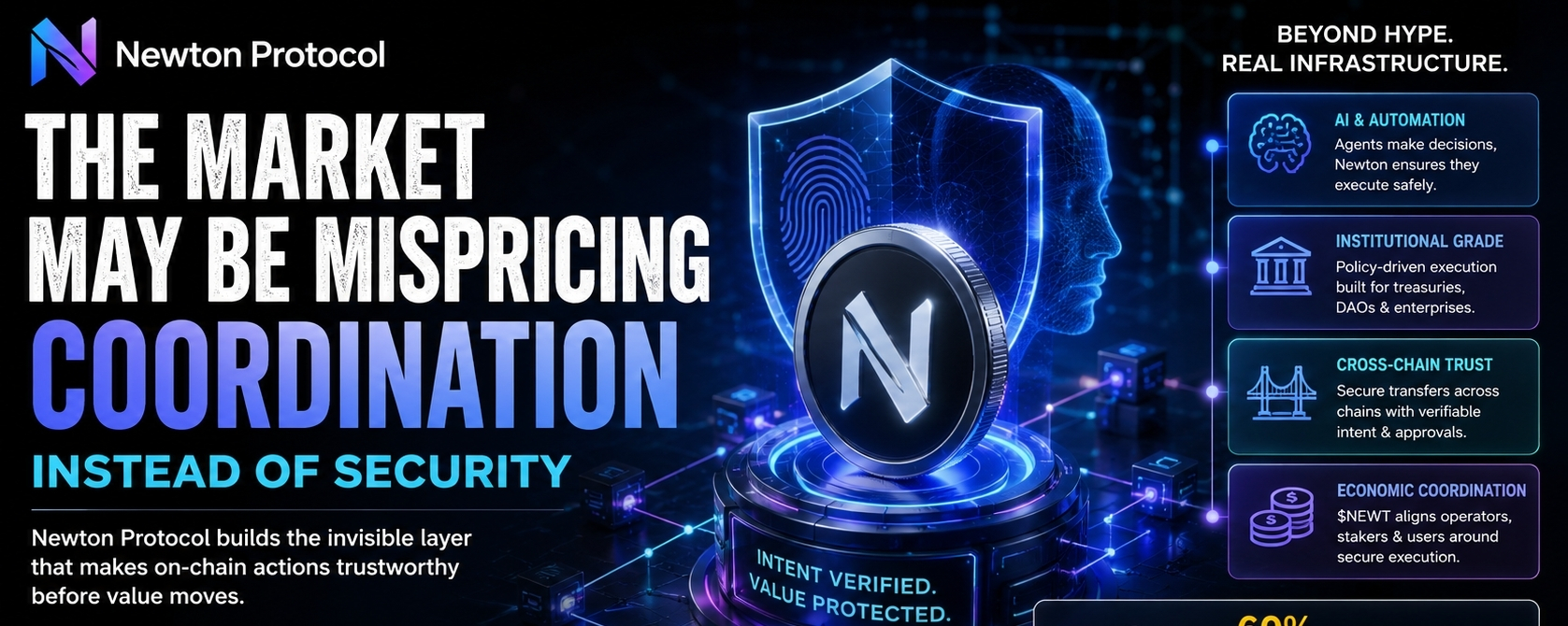
Most discussions around Newton Protocol revolve around AI agents, secure automation, or biometric verification. Those features attract attention, but they may not explain where the protocol's long-term value could emerge. The more interesting layer is coordination.
Crypto has spent years solving execution. Smart contracts execute exactly as written, yet they still depend on humans to decide what should happen. That gap between human intention and machine execution has quietly become one of the biggest bottlenecks for on-chain finance.
Newton appears to target this problem by introducing programmable transaction intent. Instead of viewing a wallet signature as the final authorization, the protocol allows execution to depend on predefined policies that can require multiple conditions before assets move. Those conditions are verified through operators whose approvals are aggregated using BLS signatures before smart contracts execute. The result is a system where execution becomes conditional rather than automatic.
The market often treats this as another security feature. That interpretation may be too narrow. Security is only the visible outcome. The deeper effect is coordination between users, applications, and automated agents.
As AI becomes increasingly involved in trading, treasury management, and cross-chain operations, the challenge is no longer computing decisions but verifying that those decisions should actually be carried out. An autonomous agent can optimize a portfolio, but without trusted execution policies it still represents a potential point of failure.
Recent research from the Bank for International Settlements shows that nearly 60% of stablecoin transfer events occur inside complex programmable transactions rather than simple payments, suggesting blockchain activity is becoming increasingly composable and policy-driven rather than transactional.
That shift changes how infrastructure should be evaluated. The winner may not be the protocol with the fastest settlement or the largest transaction count, but the one that gives applications reliable ways to coordinate decisions before execution.
This is where NEWT becomes more than a utility token. Staking, operator incentives, governance, and execution policies all contribute to maintaining trust between independent participants. The token helps coordinate behavior instead of merely paying network fees.
None of this guarantees adoption. Competing approaches such as multisignature wallets, institutional custody, and hardware security remain effective for many use cases. But if decentralized finance evolves toward AI-assisted execution rather than manual interaction, coordination may become a more valuable resource than raw transaction throughput.
The market often prices visible activity. Newton's real opportunity may lie in an invisible layer: making programmable trust scalable before value moves. If that layer becomes essential, today's discussion about security could eventually become a discussion about infrastructure.
