
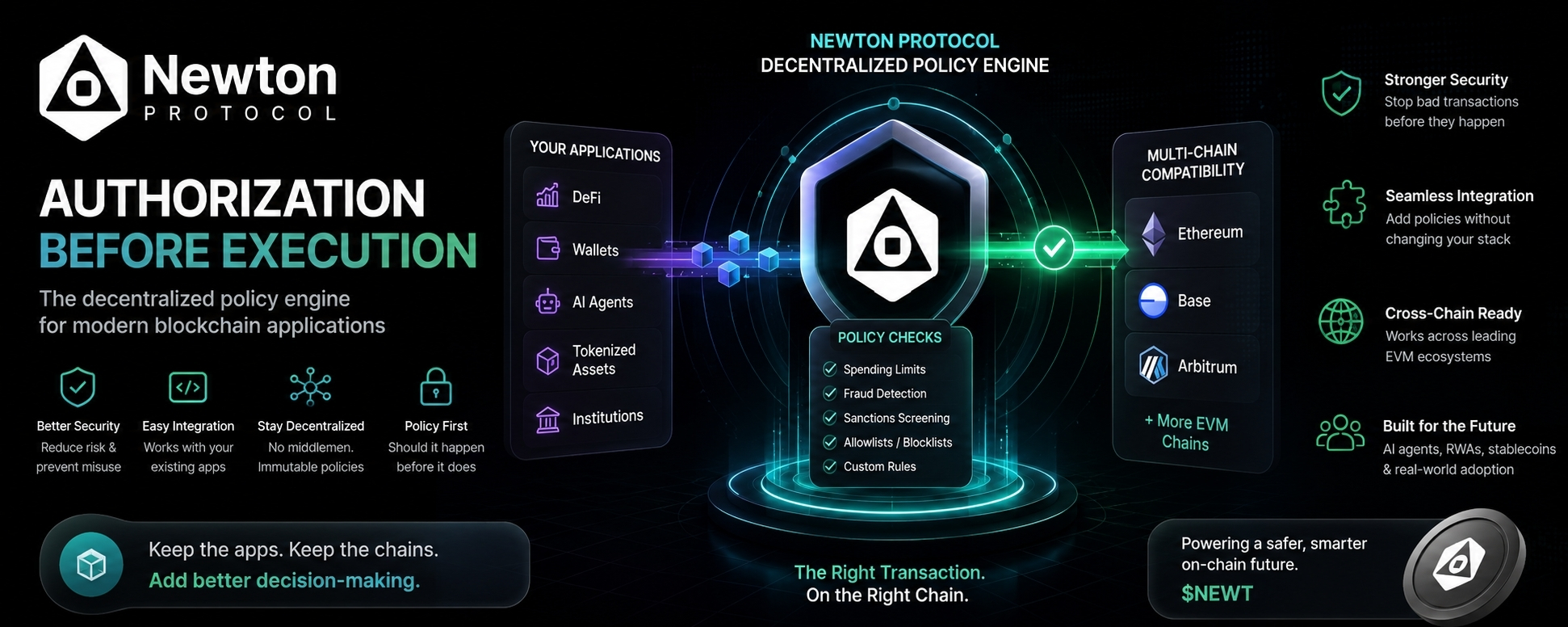

I've been spending some time looking into Newton Protocol lately, and one thing keeps standing out to me. Most blockchain projects that promise better security usually expect developers to rebuild half their application, migrate to another chain, or redesign the entire architecture. That's a tough sell.
Newton takes a completely different approach.
Instead of asking builders to change everything, it simply adds an authorization layer before transactions are executed. It sounds like a small change, but I honestly think it's one of the more practical ideas I've seen in blockchain infrastructure.
From what I've read, Newton acts as a decentralized policy engine. Developers can create rules that transactions have to satisfy before they're allowed to go through. That could mean spending limits, fraud checks, sanctions screening, allowlists, or any custom business logic that fits the application.
What I like most is that it isn't trying to replace existing ecosystems. It's designed to work across EVM chains like Ethereum, Base, and Arbitrum, so developers can integrate it into applications they already have instead of starting over. In a space where everyone seems to be launching another chain, that feels refreshingly realistic.
The timing is interesting too. Newton's mainnet beta went live on June 23, 2026, and it's already being used to enforce policies for DeFi vaults. That changes the conversation. It's no longer just an idea in a whitepaper—people can actually see how it performs in real conditions.
The more I think about it, the more I feel Newton isn't competing with Layer 1 networks at all. It's trying to solve a different problem.
Most people focus on whether a blockchain can execute transactions quickly. Newton asks a different question: should that transaction happen in the first place?
That might end up being just as important.
Blockchain applications don't only fail because of bugs in smart contracts. Sometimes the code works perfectly, but there simply aren't enough safeguards around how it's used. A wallet might send funds to the wrong address, ignore compliance requirements, or give an AI agent far more freedom than it should have. Those aren't coding problems—they're policy problems.
That's exactly where Newton seems to fit.
Looking at the market, NEWT is still relatively early. It's trading around the $0.047-$0.049 range, daily volume is sitting around $6 million, and the market cap is still fairly modest compared to many established projects. It's also well below its previous highs, which tells me the market is still figuring out how to value it.
I also think the token has a clearer purpose than many infrastructure projects. According to the official documentation, NEWT has a fixed supply of one billion tokens, with 215 million circulating at launch. The token is designed for staking, governance, protocol fees, and activity across the network instead of existing purely as something to trade.
Personally, I'm cautiously optimistic.
Not because I think every compliance-focused project will succeed, but because Newton seems to be solving a problem that's becoming more obvious as crypto matures. Stablecoins, tokenized real-world assets, institutional adoption, and AI agents all need better authorization and risk controls. Speed alone isn't enough anymore.
If I'm watching the token, I'm less interested in chasing pumps and more interested in seeing whether adoption follows the mainnet launch. Real integrations matter much more than short-term price action. If developers actually start building around Newton, that's where I think the long-term value comes from. If activity slows and token unlocks outweigh demand, the market could easily lose interest for a while.
I've looked at quite a few projects trying to improve trust in blockchain systems, and many of them make huge promises that feel difficult to deliver. Newton feels different because the idea is surprisingly straightforward.
Keep the applications.
Keep the chains.
Just add better decision-making before transactions are executed.
That feels much easier to imagine developers adopting than asking everyone to migrate to an entirely new ecosystem.
Of course, there are still risks. Infrastructure built around policy and compliance isn't always easy to market, and Newton still has to prove it can stay decentralized while supporting real-world requirements. The tokenomics also include a long-term vesting schedule, so supply dynamics will probably remain something investors watch closely.
Even with those risks, I find Newton more interesting as a builder's project than a trader's project. If crypto is moving toward a future with autonomous agents, tokenized assets, and regulated financial applications, then authorization could become just as important as execution.
I'm curious to see whether Newton can become that missing layer.
What do you think? Is Newton building something developers will genuinely need, or is it simply benefiting from the right narrative at the right time?
@NewtonProtocol #Newt #newt $NEWT
