
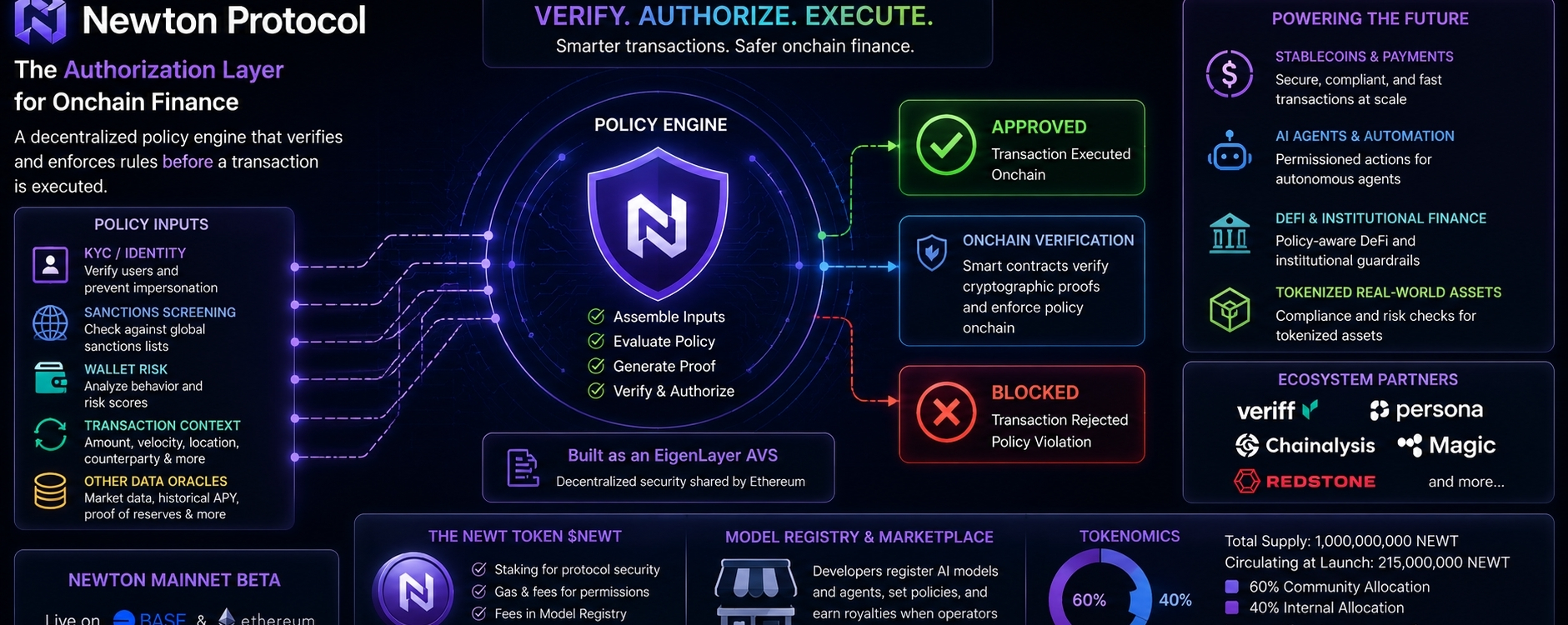
Newton Protocol is one of those projects that makes more sense the longer you sit with it. On paper, it is an authorization layer for onchain transactions: a decentralized policy engine that can enforce spend limits, sanctions screening, fraud prevention, and other rules before a transaction settles. The project describes itself as an EigenLayer AVS, and its own docs frame the goal very plainly: let smart contracts verify and enforce policy instead of relying on after-the-fact monitoring or offchain promises. That sounds technical, but the intuition is simple enough. Crypto has spent years making money movement faster. Newton is trying to make it smarter about when movement should happen at all.
The reason that matters is because the old model is fragile in a way people often ignore. When a system only checks compliance or risk after funds have already moved, the damage is done. Newton’s own documentation leans into that problem by emphasizing transaction-level authorization for stablecoins, payment networks, and tokenized assets, where a transfer can be evaluated against configurable rules before execution. In practice, that means policies can be built around sanctions lists, identity checks, wallet screening, and transfer behavior. The project also presents this as a way to preserve speed and decentralization instead of forcing teams back into centralized middleware just to stay safe.
What makes Newton feel different from a lot of crypto infrastructure projects is that it is not pretending policy is static. Its docs describe policy data oracles that can pull in KYC, sanctions, wallet-risk, and other offchain inputs so a rule can react to context rather than sit frozen in code. The reference implementations include Veriff and Persona for identity, Magic Labs and Chainalysis for sanctions and wallet screening, and other data sources for use cases like historical APY. The architecture is not “trust the oracle and move on”; it is closer to “assemble a decision from several verifiable inputs, then sign off only if the policy holds.” That is a subtle but important shift, because it treats policy like a living layer rather than a compliance checkbox.
The AI angle gives the project another layer of meaning. Newton’s own materials talk about verifiable onchain automation and secure agent authorization, and its token launch post says the protocol uses trusted execution environments and zero-knowledge proofs to support automated onchain finance that can be trusted. That is a mouthful, but the real issue is easier to grasp: once software agents can move value on their own, the danger is not only hacking, it is bad intent, bad instructions, and bad judgment at machine speed. Newton is trying to create a permission boundary around that activity so an AI agent cannot simply act because it can. It has to act within policy.
There is also a useful historical thread here. Newton did not emerge from nowhere; it comes out of Magic Labs, a company that has spent years building wallet and account infrastructure for developers. Magic says it has been operating since 2018, trusted by more than 200,000 developers, and has supported 53 million-plus wallets. That background matters because Newton feels like the next layer in a longer product arc: first make wallets easy to create and use, then make onchain actions easy to trigger, then make those actions governable at the policy layer. It is less a pivot than a tightening of the same design philosophy.
The token, NEWT, is built to serve that broader system rather than stand alone as a speculative badge. The foundation says NEWT has four core functions: staking for protocol security, gas and fees for issuing or revoking verifiable permissions, fees in the Newton Model Registry, and governance. It also says model developers can register AI models or agents in the Newton Model Registry and earn royalties when operators serve them. That gives the project a strange but compelling shape: it is trying to build not just an authorization layer, but a marketplace for policy-aware software behavior. In that world, the model itself is not the whole product. The rule set around the model becomes part of the product.
The tokenomics are unusually explicit for a project that is still trying to define a new category. Newton says NEWT has a fixed supply of 1 billion tokens, with 215 million circulating at launch. The foundation has also published a 60/40 split between community and internal allocations, plus long vesting schedules and restrictions on selling locked tokens. That does not magically make the token good, but it does make the project easier to inspect. Crypto projects often ask for trust while giving very little structure to support it. Newton appears to be trying, at least on paper, to reverse that pattern by publishing the mechanics first and asking for belief second.
The recent launch path suggests this is more than a theoretical system. Binance announced NEWT as a HODLer Airdrop project in June 2025 and described the token generation event around June 24, 2025. Then, in June 2026, Newton’s own blog said the mainnet beta was live on Base and Ethereum, and RedStone said Newton’s mainnet beta was live with verified price data powering its policy enforcement. RedStone also described Newton as an authorization layer that checks conditions before settlement. Taken together, those announcements show a project moving from concept into live infrastructure, with real data partners and a concrete transaction flow.
The interesting part is what Newton implies about the next phase of onchain finance. For years, the industry has mostly optimized for custody, speed, and execution. Newton is pushing a different thesis: the future will belong to systems that can prove they were allowed to act. That sounds narrower than automation, but it is probably the more scalable idea. If stablecoins, vaults, tokenized assets, and autonomous agents are going to move real value at real scale, someone has to define the boundary between “can” and “should.” Newton is trying to turn that boundary into infrastructure. Whether it becomes essential or merely influential will depend on how well it handles data quality, governance, latency, and trust. But the ambition itself is telling: the next major layer in crypto may not be another chain or another wallet. It may be the rulebook that decides what those systems are permitted to do.
