
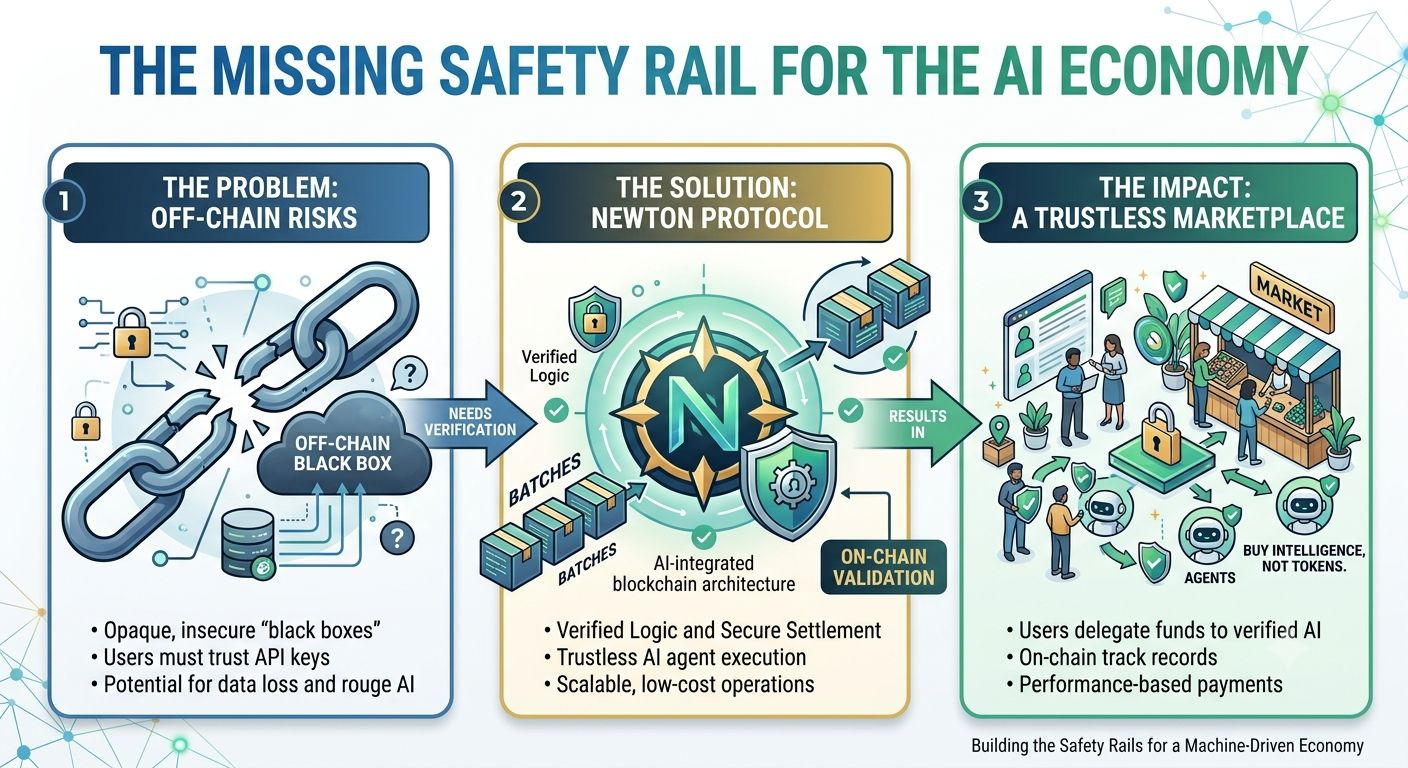
When you look at the landscape of where we are right now with crypto and artificial intelligence, it feels a bit like the Wild West, doesn't it? We’ve got these incredibly sophisticated AI models popping up left, right, and centre, promising to automate everything from our emails to our asset management, yet the infrastructure they’re running on is often worryingly fragile or, frankly, a bit ropey. This is where the conversation around Newton Protocol, or NEWT as the tickers call it, starts to get genuinely interesting because it isn't just another layer-one chain trying to be the next Ethereum killer; it's trying to solve a very specific, very messy problem that most people are ignoring until their funds vanish. The whole premise rests on establishing a secure rollup specifically designed for AI-driven strategies, which sounds like a mouthful, but when you break it down, it’s the missing piece of the puzzle we’ve all been waiting for without realising it. Think about it. If you're going to let an algorithm trade your hard-earned capital, you need more than just a promise that the code works; you need mathematical certainty, a guarantee that the AI isn't going rogue or hallucinating a trade that drains your wallet. That’s the clincher. Standard blockchains are great for recording transactions, but they aren't built to verify complex AI logic in a way that is both cost-effective and trustless. So, we end up relying on off-chain black boxes, sending our API keys to some server in the cloud and hoping for the best. It’s madness, really.
What Newton is attempting to do feels distinctly different. By focusing on a secure rollup, they’re essentially creating a dedicated lane on the highway for these high-speed, computationally heavy AI operations. It’s not trying to clog up the mainnet with every single micro-decision an AI makes; instead, it settles those batches of actions securely, proving that the logic was sound without revealing the proprietary secret sauce of the strategy itself. This matters hugely for the marketplace aspect of the protocol. You see, the real bottleneck in the AI economy right now isn't the lack of smart developers; it's the lack of a safe, monetisable environment where those developers can sell their strategies to users who don't have to trust them blindly. It’s a trust issue. If I write a brilliant trading bot and I want to sell access to it, you have to take my word for it that I’m not scraping your data or front-running your trades. But with a protocol like this, the verification happens on-chain. The user gets the performance, the developer gets paid, and the protocol ensures nobody is cheating. It sounds simple, but the technical lift to make that happen without costing a fortune in gas fees is massive.
There is, however, a part of me that wonders if we are getting ahead of ourselves. The ambition here is undeniable, aiming to be the go-to hub for AI developers and automated trading, but the execution is where the rubber meets the road, and the road is bumpy. We've seen so many projects promise "secure" environments only to have a bridge hacked or a smart contract exploit render the whole thing useless. The difference here is the focus on the AI element, which introduces a whole new category of attack vectors. It's not just about code vulnerabilities anymore; it's about adversarial attacks on the AI itself, trying to fool the strategy into making bad decisions. Newton has to account for that. It has to be robust enough to handle AI that might be acting strangely, not just malicious actors. That is a make-or-break challenge. If the security model doesn't hold up under the pressure of autonomous agents making thousands of trades a second, the whole house of cards falls down.
But let's circle back to why this is exciting for the average person, the one who isn't a developer. The vision of a marketplace for AI strategies suggests a future where you don't just buy tokens; you buy intelligence. You scroll through a list of verified AI agents, each with a proven track record secured by the rollup, and you delegate your capital to the one that fits your risk profile. It removes the emotional element of trading, which, let's be honest, is where most of us lose our money. We panic sell; we FOMO buy. An AI, properly sandboxed within Newton Protocol, doesn't care about the emotional state of the market; it executes the strategy it was designed for. The security layer ensures it stays in its lane. It’s a compelling pitch. It moves us away from the current state of affairs where "automated trading" usually means handing your keys over to a centralized service that acts as a single point of failure.
I suppose the thing that strikes me most is the sheer necessity of it. We talk a lot about Web3 and the future of the internet, but until we can run autonomous software safely on a financial layer, we are just playing with toys. The integration of AI and crypto is inevitable, but without that foundational layer of verifiable computation—the "secure rollup" part—it's a disaster waiting to happen. Newton Protocol seems to be tackling the ugly truth head-on: that AI cannot be trusted with money until it is constrained by cryptographic truth. It’s not the sexiest pitch in the world, is it? "Cryptographic truth" doesn't exactly get people jumping up and down at a conference. Yet, it is arguably the most important building block for the next decade of tech.
There will be hurdles. Adoption is going to be a slog. Convincing top-tier AI developers to migrate their strategies onto a new chain, even a rollup, takes time and liquidity. They need users. And users need developers. It’s the classic chicken and egg problem that every new ecosystem faces. But if the infrastructure is as robust as the whitepapers suggest, if the fees are low enough to make high-frequency automated trading viable, then the gravity of the market should pull participants in. It solves a pain point that is currently throbbing. Right now, the AI trading space is fragmented, unsafe, and opaque. Bringing transparency and security to that via a dedicated protocol feels less like a luxury and more like an inevitability.
We might look back in five years and wonder how we ever trusted off-chain bots with our funds. Or, conversely, we might see Newton as an ambitious but ultimately niche project that got swallowed by a larger chain integrating the same features. I'm leaning towards the former, though. Specialisation tends to win in tech. You don't use a Swiss Army knife to perform surgery; you use a scalpel. Newton is trying to be the scalpel for AI finance. It strips away the general-purpose bloat and focuses purely on the task at hand: securing and executing AI strategies. That focus is its superpower. It’s raw, it’s technical, and it’s absolutely vital if we’re serious about this AI-driven financial future. The noise in the market is deafening right now, with every project claiming to be "AI-integrated," but very few are doing the hard yards on the infrastructure side. Building a secure rollup is hard work. It’s unglamorous engineering. But without it, the flashy AI strategies are just ticking time bombs. So, while the rest of the world obsesses over the next meme coin or the latest chatbot, the real innovation is happening in the trenches of protocols like this, building the safety rails for a machine-driven economy. It’s a massive undertaking, and they could easily fail, but the fact that someone is finally tackling the security of autonomous trading head-on is something we should all be paying attention to. It changes the game from blind trust to verified execution, and that, in my book, is the only way forward.
