
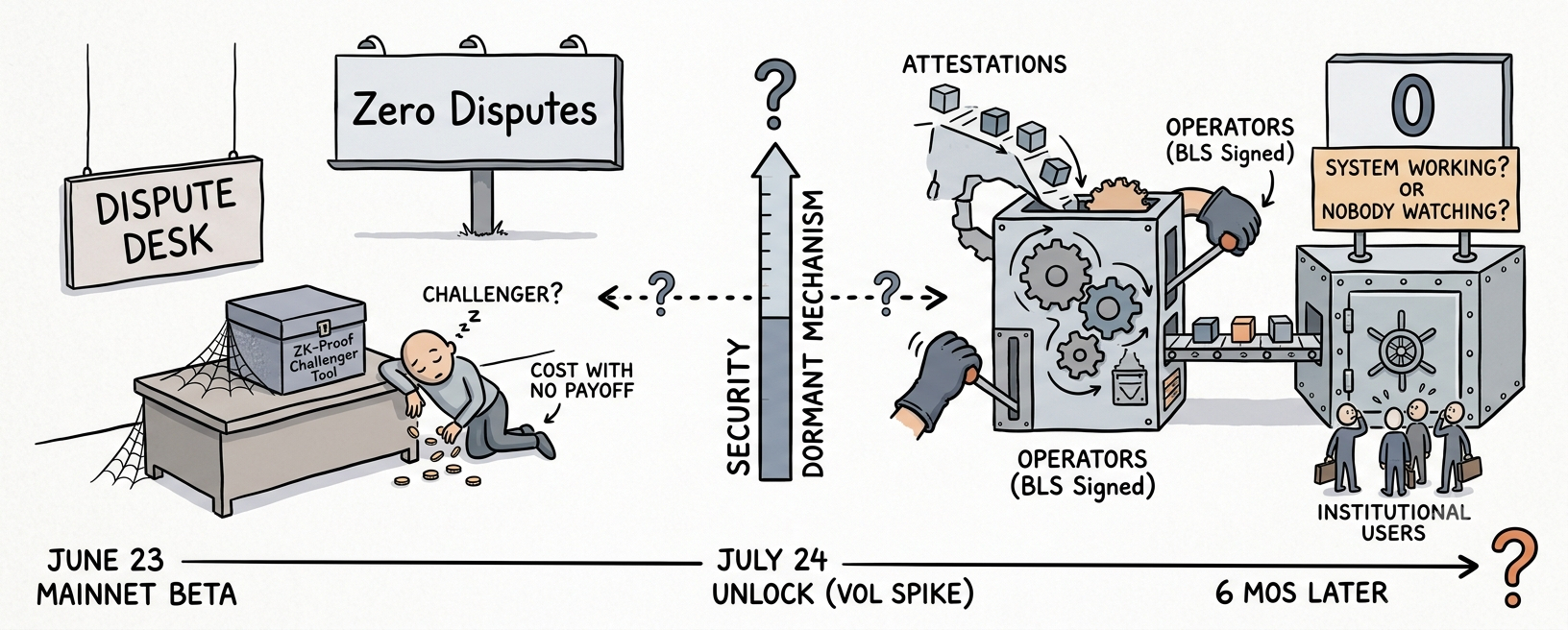
i read through newton's challenger design three days ago — the piece that lets anyone dispute a wrong attestation using zero-knowledge proofs after operators have already signed off. the design itself is actually elegant. no reputation system, no trusted challenger role, just cryptographic proof that an attestation was wrong, open to anyone willing to submit one. i checked the explorer afterward looking for dispute activity since the june 23 mainnet beta. found zero.
that's when the elegance started looking like a different kind of problem.
here's the mechanic. operators evaluate an intent, reach consensus, sign a bls attestation, and it goes onchain. if that attestation is wrong — a bad policy evaluation, a stale oracle feed slipping through, an outright operator error — the system relies on a challenger noticing and generating a zk proof to dispute it. running a full verification of every attestation and generating a proof when something looks off costs real compute and real gas. most of the time, attestations will be correct. so most of the time, checking is pure cost with no payoff.
that's the verifier's dilemma, and it's not a newton-specific idea. it's a documented problem in optimistic systems, and arbitrum lived through the most extreme version of it publicly. co-founder ed felten confirmed in september 2023 that not one single fraud proof had ever been submitted on arbitrum's mainnet, over two years after its august 2021 launch. arbitrum's own current documentation still says billions of dollars have moved through the chain without one successful fraud instance ever being caught. the fraud proof mechanism existed the entire time, fully functional, cryptographically sound. it just never got used, because the roughly dozen permissioned validators had no strong economic reason to run the expensive verification work needed to catch something that probably wasn't there.
i saw a related version of this with uma's optimistic oracle. uma's whole model depends on disputers actually showing up within the dispute window — if nobody disputes, the assertion is assumed true and finalized. uma had to iterate on disputer bonds multiple times because early versions didn't attract enough active disputing to make the security model credible on paper match the security model in practice.
this is what makes it a silent failure mode rather than an obvious one. every metric newton publishes will look clean. attestation rates will stay high. dispute counts will likely stay near zero, and zero disputes reads as "the system is working perfectly" on any dashboard. but zero disputes is exactly what you'd also see if the challenger mechanism is economically dead — arbitrum proved that a fraud-catching mechanism can sit completely unused for years while everything above it looks fine. the metric that's supposed to signal security and the metric that signals nobody's watching look identical from the outside.
the timing sharpens this. newt is trading around $0.047 right now, and the july 24 unlock brings roughly 17.9 million tokens into circulation in about three weeks. events like that tend to bring spikes in transaction volume — vault activity, repositioning, more intents flowing through the policy engine per hour than at any point since mainnet beta launched. more attestations moving through the system means more individual opportunities for something to slip, at exactly the moment when the challenger mechanism has never once been tested in practice.
for institutional users leaning on newton for compliance enforcement, this matters more than it would for a simple defi primitive. a vault relying on newton's sanctions screening isn't just trusting that operators are honest — it's trusting that if operators do get something wrong, someone economically motivated will catch it fast enough to matter. arbitrum's billions in unchallenged volume shows that "nothing bad happened" and "nobody was checking" can look exactly the same for years.
newton's operator-side security is genuinely stronger than most avs designs at this stage — the eigenlayer restaking and slashing conditions make operator misbehavior expensive in a way that's real and tested. i'll credit that without hesitation. but operator honesty and challenger activity are two separate security layers, and only one of them has an economic reason to function under normal, boring, mostly-correct conditions. the other one only earns its cost when something's already gone wrong, which is precisely when it's hardest to know in advance whether anyone's paying attention.
there is a version of this where i'm wrong, and i'd genuinely rather be wrong here. newton's challenger rewards could be structured well enough — subsidized directly rather than funded purely through caught-error bounties — that dispute participation stays healthy even when attestations are almost always correct. arbitrum eventually addressed its own version of this with the bold protocol, redesigning incentives so challenges resolve faster and more participants can join permissionlessly. the vaultkit release and newton's emphasis on progressive decentralization suggest real attention to long-term incentive design, which is exactly the kind of thing a team thinking carefully about this problem would prioritize early rather than patch later like arbitrum had to.
but i haven't seen public documentation on newton's challenger reward sizing or disclosed dispute activity since mainnet went live. arbitrum needed roughly two years and a public admission before it addressed its dormant fraud-proof problem. newton is six months in, heading into a volume event in three weeks, and the challenger role hasn't been tested even once that i can find.
isn't a design problem — it's a participation problem. design flaws show up in audits and get patched before launch. participation gaps don't show up anywhere until the one time an error actually needs catching, and arbitrum spent two years finding out the hard way that a security mechanism can look perfectly fine while sitting completely idle. 🔍
