
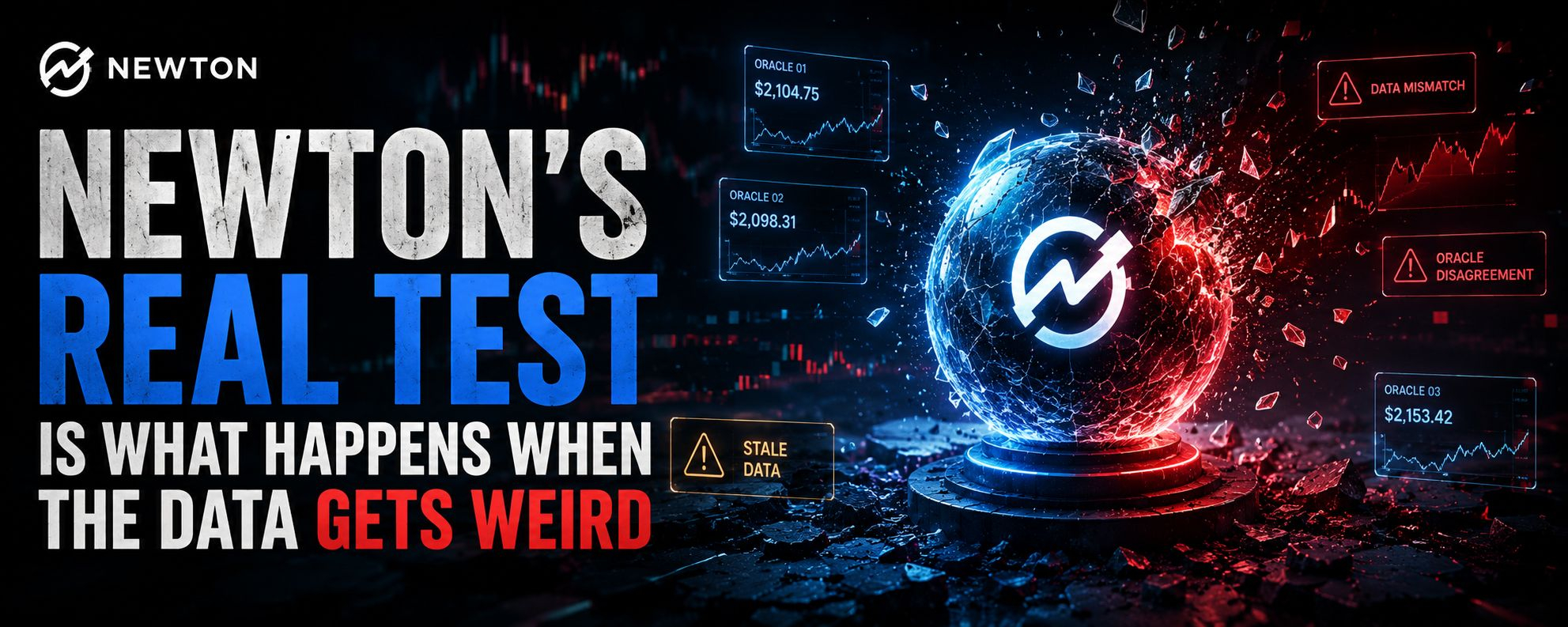

I keep thinking about Newton from a very simple angle: what happens when the operators agree, but the market is still wrong?
That may sound like a strange question, but anyone who has watched DeFi long enough has seen this movie. Everything looks fine until it doesn’t. The feed is a little stale. One exchange moves before another. Liquidity gets thin. A price looks normal on paper but feels completely wrong if you are watching the order books. Then some automated system keeps doing exactly what it was allowed to do.
That is the part that interests me about Newton.
Newton uses independent operator evaluation, median-based aggregation, tolerance checks, BLS signatures, and quoruming before a policy result is accepted. That setup is useful because it makes one bad operator less dangerous. It also gives the system a cleaner way to say, “Enough operators saw the same thing and signed off on it.”
But I don’t fully trust that as the end of the story.
Consensus tells you people agreed. It does not always tell you reality was measured correctly.
A median can remove an obvious outlier. It can smooth noisy data. It can make the system harder to fool with one bad feed. But what if most operators are pulling from similar sources? What if the middle value is stale? What if the market is splitting across venues and the “reasonable” number is only reasonable because the policy is too simple?
That is where I think Newton’s operator consensus becomes less of a math problem and more of a judgment problem.
For normal DeFi, oracle risk is already serious. For AI-driven trading, it gets sharper. An AI agent does not naturally hesitate the way a human does. It may keep routing, rebalancing, or executing because the rules technically allow it. So the real value of Newton is not just whether it can find a clean median. The real value is whether it can decide that the situation is too messy to act on.
That is the guardrail I would care about.
If the data is stale, stop.
If sources disagree too much, stop.
If confidence is weak, stop.
If the result is technically valid but the market looks broken, stop.
I’ve seen too many crypto systems fail because they were built to continue, not to pause. They could verify signatures, execute transactions, and follow rules, but they had no good instinct for uncertainty. They treated a valid input as a safe input. Those are different things.
That is why Newton feels worth watching, but not worth blindly trusting yet.
Its operator consensus can make agent execution more controlled. It can reduce single-source oracle risk. It can make automated trading less dependent on one fragile data path. But it only becomes truly useful if disagreement is treated as a warning sign, not just something to average away.
My takeaway is simple: Newton’s strongest feature may not be helping agents act faster. It may be helping them do nothing when the data is not good enough.
And in crypto, knowing when not to trade is still one of the most underrated forms of intelligence.