
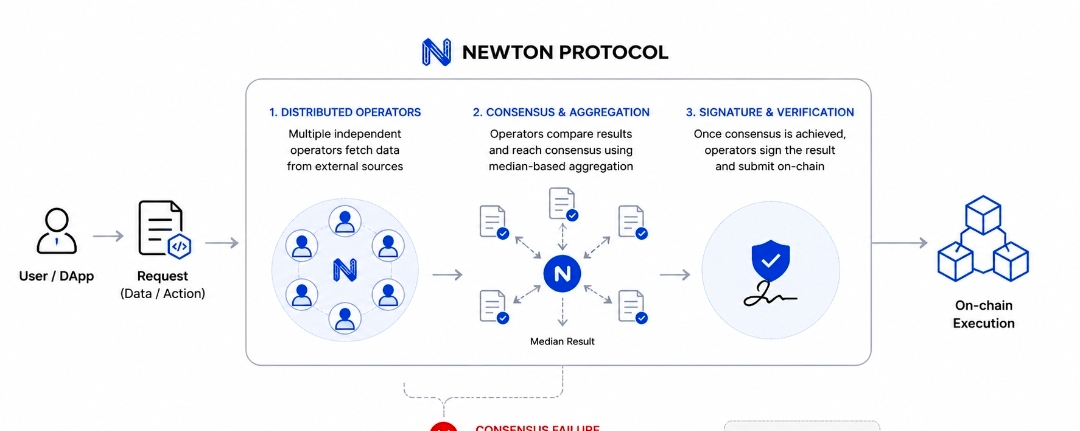

Newton Protocol has been sitting in the back of my mind for a while, not because it's the loudest project in crypto, but because it keeps making me think about something this industry rarely pays attention to. Everyone seems to celebrate transactions that go through without a problem. Dashboards track activity, investors watch volume, and communities share numbers that suggest everything is moving exactly as planned. Almost nobody stops to think about the transactions that fail. The longer I spend watching crypto, the more I feel those failures deserve a closer look.
I've reached a point where I don't immediately trust smooth-looking metrics anymore. Crypto has a way of making everything appear efficient until real pressure arrives. Markets become volatile, networks get congested, bots compete for every possible advantage, and suddenly the system starts revealing parts that were easy to ignore before. Those moments have always taught me more than months of uninterrupted growth.
That is probably why Newton Protocol caught my attention. It doesn't make me think about speed as much as it makes me think about confidence. What happens when different parts of a network don't agree? What happens when information coming from outside the blockchain isn't as reliable as everyone hopes? Most people only notice when a transaction succeeds, but I keep wondering whether the moments when a protocol refuses to move forward are actually more interesting.
After watching several market cycles, I've become less interested in perfect narratives. Every bull market creates another collection of projects that promise to solve the biggest problems in crypto. For a while, those promises usually sound convincing. Then incentives begin to take over. Traders chase opportunities, automated systems exploit every inefficiency they can find, and users behave in ways developers never fully expected. Eventually every protocol has to deal with reality instead of theory.
That's why I don't see failed transactions as wasted activity anymore. Sometimes they are nothing more than simple mistakes. Sometimes they happen because a network is overloaded. But sometimes they reveal that a system has reached a point where different incentives are pulling in different directions. Those moments can say more about the health of a protocol than thousands of successful transactions ever could.
From what I've seen, Newton Protocol seems to accept that uncertainty is part of the process rather than something that should always be hidden. Instead of assuming every request should move forward, its design appears willing to stop when agreement cannot be reached. I find that more interesting than another promise of higher throughput or lower fees. It suggests an understanding that trust isn't built by pretending uncertainty doesn't exist.
Whether that approach proves effective over time is impossible to know today. Crypto has a habit of rewarding ideas long after they are introduced—or abandoning them just as quickly. Good architecture doesn't automatically create lasting value, and strong technology doesn't always survive weak incentives. I've watched enough projects with impressive designs struggle once real economic pressure arrived to avoid making confident predictions.
The more I think about it, the less I believe crypto's biggest challenge is building faster systems. Speed has improved almost every year. Costs continue to fall. New infrastructure keeps appearing. Yet the same questions return every cycle. Can participants still trust the system when money is on the line? Will incentives encourage honest behavior, or will they slowly reshape the network into something nobody originally intended?
Those questions are difficult because they don't produce simple charts or attractive headlines. They require patience. They require watching how people behave instead of how they say they will behave. That's why I keep coming back to projects like Newton Protocol. Not because I already know where they fit into the future of crypto, but because they force me to think about what happens when reality tests every assumption.
I've learned that markets eventually expose every weakness. Sometimes it happens during a bull run when activity overwhelms infrastructure. Sometimes it happens during a bear market when incentives disappear altogether. Either way, systems don't reveal their character when everything is working perfectly. They reveal it when something goes wrong.
Maybe that's why I find failed transactions so interesting now. They're easy to dismiss as technical noise, but they often represent the exact moments when a protocol has to make a difficult choice. Continue despite uncertainty, or stop because confidence isn't high enough. Neither choice is perfect, but the decision says something about the values built into the system.
I'm still watching Newton Protocol with more questions than answers. That feels like the right place to be. Crypto has never lacked confidence. If anything, it has often had too much of it. What keeps me interested now are the projects that quietly acknowledge uncertainty instead of pretending it doesn't exist. Those are usually the ones worth observing over time, because markets have a way of revealing whether thoughtful design can survive contact with real human incentives.