
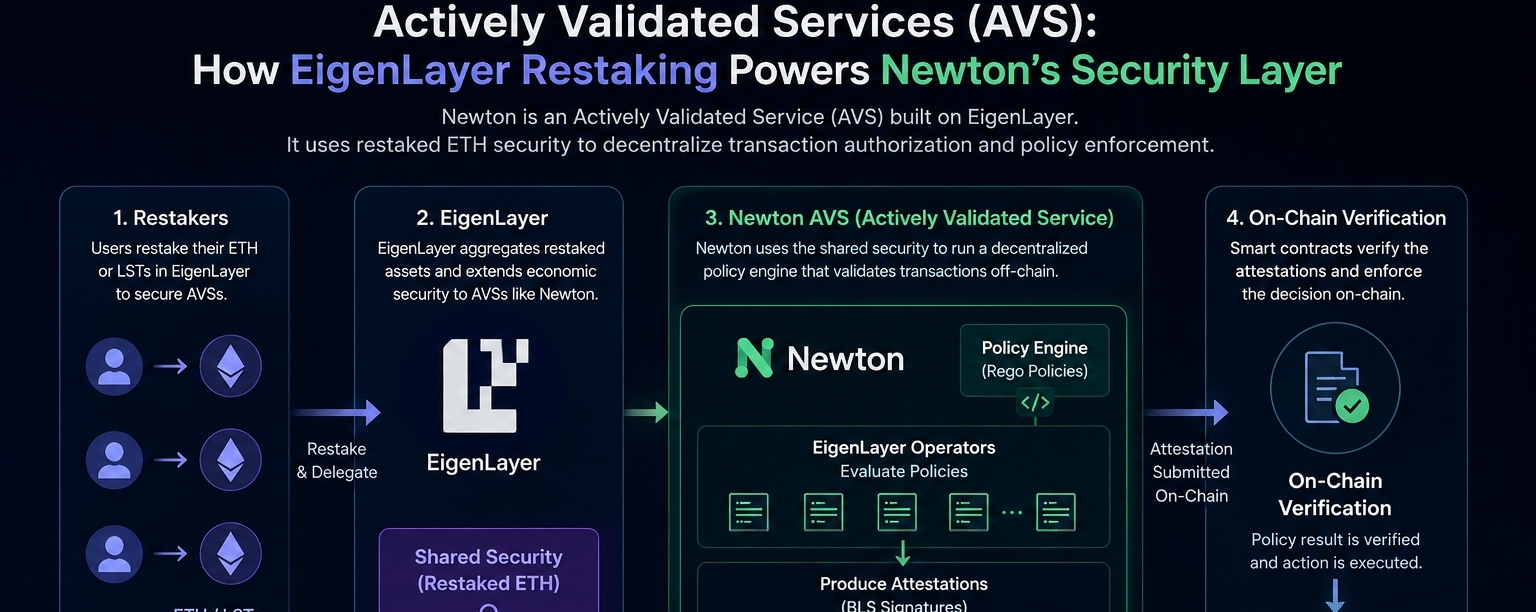
After spending time with the architecture rather than just the headlines, what stands out to me is how unflashy this stack really is. Newton does not seem to be trying to replace the blockchain; it is trying to become the quiet layer that decides whether a transaction deserves to move forward. According to Newton’s own documentation, it is a decentralized policy engine for onchain transaction authorization, built as an EigenLayer AVS, with policy evaluation handled by a decentralized network of EigenLayer operators and finalized through cryptographic attestations.
That design matters because EigenLayer is not just selling “extra yield” or a clever restaking trick. In the official AVS docs, the core idea is that a service built outside EigenLayer can borrow Ethereum-based economic security through restaking, so it does not have to bootstrap an entirely new validator set from scratch. The AVS model is, in practice, a way to make security reusable. That sounds abstract until you look at Newton, where the policy layer, operator evaluation, and onchain verification are separated cleanly enough to feel like real infrastructure rather than a marketing diagram.
What I find most interesting is the restraint in the design. Newton’s docs describe policy definitions in Rego, evaluation by EigenLayer operators, and BLS attestations that prove the policy was actually checked. That is not the language of hype; it is the language of systems that expect to be audited, disputed, and extended over time. And that is probably where the long-term value sits. If this works, the win is not speed alone, but a stronger foundation for compliance, fraud prevention, and transaction policy that can survive beyond one chain, one team, or one cycle of market enthusiasm.
I remain a little skeptical, because every shared-security model asks the same hard questions about operator risk, integration complexity, and what happens when the system is stressed. Still, the shape of the idea feels durable. Restaking gives the security base; AVS turns that base into a service; Newton uses that service to make authorization verifiable instead of merely promised. That is the kind of architecture that tends to grow quietly, and sometimes those are the systems that last.