
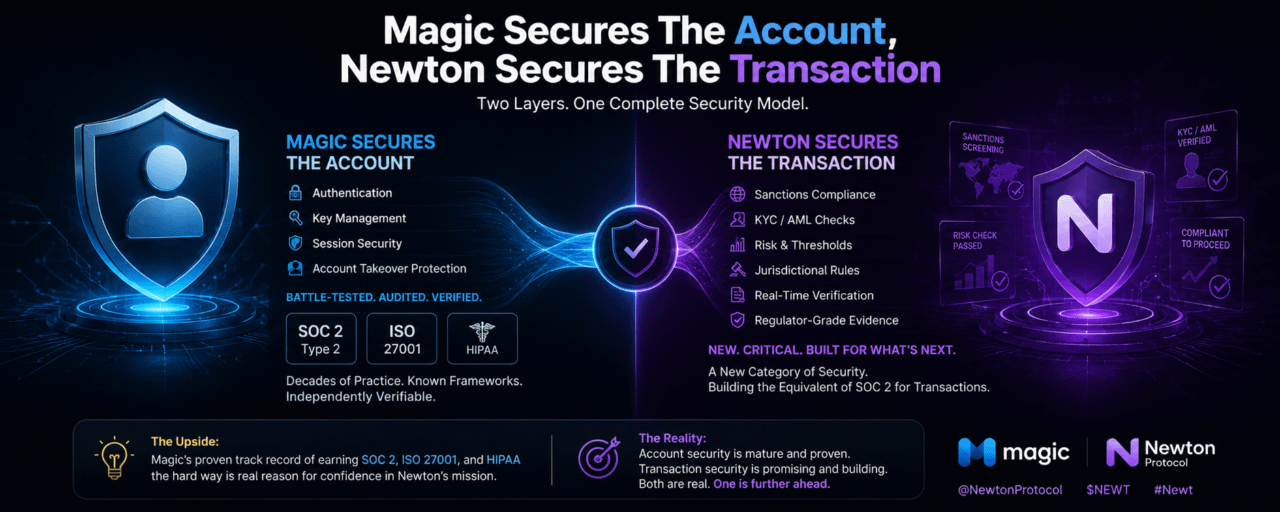
Magic Labs has a tagline that shows up in its Newton announcements, drawing a clean line between what Magic itself does and what Newton does: Magic secures the account, Newton secures the transaction. It reads like a tidy piece of marketing copy, the kind of line built to fit neatly into a press release. But the actual claim underneath that sentence is bigger and harder to deliver on than the neat phrasing suggests, and it is worth pulling apart what "securing" actually has to mean at each of those two separate layers for the sentence to be true rather than just catchy.
Securing an account is a well understood problem with decades of established practice behind it. Authentication, key management, session security, protecting against account takeover, this is the domain Magic built its original reputation on with embedded wallets, and it is backed by real, verifiable certifications: SOC 2 Type 2, ISO 27001, HIPAA. Those are established frameworks with known audit processes, known failure modes, and known ways an institution can verify the claim independently rather than just taking a company's word for it. When Magic says it secures the account, there is a whole compliance industry that already knows how to check whether that claim holds up.
Securing a transaction is a fundamentally different and much newer problem, especially at the specific layer Newton operates on. It is not just whether a transaction executes correctly and without technical bugs, which is the traditional smart contract security question most of the industry already has decent tools for. It is whether a transaction complies with sanctions rules, KYC requirements, risk thresholds, and jurisdictional restrictions, verified in real time, before the transaction settles, in a way that produces evidence a regulator would actually accept. That is a newer category of problem, without decades of established audit frameworks behind it the way account security has, and Newton is essentially building the equivalent of SOC 2 for transaction-level compliance from a much earlier starting point.
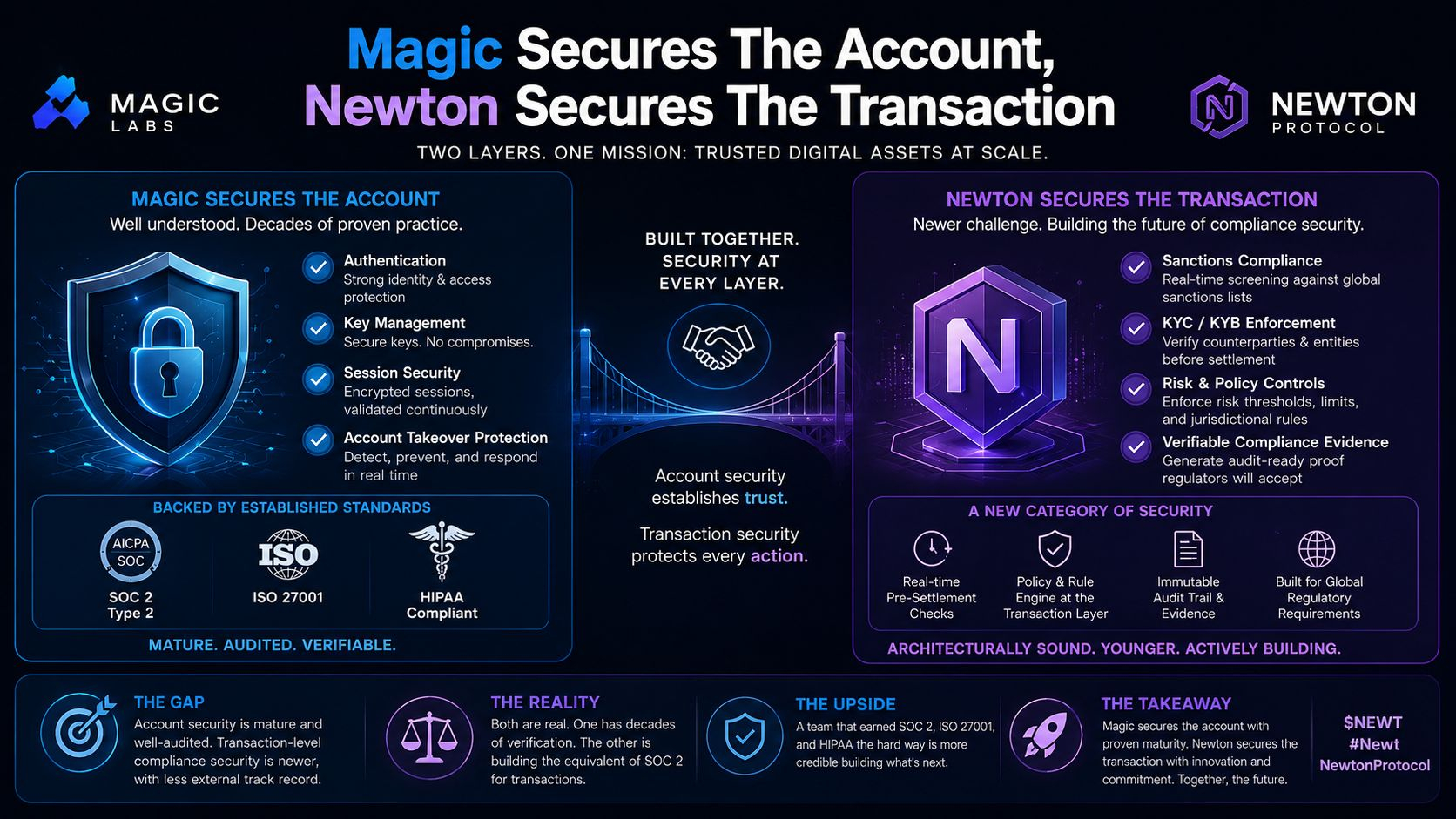
Here is the gap between the tidy tagline and the harder reality. The sentence implies these are two equally mature, equally proven security domains, simply divided cleanly between two companies working together. Account security genuinely is mature, well-audited, third-party verifiable. Transaction-level compliance security is real, actively being built, and architecturally sound based on what is publicly documented, but it has not accumulated anywhere near the same track record, the same established third-party verification standards, or the same years of adversarial testing that account security has. Placing both halves of that sentence next to each other, with equal confidence, slightly overstates how proven the second half actually is compared to the first.
I do not think this is dishonest marketing so much as it is the natural way any company describes a new capability by pairing it with an established one for credibility. But anyone evaluating Newton specifically, rather than evaluating Magic's existing wallet security, should be clear-eyed about which half of that sentence is backed by a decade of audited practice and which half is a newer, architecturally promising but comparatively young system still building its own track record under real adversarial conditions.
The upside is that Magic's approach to the first half of this problem, genuinely mature, genuinely third-party verified account security, gives some reason for confidence that the same team applies rigorous standards to the second half too. A team that earned SOC 2, ISO 27001, and HIPAA certification the hard way is more credible building transaction-level security than a team with no track record of surviving external audits at all. That is a real, legitimate reason to take Newton's compliance claims more seriously than a typical unproven protocol's. It is just not the same thing as transaction security already having the maturity account security has.
Magic Labs' framing that it secures the account while Newton secures the transaction pairs one genuinely mature, third-party audited security domain with one that is architecturally sound but meaningfully younger and less externally verified, and the credibility of the first half is a real reason for optimism about the second, not proof that both halves have already reached the same level of proven maturity.